
Publication in Russian on the Zen blog
https://dzen.ru/a/ZiH4XBOmcS3Q9Rn0
How estimates are formed in video production and what the price of a video is made up of.
Publication from PiterPro_Production together with Mikhail Smirnov (founder and head of CMCproduction and SmartREC).
Undoubtedly, the most popular question that we and other production companies regularly face is the question of the price of the video. Namely, where does its final cost come from? In part, the most detailed estimate makes it possible to clarify how the price is formed, but there are still many nuances and subtleties that are unclear to the client, which I would like to talk about in more detail. Due to the unusual specifics of video production, even the most complete financial document does not provide a complete answer to the question of an ordinary customer. Our General Director decided to correct this problem and compiled a detailed article, after reading which you should not have any questions regarding the pricing system in production.
General Director of PiterPro_production Ermakov Andrey Igorevich.

The formation of estimates can be carried out according to two different scenarios.
1) If the client has a specific budget allocated for the video, then based on this amount, we decide on the style of the video. We can offer both a graphic video and a shooting video. At the same time, we try to squeeze the maximum out of the available funds. In addition, we have a single pricing system for all clients. There are cases when the customer has his own initial vision of the finished product, or the future video should become part of a large advertising campaign. Of course, taking these initial data into account, we come to a common denominator. Below you will find information about creating an estimate.
2) Another option is when the client does not yet fully understand what exactly he wants and only has an approximate idea of how much money he is willing to spend. In such cases, we ask you to tell us more about the product, service or company and fill out a brief. Based on the information provided, we prepare different concepts and immediately indicate an approximate budget for each. This makes it easier for the client to decide on the style of their future video. After we have passed the “Getting Acquainted” stage and the customer has chosen one of the concepts, the most interesting part begins - creating a budget.
Budgeting.
The video production process is divided into three stages:
- pre-production - creating an idea (concept), writing a script, creating a storyboard and general preparation for filming (purchasing the necessary props, searching for locations, casting actors, etc.);

- production - the filming process itself based on the idea and script that was created during pre-production;
- post-production - processing and editing of footage, graphics development, voiceover recording, color correction. If the creation of a video does not involve filming and only 2D and 3D graphics are used, then after writing the script, the project immediately goes into the post-production stage.
Let's analyze each stage and find out what exactly influences price formation.
In video production, everything counts as a shift. The only exception is the “accord” - the amount that a certain specialist (director, producer, cinematographer, etc.) receives for the project as a whole, regardless of the number of shifts that he worked to create the project. “Chord”, as a rule, takes place when creating a large advertising video or film.
Let’s take a closer look at the method of calculating estimates with specialists’ work shifts. The cost of a shift is a very subjective figure. It is determined by the producer or the specialist himself. Of course, the price of a shift depends on the specialist’s experience, as well as on how much he is in demand in the market and, roughly speaking, how much he therefore wants to earn in one work shift.
Anfisa Chekhova on the set of a Tik-Tok commercial


Ksenia Borodina on the set of a Tik-Tok commercial
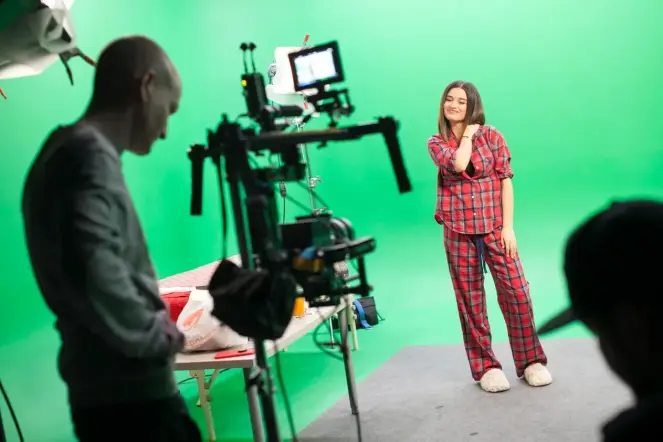

And here a logical question arises: how to determine in advance the number of shifts that will be required to implement the project?
In fact, the ability to accurately determine this number only comes with experience. And it is precisely thanks to this skill in calculating how many shifts are required for filming and subsequent editing that 70% of the cost of the video is formed.
Now let's look at the procedure for compiling a list of equipment that will be needed on the set. Of course, the quantity and quality of devices depends on the budget and type of video. Typically, for simpler videos, a standard set of filming and lighting equipment is used. Such videos do not involve time-consuming filming tasks, such as complex angles, long runs or large additional light sources.
For such projects, our production already has pre-compiled commercial proposals, so if a client sends a request for such a product, he will very quickly receive information about prices.
You're probably wondering now - how do they determine the level of a video? It's actually simple. Usually it is enough for us to see the completed brief and the videos that clients send as references. The presence of references is important, since the examples selected by the customer give a clear idea of his preferences. And, of course, we focus on the purpose of creating the video, as well as where it will be shown and published.
Now let's talk about the most interesting part. Namely, about drawing up a commercial proposal for complex production videos.
Shooting an advertising video for Volkswagen
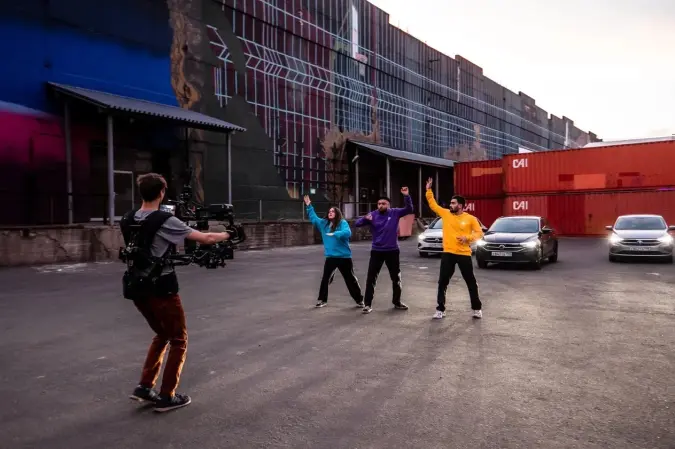
The simplest scenario is when the client knows the limits of his budget, and we, already focusing on a specific figure, try to select the appropriate equipment and necessary services in order to find the best price-quality ratio. All this is done to make the product as attractive as possible.
Now let's return to the topic of a single price list and pricing.
The most difficult and most common option is when a request comes from a customer who only knows the “object” itself that he needs to shoot. By “object” we mean: plant, enterprise, service, product, etc. In other words, the client only knows what the video will be about. To help the customer decide on the type of video, our company has developed a system of “concepts”. To do this, we sign an agreement to create concepts and begin to develop them. Each concept specifies its own original idea, presentation, style, character, message of the video, and even suggestions for color scheme. Concepts are formed taking into account the objectives of the video and the target audience of the “object”. As a result, the client receives several versions of what their future video might look like. One version may consider a method of neutralizing a specific pain of the client, while another may be about solving a different problem. The provided concepts can be presented to the management or marketing department so that they can collectively select the most suitable option and begin further work. Thanks to this system, we ultimately understand what direction and style of video the client prefers.
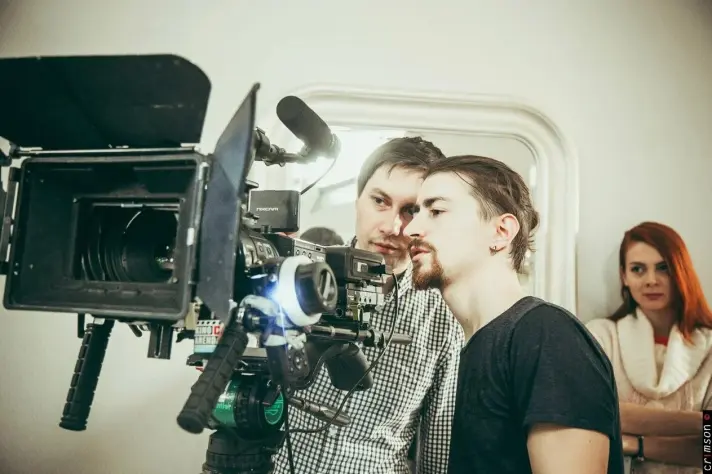
Next, after choosing one of the concepts, we begin to formulate an estimate. The producer, director of photography and director study the concept and analyze what is needed to implement the project - what equipment is needed, what specialists need to be involved, what locations to find, etc. If they came to the conclusion that this video needs to be shot on RED or ARRI, then it immediately becomes clear that to ensure the functionality of these cameras, additional specialists will be required, that is, a technician and engineer, etc.
Archive footage - filmed on a RED camera
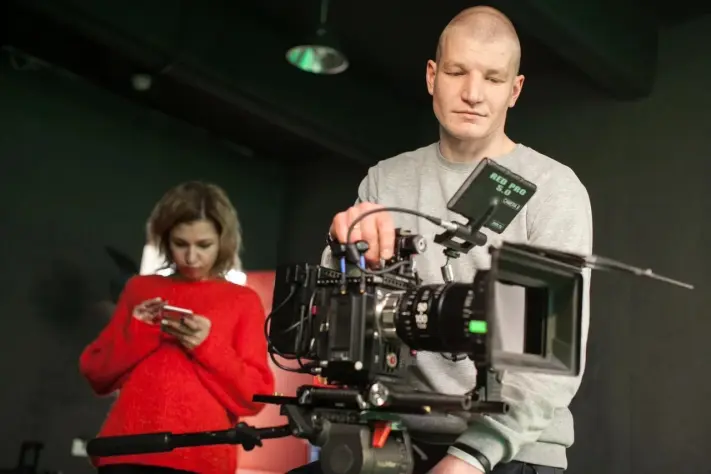
You also need to understand that there is no point in shooting video with such cameras if you do not take the necessary lighting equipment for them. Consequently, even more specialists are required to work with this equipment.
Archive footage - a cameraman sets up the lights on the set of a presentation film for the company NII VECTOR

Also, do not forget that we are all human and we all need to eat. The cost of lunches is calculated based on portions per person. In simple terms, in our field one thing always leads to another.
Now let's look at individual items of our estimate, about which people often have questions. These are the “producing/directing” items, which take up 10%-20%, and sometimes even 30% of the project cost. They often ask what is included in it, and believe that it is just a production extra charge. The answers are actually simple. The director and producer of the project are the people who lead the project from the very beginning until delivery to the client. Let's look at the responsibilities of a director. It is always clear to everyone that the director directs the actors and director of photography on set, and makes sure that the footage matches the original vision of the video. But no one even understands that the director still does a lot of work before and after filming. Before filming, during the “pre-production” period, he monitors the writing of the script and makes his own adjustments, discusses and comes up with the director of photography on how to shoot this or that scene. All this is done in advance before filming. Then, after filming, it also seems unclear what the director can do. After all, it seems like everything was filmed and then working with the footage is already the problem of the editing director. This is also an erroneous opinion, since after filming the director is in communication with the editing director, looks at preliminary versions, takes, etc.
Director Nikita Khozyainov directs on the set
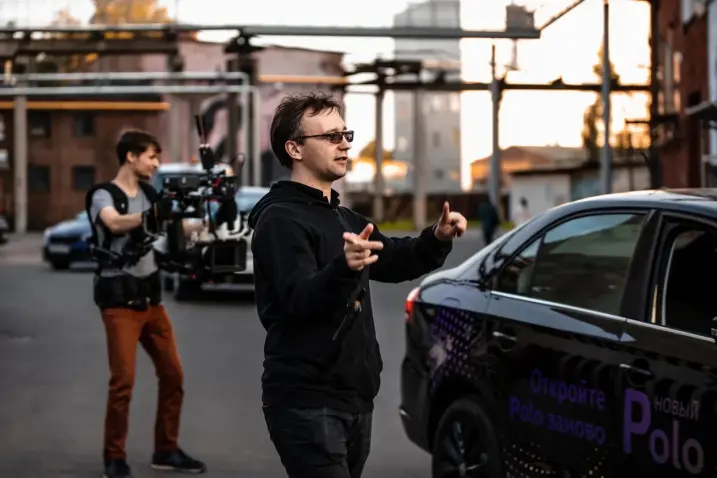
And his work does not end until the final version is handed over to the client. Now let's look at the work of the producer before and after filming. Before filming, at the “pre-production” stage, he conducts all negotiations with the client, assembles a film crew, distributes the budget, searches for locations, etc. After filming, during the “post-production” period, the producer controls the deadlines for delivery of the work, and also continues communication with the client, while being responsible for all document flow between the contractor and the customer. At the same time, this item includes all accounting and legal expenses, as well as the work of the courier. I think this information is enough to understand the reason for the existence of this item and why such work costs money.
Of course, a whole production team is working on bringing the project to life, and the entire staff is involved in this cycle. The sales manager discusses with the client all the nuances that need to be taken into account, the producer is in touch with the customer all the time to organize everything correctly. The marketer works with the writer and director on an idea. The director and his assistants make sure that no important details are missed, the accountant handles the closing documents, and the courier carries the documents. And all this is done so that you can calmly enjoy a cup of coffee in our cozy office.
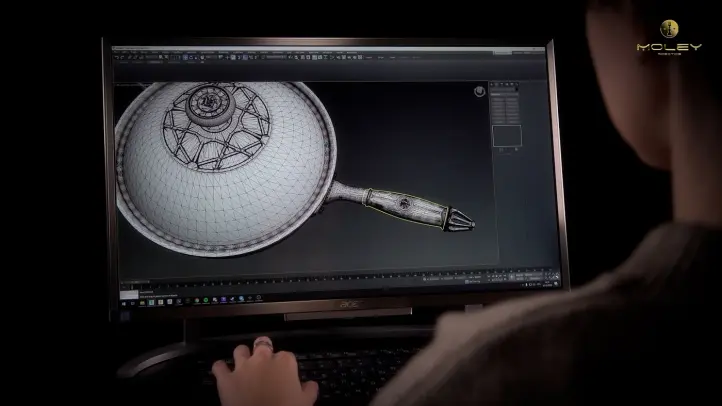
Editing director Ilona Morozova is working on her next project
In my article, I did not delve into the topic of types of equipment, since this article is not about what the video is shot with, but about how its cost is formed and what it depends on. I hope that my article will be useful both to customers and, perhaps, to other production companies.
Author's video content.
In collaboration with CMCproduction & SmartREC video studios
https://www.youtube.com/c/ViolettaWennman
https://ok.ru/shipshard1
https://vk.com/shipshardvk
https://www.pinterest.ca/omegagirs/
https://dzen.ru/shipshard
https://t.me/shipshard
I INVITE YOU TO THE TELEGRAM CHANNEL
UNCENSORED
https://t.me/shipshard
Publication in Russian on the Zen blog
https://dzen.ru/a/ZiH4XBOmcS3Q9Rn0






