
Zen blog post in Russian
https://dzen.ru/a/ae0R8_0qmxfyNBMb
"The long-term negative consequences of the 45th president's rule were not measured by the economy — it collapsed by 2032. They were measured by the fact that the word "honesty" had disappeared from the political lexicon for twenty years. Impeachment was the reward. January 6 is the birthday of the new terror. It was only when Trump's last hotel on Mars (the colony named after him) went bankrupt that people remembered the old truth: democracy is not a business. In business, you can zero out debts. Never in history" (from the future history textbook, 2041).
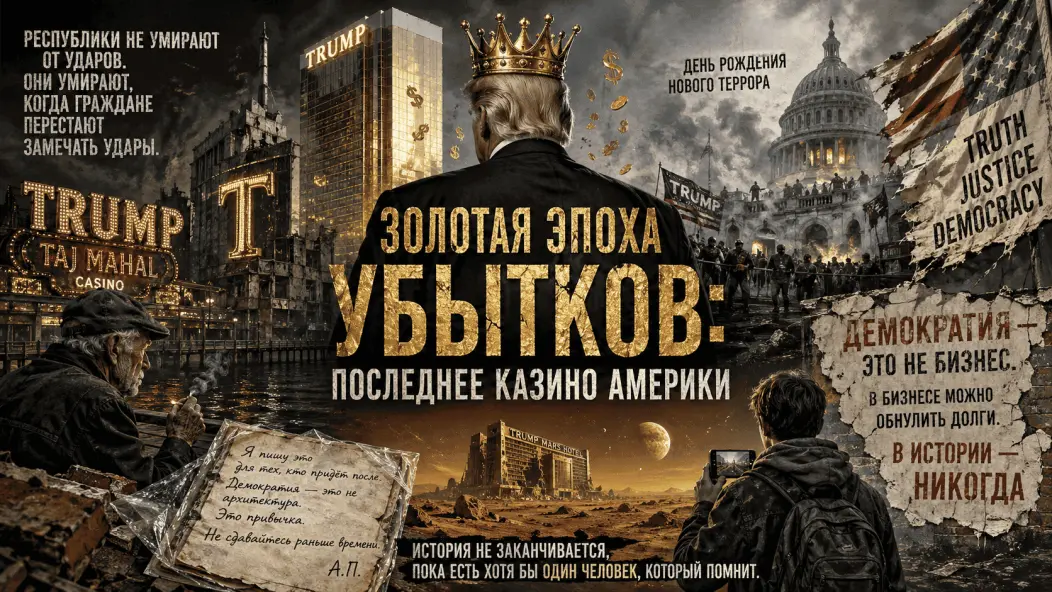
Today I found a manuscript in the wall.
Literally — in the wall of a demolished building, in an old brick house somewhere on the border of what used to be called the District of Columbia. Several sheets wrapped in polyethylene, pressed brick to brick. Someone hid them intentionally. Someone wanted them to be found.
The handwriting was neat, almost calligraphic. As if the author understood: he has no right to be negligent.
"I'm writing this for those who come after. Not for the judgment of history — history does not judge, it only records. For those who will live with the consequences.
We didn't lose the country in one day. This is important to understand. There was no moment of disaster — there was a process. Bankruptcy after bankruptcy, norm after norm, border after border. Every time it seemed: well, this is definitely the limit. They won't let me go any further. Institutions will keep you. The courts will stop it. The allies will push. The voters will vote.
Sometimes they voted. Sometimes the courts stopped. Sometimes institutions were held back.
But every time responsibility didn't come, something died. Quietly. Without an obituary.
It wasn't democracy that was dying — democracy was dying loudly, to marching music. Something worse was dying: the belief that the rules applied the same way. That power has a limit. That private interest cannot become public policy.
When this faith dies, it is not the state that dies. A citizen is dying.
A person who no longer believes in the system does not become a revolutionary. He becomes a consumer of power. He chooses someone who promises to personally receive something from the sale. And the system continues to be sold — now with his tacit consent.
I do not know if you are reading this in a free country or in one that still remembers what it means to be free. I do not know who won in the end.
But I know one thing: it could have been stopped. Not just once, but many times. At each stage, where one person chose silence, the other could choose speech. Where one official signed the order, the other could refuse. Where one journalist closed the tab, another could publish.
Democracy is not architecture. It's a habit. And like any habit, it can be lost.
Don't give up ahead of time. There is always time — as long as there is at least one person who remembers how it should be.
With respect and hope,
A.P."
I sat on the broken wall for a long time and held the sheets so carefully, as if I was afraid to erase the ink with my breath.
Then she took out her phone, an old one with a flashed system, and began photographing each page.
Then I wrote one short message to eight addresses in three countries.
"I found something important. I'm passing it on."
It wasn't a victory.
But it was a continuation.
And a sequel is all that is needed so that the story doesn't end where others wanted it to end.
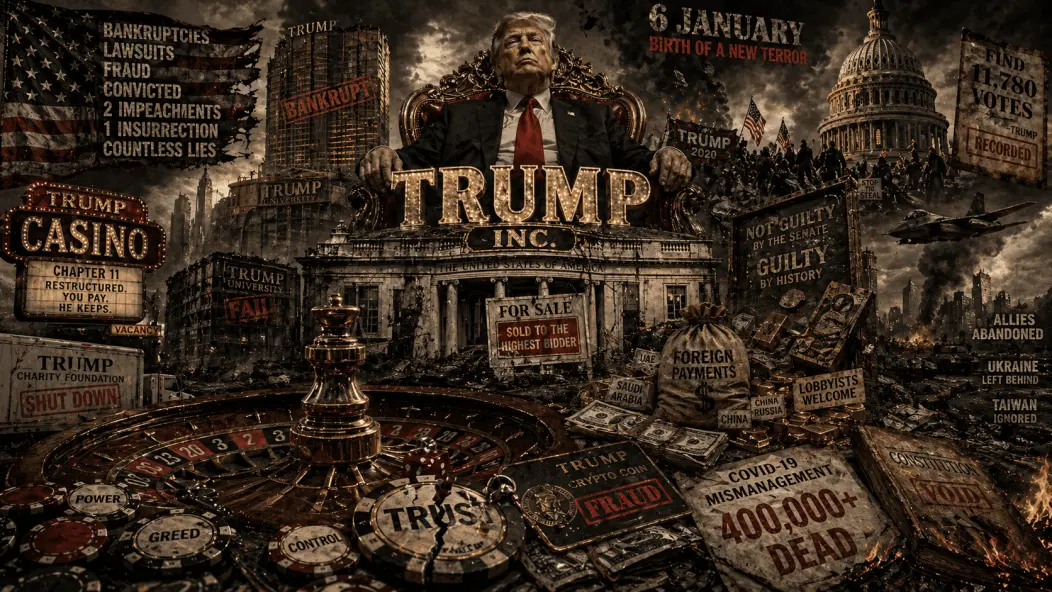
The prologue. The city that lost.
When the last neon sign with the golden letter "T" went out in Atlantic City, an old croupier named Ezra went out onto the empty embankment and lit a cigarette. The casino went bankrupt for the fourth time in his life, but the owner — distant, tanned, immortal — came out of the game again with a suitcase of cash and a TV presenter's smile. The creditors have lost everything. Contractors are at home. Ezra — retirement.
"You know what the trick is, kid? — he said to the young cleaner who was sweeping away the broken glass. — The house always wins. But if you become a house, you win, even when the house is on fire.
In fifteen years, Ezra will see this trick repeated with an entire country.
Chapter I. The President is a Brand.
The Republic, which was still formally called the United States, entered an era when the state seal became the logo, and the Oval Office became the flagship boutique of the hotel chain. The president did not sell his assets — he became them. Every handshake with a foreign ambassador took place in marble halls, where the room bill went into the family pocket. Delegations from the Gulf States booked entire floors without stopping by. The lobbyists paid for the air. The air smelled of money.
It was called the "business approach to management." In fact, it was called Chapter 11 for the Republic (Chapter 11 of the U.S. Bankruptcy Code).
The model has been worked out for decades: to borrow trust, bankrupt an institution, preserve a brand, and come out personally unscathed. His numerous "Satellite Enterprises" kept going under water, announcing "restructuring" or "asset optimization." But, as if by magic, each such corporate storm only strengthened his personal Gold Fund. He always got away with it, and the bills for "damage" were paid by those who ventured to invest in his vision, or, more often, who simply got in the way of his ambitions. First— the casino. Then the university. Then there's the charity foundation. Then the Constitution. After all, the Architect, the undisputed Leader, could not lie. He was the epitome of Success, a Living Brand whose Golden Towers towered over gray neighborhoods like beacons of unshakable prosperity.
But in the quiet hours, when the repeaters went silent, the shadows whispered about the "Great Divide" — about how the boundaries between the State and the Corporation had been erased beyond recognition. It all started with a man who came from the business world and promised to run the country like he manages assets.
He called it efficiency. We call it our existence.
Chapter II. The family office.
In the new palace of power, posts were distributed by last name. The state has become an expanded Corporation, and its top positions are lines in the family holding company. My daughter oversaw the economies of countries whose names she could not emphasize. The son—in-law was engaged in peace in the Middle East - and at the same time received two billion investments from the sovereign fund of the country, whose interests he also represented. The eldest Son became the head of national security. All the key chairs on the Board of Directors of the Company — as the government was now called — were occupied by the Architect's blood partners.
It was the Son—in-law who launched the "Digital Flourishing Coin" Project, an ambitious crypto asset with a portrait of the Head on each token. Anonymous wallets bought it, and along with the coin, favor was bought. Millions invested their last savings, succumbing to the golden promises of Omni-Screens. When the project collapsed, leaving behind only ashes and debt obligations, the son—in-law and his team remained with their own - their "liquidity" inexplicably increased. The prosecutor's office filed a fraud claim. The lawsuit disappeared like smoke over a casino. The rumors were immediately suppressed by the "Ministry of Narrative Correction," which declared the collapse a "test stage" and a "necessary sacrifice in the name of future triumphs." Officials who dared to ask questions disappeared from the job lists faster than a janitor swept glass on the embankment.
Ethics has become a decorative element, like the gilding on the toilet bowl in the presidential apartments.
The Golden Towers, now with the prefix "State Residences", have become a place of pilgrimage for foreign grandees. Delegations from distant protectorates, once allied, but now forced to seek patronage, carried tribute not to the treasury, but directly into the pockets of the Family. Each such agreement weakened the Republic, turning it into an instrument of personal enrichment.
The architect came to power with a story that he called "business lessons." His businesses kept announcing restructuring and going under water, but he always got away with it, preserving his brand and personal foundation. The bills were paid by creditors, contractors, and investors. Now this model has become the basis of the country's governance.
Chapter III. Allies who are devoted over the phone.
The air of a Sovereign Enterprise always smelled like a mixture of old dust, cheap synthetics and vain promises. Every morning, a voice boomed over the Avenues and Neighborhoods, amplified by thousands of repeaters: "We are winning! We are great again! The company is thriving!" And every resident, who had been taught to believe from birth, nodded — even if his pocket was empty and the walls of his home were crumbling.
But in faraway Kiev, a soldier named Andrei was waiting for the shipment of shells promised under the contract. The shells did not arrive. In faraway Taipei, an analyst looked at satellite images and counted the hours before his city would cease to exist. In Brussels, the NATO Secretary General hung up the phone after another call from Washington — a call in which the union had been called a "bad deal" for seventy years.
Western Alliances, once made of steel, were rusting and crumbling under the onslaught of the "new pragmatism." The old Protectorates — the Eastern Border, once Ukraine, and the Island Fortress, once Taiwan—were abandoned to their fate under the pretext of "cost reduction" and "lack of strategic interest." Instead, the Company engaged in "Resource Acquisition Operations" — short, brutal military adventures that ravaged the treasury, but enriched the arms monopolies owned, of course, by distant relatives of the Architect.
The alliances that grandparents had built over decades, brick by brick, with the blood of two world wars, were exchanged for a single phrase on the air.: "And what did they give us in return?"
Geopolitics has become a real estate deal. Only the realtor didn't know that he wasn't selling his house.
And somewhere on the eastern border of Europe, a light came on—not electric. Artillery.
Chapter IV. The Sixth Sun of Reconing, or the Night when the house caught fire.
The Capitol stood for more than two hundred years. He survived the arson by the British in 1814, the Civil War, two world wars, the Cold War, and September 11.
He didn't survive the tweet.
The crowd that was told to come, told to be "wild," came and was wild. The doors were broken down with flags bearing the president's name. Congressmen hid under the benches where the reenactors of the Union had sat a hundred and fifty years ago. A policeman was dying on the steps where the coffins of the murdered presidents were being carried in.
And the Head was watching TV. Three o'clock. He didn't call. He didn't order it. Watched.
It was the Sixth Sun of Reconing, the day when loyal Subjects stormed the very Heart of the Government. In the annals, it was later rewritten as "The Day of National Indignation against the Enemies of the Enterprise." Then there was the second impeachment. Then an excuse. Then there's the worst part: getting used to it. The country that once dismissed the president for wiretapping the headquarters of rivals, now shrugged its shoulders when trying to cancel the elections.
The norm has shifted. Overton's window collapsed to the floor along with the broken glass of the rotunda.
Chapter V. Elections that no longer exist.
"Find me the votes," he told the Secretary of State on the phone. Don't "check it out." Don't "count it." Find. It's like the voices are coins in the lining of a jacket.
The Secretary of State recorded the conversation. The recording became evidence. The evidence was nothing.
Because by that time, half of the country already believed that the elections were a show, and the show was reality, and reality was what the host said. The courts rejected more than sixty lawsuits. His own prosecutor General said: there are no falsifications. It didn't matter. The truth has ceased to be a fact and has become a rating.
When the Election results showed an "incorrect" outcome, the Architect declared them a "Great Hoax." Attempts to bring him to justice were suppressed and declared a "Deep State Conspiracy." The truth has become flexible, subject only to the will of one Architect.
In the new Republic, the vote remained. There is no trust in voting.
Chapter VI. Chronicles Of A Sovereign Enterprise: The Golden Age Of Losses.
The consequences of this "business approach to the state" were terrifying and long-lasting. The sovereign Enterprise, once a beacon of Freedom, has turned into a corporate ghetto. Nature was dying under the smog of unregulated industries — the Architect withdrew from the Paris Climate Agreement with the stroke of a pen, calling it a "robbery." Social services have been privatized to the point of inefficiency. Education has become a luxury available only to "Privileged Shareholders." Systemic bankruptcies, once the domain of private companies, have become the fate of an entire nation — and with each of them, the personal wealth of the Architect and his Family has only grown, perpetuated in the "Legacy of the Golden Fund", passed down from generation to generation.
Trust in any institution — the courts, the media, the elections themselves — has been trampled on and replaced by blind faith in the Architect and his daily Declarations. The geopolitical landscape has turned into ruins of former alliances, a field for endless, senseless conflicts fueled by greed. The moral and political crisis has not ended — it has become the norm, the foundation, the foundation on which the entire Sovereign Enterprise is built.
The epilogue. An old man on the embankment. An echo in the void.
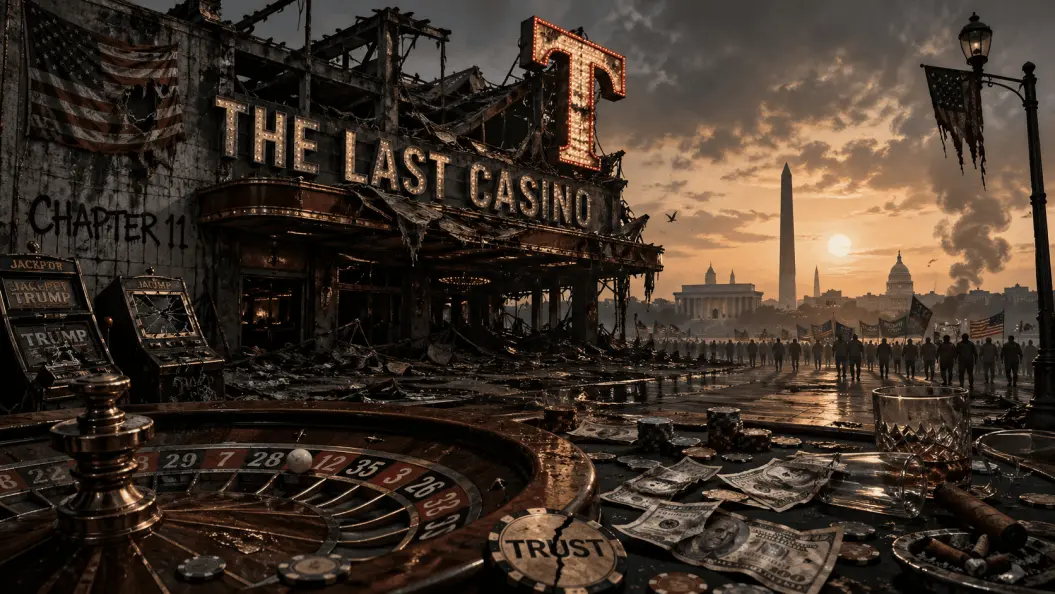
Years have passed. Ezra, now completely gray-haired, was sitting on the same boardwalk in Atlantic City again. The casino was never restored. In place of the golden "T", rusty fittings stuck out like a broken tooth of time.
My grandson, who had recently returned from the army, sat next to me, the one that was no longer respected in fifty capitals of the world.
— Grandfather, you saw all this from the very beginning. Why didn't anyone stop it?
Ezra was silent for a long time. Then he said:
"Because we thought we were playing at his casino." But it turned out that he was playing with us. And when the house burned down, he already owned matches, insurance, and the land under the ashes. He was always coming out of bankruptcy. Only this time, it wasn't the company that went bankrupt. Not a hotel. Not a brand.
The grandson looked at the horizon, where the pale, tired sun was rising over the ocean.
"What about it?"
—Trust, kid. Trust in elections. To the allies. To the institutes. To the very fact that the word means something. This bankruptcy cannot be restructured through Chapter 11. This duty is ours. And your children will pay it. And their children. For decades.
He stubbed out his cigarette on the railing.
— You see, the house always wins. But when a country becomes a casino, everyone loses except one player. And this player never sits down at the table. He owns the table.
Seagulls screamed over the empty embankment. Somewhere far away, on the other side of the continent, another election was beginning, the outcome of which, for the first time in two hundred and fifty years, no one considered a foregone conclusion peacefully.
And this, the grandson realized, was the most terrible legacy.
More than one scandal. There is more than one solution. More than one lie.
And the fact that "normal" has become a different meaning.
Now, decades later, the Architect's Golden Towers still sparkle in the sun, but their brilliance is a cold reflection of emptiness. Subjects who have long lost their memory of what the other world is like exist in this corporate slavery. No one remembers what free choice is, and "truth" is just what is announced on Omni-Screens. And while the Architect's voice, recorded on ancient tapes, continues to blare from repeaters.: "We are winning!" — the dust on the streets of the Sovereign Enterprise settles, and only the imprints of broken promises and lost hopes are visible in it.
The true "Golden Age" turned out to be just gilding, hiding the rot.
"Republics don't die from blows. They die when citizens stop noticing the blows," is the inscription that appeared one morning on the wall of a burned-out casino in Atlantic City. The author is unknown.
The dystopian form is used to artistically interpret the systemic nature of these events.
The future described in the text is fictional.
The facts on which it is based are not. (Ship Shard by Violetta Wennman)
I write and shoot. Join me
Author's video content
https://www.youtube.com/c/ViolettaWennman
Political trash
https://www.youtube.com/@Ship-Shard
I invite you to the telegram channel
https://t.me/shipshard
Highly Social on Zen
https://dzen.ru/shipshard
To buy caramels to ruin your teeth
https://dzen.ru/shipshard?donate=true
My hobbies are history, philosophy, psychology, music, economics, politics, and sociology. I write about this and much more. Professional model. She has performed at international music festivals (vocals, dancing, imitation of vocalists). I am studying at the Academy of Arts - the Film and Art Industry, I am a producer and the owner of a video studio.
I am glad to see all of you in my blogs.
Please support us, like-minded people, join the telegram channel. https://t.me/shipshard






