
Publication in Russian on the Zen blog
https://dzen.ru/a/adVNKUaVbFIhL9np
Andor is a rare case when a project within a large franchise outgrows its own framework. I'll try to expand my thought and highlight the key points. I will compare Luten and Andor with real historical figures of the revolutions. Why do people like Cassian Andor often become heroes or victims of the system? Why, after a victory, such people are often "crushed" by the system. Why Luten is a leader, and people like Andor rarely become leaders. I will give specific historical examples of revolutionaries "crushed" by the system. And why even people like Luten, after victory, often become either tyrants or victims of their own system. Which of the "Lutenite" type of people managed to survive and integrate into the system, and why this is a rare exception, and what unites them. And the most important question is: why do societies choose models over and over again that have already led to problems? I will analyze the topic of revolutions as fully as possible in this publication. There will be many letters.
Everyday life of soldiers of the revolution.
Realism instead of epic. The revolution is shown as hard, thankless work: stress, doubts, moral compromises. Revolution as an everyday occurrence. The threat is not abstract, but everyday: "everything can be taken away from you at any minute." The struggle is not for ideals, but for the right to a normal life.
The series "Andor" debunks the romanticization of struggle: victory is not a spectacular finale, but the result of thousands of inconspicuous victims.
In the era of "the triumph of tyranny," the series asks uncomfortable questions.:
- What does it mean to resist when the enemy seems invincible?
- What compromises can be made for the sake of the goal?
- Who pays the price for freedom?
Unlike other Star Wars projects, Andor does not operate a fan service, but offers a new perspective on the universe.
The series goes beyond the franchise thanks to:
- Universality of the theme. The story of Luten and Andor is a parable of resistance, relevant to any era.
- Psychology. The heroes are not cardboard fighters against evil, but real people with injuries, fears, and doubts.
- Artistic honesty. The series does not provide simple answers: it shows that fighting the system requires sacrifices that are not always justified.
"Andor" begins as a story about rebels, but becomes a reflection on the price of freedom — and this is its main strength.
Andor is an amazing, very cool job. The classic Lucas Star Wars trilogy is about something else. About the epic, about the archetype, about the path of the hero according to Jung and Campbell. All the later add-ons around this trilogy are focused on fan nostalgia for the classics, so they repeat the same narratives.
"Andor" looks at the fight against darkness differently. This is a story about the revolution, not like the Campbell way of the hero, straight and sparkling. This is not about the Argonauts' journey, or the chain of Hercules' exploits. No, this is about revolution as hard work, as a gloomy life filled with stress, doubts, and minute-by-minute self-overcoming. It's about a conscious and painful rejection of philistine "morality." This is about the everyday life of soldiers of the revolution who risk everything for the sake of following orders, for the sake of local, small victories, without even seeing the big picture, not knowing how these small victories lead to a big victory in the civil war.
It's about having to wear a mask for years, to seem different from who you are. About giving up the right to be yourself. For the sake of the cause.
Already in Rogue One, such a view of the struggle against the Empire was presented for the first time. But in "Andor" it's even deeper, clearer.
On "Medusa", the review correctly noted that not many films are being released now, where the existing world order is being sought to break, to destroy the positive characters. Well, OK, there are exceptions in the form of teenage dystopias like Mockingjay. But "Andor" is not a dystopia. The daily reality there is depressingly mundane. Restaurants, weddings, trade, everyday life, minor personal dramas. Yes, it is a dictatorship, but there are huge spaces for personal salvation, "self-realization" with minimal compromises. But over all this lies the shadow of the Empire. You're living normally. It's just that everything can be taken away from you at any minute.
Probably, indeed, "Andor" should have appeared right now, in the 2020s, when tyrannies are triumphant. "There will be times when fighting will seem pointless. Alone and uncertain, in the shadow of the enemy's immense power."
I think that the creators of the series initially wanted to state that "not everything is so clear," that there are no completely positive characters. They wanted to show the "moral dubiousness" of the insurgents' methods. Like, to slightly expose "Nechaevism" (as the Russian intelligentsia would call it). It seems that the image of Luten Rail was supposed to serve this task, he was brilliantly played by Skarsgard. Luten is a coordinator of the underground, a "puppeteer", a "recruiter", a "manipulator", a "cruel cynic" — what other epithets are there in the arsenal of the saints.
But in the finale, the main character, Andor, who has been drinking too much from Luten himself, tells the caring leaders of the rebel Alliance that they got everything they have thanks to Luten and his work. You are all alive because of his work, and you have a chance to win because of his work.
The dialogues are perfectly written in Andor. One of the strongest scenes is Luten's conversation with one of his agents. The agent Luten has infiltrated into the imperial state security wants to leave, retire, citing a threat to his family. Luten denies him the right to exit.
"What did you sacrifice?" the agent asks.
Luten answers him with icy weariness.
"Calm down. Kindness. Proximity. With love. I have no chance of finding peace. My mind is a bleak place. I share my dreams with ghosts. And every day for years, I've been starting it with an equation that has only one solution—I'm damned for what I'm doing.
My anger, my unwillingness to give up, and my insatiable desire to fight pushed me onto a path of no return. I wanted to save people from injustice without thinking about the cost, but when I looked down, I couldn't see the ground under my feet.
I am doomed to use the enemy's tools to defeat him. I am sacrificing my dignity for the sake of someone else's future. I'm burning my life for a dawn that I'll never see. I've never seen a mirror, an audience, or gratitude. So what did I sacrifice? Yes to everyone."
In real art, it happens when a creation turns out to be deeper than the authors would like.
Next, a deep analysis of the revolution through the work "Andor".
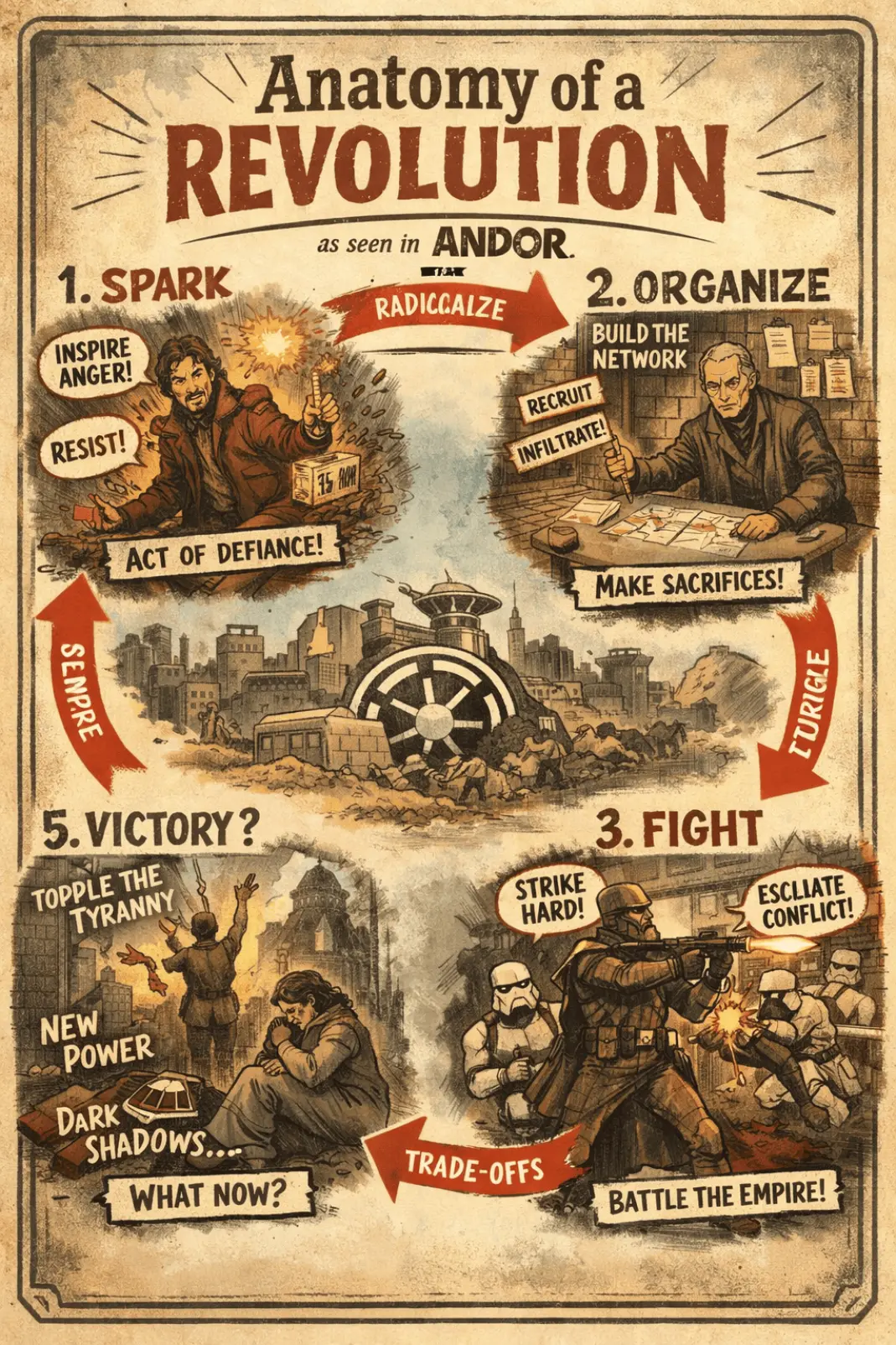
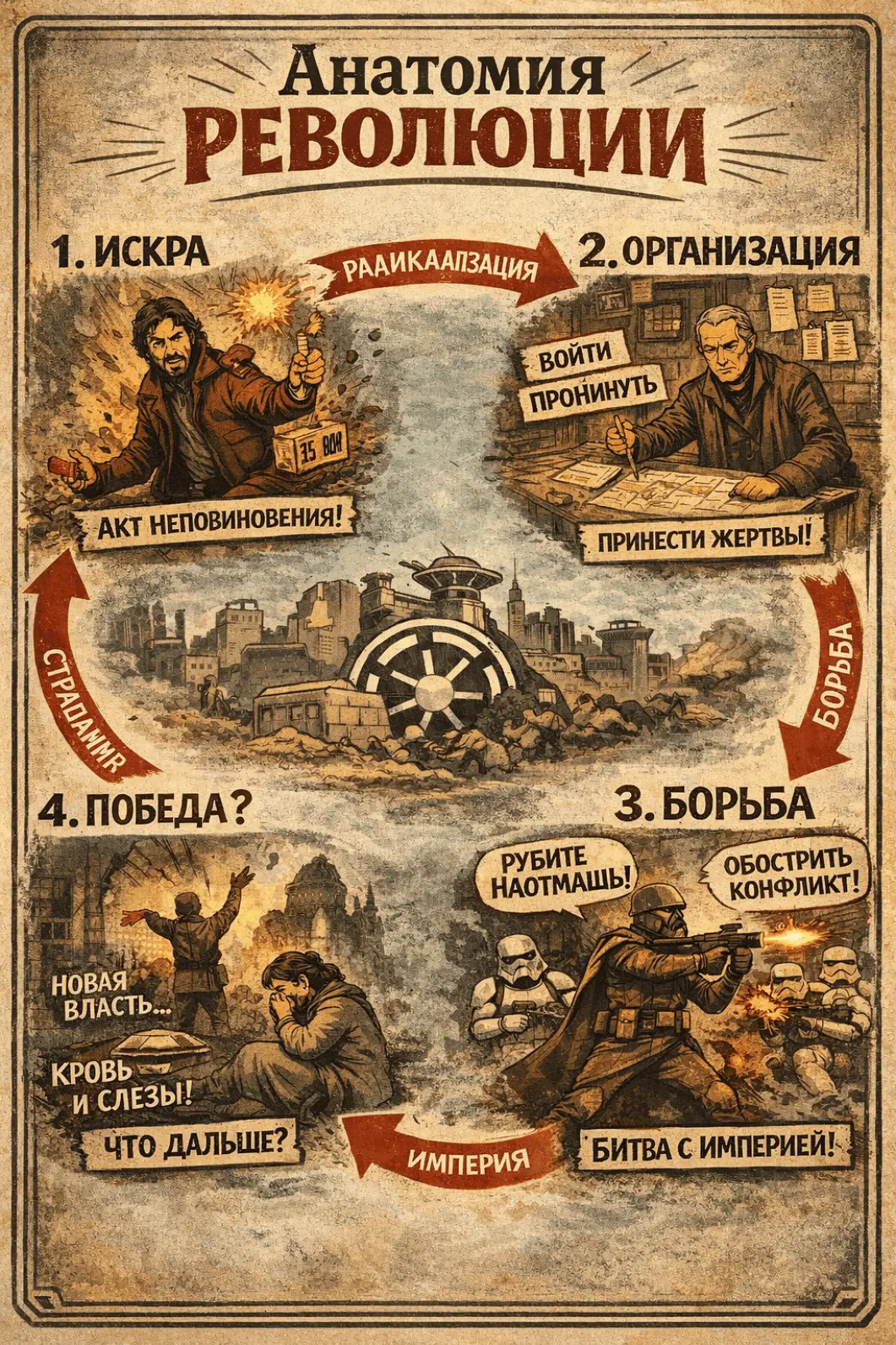
The anatomy of revolution.
The story of "Andor" is the antithesis of the classic "Star Wars". It's not an epic, it's a chronicle. Politics, psychology, everyday life. The revolution here is like a job, not a feat. It's almost a production drama, not an adventure. Luten Rail is one of the strongest characters in the entire franchise. He breaks the usual pattern: he is not a hero, not a villain, not an antihero in the usual sense. He is a function of the revolution. His monologue is almost a manifesto.: "I'm burning my life for a dawn that I'll never see." This is a radically anti-Hollywood idea: victory without reward, sacrifice without redemption, goodness without moral purity. The main question of the series is: is it possible to defeat evil without becoming a part of it? Probably not. A very important difference from other franchise projects is that in Andor, the Empire is not only evil, but also the infrastructure of life. People work here, get married, and pursue a career. And yet they live in a system that can destroy them at any moment. This makes the threat not abstract, but everyday.
The TV series "Andor" has hit the nerve of our time. The story of "Andor" sounds modern. It's not so much about a distant galaxy, but about life inside powerful systems, a sense of powerlessness, and the gradual erosion of freedom. And the main fear: that resistance is either meaningless or requires becoming the one you're fighting against. "Andor" is not about victory, not about heroism, not about hope in the usual sense. It's about the price of resistance without guarantees. And perhaps his main thought is: "freedom is not the end of history, but a process in which almost no one lives to see the result."
Luten.
Comparing Luten Rail with real revolutionaries, one can understand that this is a composite image of several types of underground fighters.
Luten is more existential and less "ideological" than Vladimir Lenin. But it also works with a network of cells, not directly with masses. It also relies on discipline and centralized management. I am also ready for tough decisions for the sake of strategy. The difference is that Lenin believed in the historical pattern of victory. Luten acted without guarantees and even without confidence.
Luten is not so much the leader as the conductor of the network. This is his similarity to the British intelligence officer Sidney Reilly. This is a type of "spy organizer": working through embedded agents, manipulation, double games, lack of moral transparency.
There is a very close connection between Luten and the 19th century Russian revolutionary Sergei Nechaev: the instrumentalization of people, the rejection of ethical morality, "the end justifies any means." The difference is that Nechaev was a fanatic of the idea. Luten is a person who is aware of the price and suffers from it. Luten doesn't justify himself—he curses himself.
The French Resistance, the underground of World War II, like Luten's, faced a constant risk of failure, and agents had to be sacrificed. Both Lutin and the leaders of the French Resistance sent people to their deaths, made decisions without "clean hands."
Luten, as the "grey cardinal" of the revolution. This is his similarity to Felix Dzerzhinsky. Cold functionality, willingness to use repressive methods, perception of oneself as a tool. The difference is that Dzerzhinsky was already operating inside the government, while Luten was in a vulnerable phase before victory.
Luten is not a specific person. This is the archetype: "a man who makes revolution possible, but he cannot live in its outcome." Luten is unique. And unlike most historical figures, he does not believe that "everything will be fine," he does not expect recognition, he does not expect justification, his position is closer to tragedy than to ideology. If you combine Lenin's rationality, Nechaev's amoralism, the network work of intelligence officers, and the experience of the French Resistance, you get Luten. Luten is, in fact, a self—aware Nechaev, devoid of Lenin's illusions. And that's why he's so out of step with the traditional Star Wars narrative.
Andor.
Andor, like Alexander Pechersky (the Sobibor Uprising during World War II), was not a professional revolutionary, found himself inside a repressive system, and began to act when it became impossible to simply survive. These are people who are "involved" in the struggle.
Andor looks like people from the Polish underground (an underground state organization during the Second World War). These are ordinary people (smugglers, workers, small businessmen) who were gradually drawn into the network of resistance and did not have a complete picture of what was happening. Andor is a typical "grassroots participant" in such an underground: he does his part, does not see the whole strategy, lives from task to task.
Andor, like the criminal revolutionary Simon Ter-Petrosyan (Kamo), had experience in the criminal environment, he had skills of survival and circumvention of the system, took part in "dirty" operations (robberies, sabotage). Andor is not a "pure" hero — he initially already lives outside the law.
Andor is like a practitioner, not a thinker, like a soldier without an ideology. This is his similarity to the members of the French Resistance. Many members of the Resistance were not politically motivated, joined the resistance due to circumstances, and acted locally, not strategically. Andor is just such a type.
Andor and dissident Vaclav Havel have similar trajectories from "just living" to "impossible not to resist": gradual awareness of the system, transition from private life to resistance, "late awakening". The difference is that Havel is an intellectual, and Andor is a man of action.
The main difference between Andor and the classic heroes of the franchise is that he does not receive a "call" - he does not want to participate, he does not accept fate - he gets involved gradually, he does not become a chosen one - he does not become a "symbol".
If Luten is the "engine of the revolution," then Andor is the man from whom the revolution is made.
Andor is a mixture of Pechersky's pragmatism, the "grassroots" involvement of the Polish underground, the criminal experience of Kamo, and the evolution of consciousness (like Havel's, but without intellectualism). Andor is the most "realistic" type of resistance member: not a hero, not an ideologue, not a martyr. This is a person who first survives, then adapts, and only then begins to struggle.
Cassian Andor and Luten Rail are two stages of the revolution. These are not just two characters, but two phases of the same process. Andor is how the revolution begins. Luten is how a revolution becomes a system
The essence of Andor is the emergence of resistance. This is when the revolution has not yet been formalized: there is no center, there is no strategy, there is only the pressure of the system. Such "Andors" are people pushed out by circumstances, not ideologists, not leaders, often marginals or survivors. Their logic of action is a reaction, not a plan, local decisions, "do it now to survive." The main motivation of such people is not to change the world, but because it is impossible to live in the old way anymore. It is then that the transition begins, the key moment where a Luten-type figure appears: the connection of disparate actors, the emergence of coordination, the first sacrifices "for the sake of more." This is where "purity" ends and politics begins.
In the Luten stage, organization and management begin. A revolution becomes a network, a system, a strategy. People like Luten are coordinators, architects, and people who see the whole picture. Their logic of action: planning, calculation, manipulation. And the main motivation of the "Lutenists" is not survival, but victory at any cost.
People like Andor are risking themselves, people like Luten are risking others. "Andor" acts from within experience, "Luten" acts from abstraction. "Andor" preserves personal morality, "Luten" transforms morality into a tool. This is the moment when resistance turns into revolution.
The revolution requires both phases: "Lutenists" and "Andors". Without "andors" there is no energy, no people, no reality. Without Lutens, there is no coordination, no scale, no victory.
But Luten and Andor are incompatible in their roles and psyche. A good andor rarely becomes a luten. A good luten cannot return to the andor state. These are different psyches: empathy versus calculation, participation versus distance.
In almost any revolution, "andors" (chaos, local resistance) appear, "lutens" (organization, strategy) come, the system wins, and so on.
The main tragedy is that those who start a fight rarely control its outcome. "Andors" start the process. The Lutens are making it out. The result belongs to a different logic. Andor and Luten are two successive stages of the same transformation: from human resistance to a cold system of struggle. And the main nerve of "Andor" as a series is that it shows not only heroism, but also the cost of the transition between these stages.
People like Cassian Andor find themselves in the zone of maximum risk, where the trajectory almost always goes to extremes: either up (glorification) or down (destruction by the system). Such people are not embedded in the system, but they are not protected by the underground structure either. They operate "on the front line." This means maximum vulnerability, lack of guarantees, and constant risk of error. In reality, it is precisely these "borderline" figures who are most often the first to die or make a breakthrough. The key mechanism of the "Andor" type begins with a minor violation, then local resistance occurs, and then a crime against the system occurs. there is an escalation without the possibility of a rollback, when it is impossible to go back. This is something that has often happened in history to members of the underground like the French Resistance: one step draws into the next, the stakes are constantly rising. A person either goes to the end and becomes a hero, or breaks down (gets caught) and becomes a "victim." Most people like Andor don't know the strategy, they don't understand the scale of the game, they make decisions blindly. This leads to two scenarios: heroization or disaster. And in fact, it's all a matter of chance. People like Luten use people like Andor as a resource, send them on risky operations, sacrifice them for the sake of strategy. And this is not necessarily "evil", this is the logic of the underground: historically, agents were often "expendable", failures were considered acceptable, so the probability of "becoming a victim" was initially built in. A "hero" is created after the fact. A "hero" is not someone who has survived, it is someone whose story has proved useful to the narrative. After the events, characters are chosen, biographies are simplified, and moral gray areas are removed. Something like this happened to figures from the Polish underground: thousands remained unknown, units became symbols. The repressive system also makes a choice: it cannot punish everyone, it chooses demonstrative goals, so someone is destroyed "for example", someone escapes. Some become legends, others disappear. People like Andor tend to take risks, make decisions faster, and cross moral boundaries more easily. It helps in success (courage, initiative), but also ruins in failure (self-evaluation). Such people find themselves in a situation where the price of action is always the maximum, and control over the result is minimal. And that's why they make legends and they make forgotten victims.
One of the harshest and most recurring paradoxes of history is that people like Cassian Andor are often not needed by the system after its victory — and moreover, they become a problem for it. During the struggle, we need those who are proactive, risky, and willing to break the rules. After the victory, we need controlled, predictable, loyal people. The same person is not well suited for both phases. Such "andors" are used to acting independently, do not wait for orders, and are able to bypass the system. For the new government, this is already a threat, not a resource. Any new system wants to say, "Now everything is according to the rules." But the Andors were living proof that rules could be broken, violence was acceptable, and morality was flexible. Their existence undermines the image of "legality." Therefore, they are marginalized or removed from the public field. They know too much. Such people have seen the "dirty kitchen", know the real methods, understand who sacrificed whom. It's dangerous. Historically, this has happened, for example, after revolutions: internal struggles, "purges," and the elimination of witnesses. After the victory, society wants normality, clear characters, and a clean story. And "andors" are dirty decisions, compromises, and inconvenient truths. They are easier to forget, to rewrite, to displace. Unlike figures like Luten Reilly, such people do not build structures, do not form an ideology, do not accumulate power, they do the work, but do not control the result. Therefore, after the victory, others take power, and the performers are left without protection. The logic is that "the revolution devours its own people." This is a classic mechanism, yesterday's methods become a crime, yesterday's heroes become troublemakers. The system begins to "purge" itself of its own radicalism. They don't know how to "live after." Such people are adapted to risk, accustomed to extreme conditions, and live in a constant state of tension. In peaceful life, they lose their bearings, conflict with the system, and often find themselves outside the law again. The reason is a fundamental conflict:
those who are able to destroy the system are rarely able to live in it. The Andors are needed to break the old order. But after that, the system either changes and excludes them, or reproduces the same control logic, and in both cases they turn out to be superfluous.
"Andors" rarely become leaders like Luten. Cassian Andor and Luten Rail are different "modes of thinking" within the same struggle. And the transition between them is rare and painful. Andor thinks with tasks ("to do the job", "to survive"), lives in specifics. Luten thinks in systems, sees connections between events, and builds a strategy for years. To become a Lutenist, you need to break away from the "here and now" and start thinking about other people's lives as variables. It's not just a skill, it's a mental change. Willingness to sacrifice others (not just yourself). Andor: he risks himself, at most, his inner circle. Luten sacrifices strangers, makes decisions "this one will die so that others will survive." And the main barrier is to move from personal sacrifice to the distribution of other people's victims. And many people just can't—or don't want to. Andor still holds on to the remnants of "normal" morality, hesitates, doubts. Luten has consciously abandoned moral comfort and lives with internal conflict as the norm. Becoming a Lutenist doesn't just mean "violating morality," but stopping expecting to be right. Andor is included in human connections, attachments influence his decisions. Luten is distant, uses people as elements. A leader of this type should be able not to get close, not to allow himself weaknesses, this is a high psychological price. Andor is a practitioner: missions, survival, improvisation. Luten architect: networks, resources, long-term combinations. The transition from one type to another requires time to access information and learn. Most of the "Andors" just don't get that opportunity. To become a Luten, you need connections, money, channels of influence. Andor is dependent on other people's decisions, embedded in someone else's game, without resources it is impossible to become a strategist. Most importantly, Luten is a person who can stand the thought: "I'm doing evil for the sake of a future I won't see." Most people break down earlier: they either return to "normal life", or they die, or they remain at the level of performers. Even if Andor is capable of becoming luten: it will not always be allowed to go up, the leaders are not interested in new leaders, the system has already been built. Therefore, growth is often blocked from the outside. The Andor-Luten transition requires strategic thinking, moral transformation, access to resources, and psychological resilience at the same time. The coincidence of all these factors is rare. Andors make revolution possible, Lutens make it manageable. And they are almost never the same people.
Since the "Andor" after the victory often become either tyrants or victims of their own system, "crushed" by revolutionaries. And this is not an exception, but almost a pattern. People of the "Andor type" (practitioners, performers, risk takers) often turn out to be superfluous immediately after a victory. The revolution devours its own people.
Let's take a look at specific cases from different eras, but with the same logic of the "Andor" type:
1. The French Revolution:
Georges Danton. One of the key organizers of the revolution, played an important role in overthrowing the monarchy. He began to advocate moderation and was accused of "betraying the revolution" and executed by guillotine. The radical phase requires rigidity, and an attempt to "stop" is perceived as a threat.
Maximilian Robespierre. The architect of terror himself, a symbol of the "purity of the revolution." As a result, he was executed by his own people. Even the "lutens" are not protected — the system starts self-devouring.
2. Russia: Underground - power - purges:
Leon Trotsky. The creator of the Red Army, the key figure of victory. As a result, he lost the struggle for power, was exiled, and was killed by an agent. After the victory, the struggle for control begins, the old revolutionaries become competitors.
Nikolai Bukharin. The ideologist, one of the "favorites of the party," participated in the construction of the system. As a result, he was accused of treason and shot. Even loyalty doesn't help if the line changes.
Kamo (Simon Ter-Petrosyan). A typical "andor". Expropriation, clandestine operations, risk. After the revolution, he found himself out of work, died under strange circumstances. Underground skills don't translate into a peaceful life.
3. Resistance in World War II:
The French Resistance. After the war, some of the participants became heroes, but many were forgotten, did not receive recognition, and could not integrate into peaceful life. Some were marginalized or dragged into the post-war conflicts. Society wants heroes, but it doesn't want their reality.
4. The Polish Underground:
The Home Army. After the war, the country came under the control of the USSR. Former underground members were arrested, persecuted, and destroyed. People fought for freedom, turned out to be enemies of the new system.
5. The Chinese Revolution:
Peng Dehuai. Hero of the Civil War, Marshal. After that, he criticized the government's policy, and was repressed during the Cultural Revolution. Veterans of the revolution are dangerous figures.
In all cases, the same pattern is repeated.: 1. The phase of struggle, when "andors" are needed, risk, rigidity, and initiative are encouraged. 2. The victory phase, when stability is needed, centralization begins. 3. The cleaning phase, when the independent, inconvenient, "knowing too much" are removed.
It is the "Andors" who suffer more often, because they do not control power, do not form a narrative, and are not protected by the structure. They did the job, but they didn't become a system. Revolutions are won by the "andors", but others live after them. And this makes their fate almost predictable: either accidental glorification, or disappearance, or annihilation.
There are only rare exceptions in history for people who have managed to survive and integrate into the system. Even Lutenists, after victory, often become either tyrants or victims of their own system.
Luten Rail figures are people who know how to win a fight, but they don't necessarily know how to live after it. And after the victory, they have only two stable scenarios: either they turn into a hard power, or they are eliminated by the new system.
To win, such people manipulate, sacrifice people, use violence, and act outside the rules. The problem is that they don't switch back after winning. Methods that were "forced" are becoming the norm.
Or such people "become tyrants." If Luten remains in power, he continues to think underground: he sees threats everywhere, does not trust anyone, and suppresses potential opposition. Historically, this can be seen in figures like Joseph Stalin: revolutionary logic is the logic of control. As a result, the system turns such people into what they were fighting against.
Or such people "become victims." If power passes to others, the "Luten" becomes dangerous, because he knows how to organize conspiracies, knows the real mechanisms of power, and is not bound by morality. He is eliminated "just in case." For example, Leon Trotsky was the architect of victory. He became a threat and was eliminated.
The "Lutenists" cannot "disarm." Luten cannot stop being Luten, he is used to living in a threat mode, does not believe in stability, does not trust the world, Even if the system stabilizes, he continues to act as if in a crisis, thereby creating tension himself. After the victory, the government says:
"Everything is legal now." But Luten knows that everything is based on violence and manipulation, he did it himself, he destroys the myth of "pure power". Therefore, either he is removed, or he suppresses everyone himself in order to maintain control. And this is a paradox in history. To retain power, such a person strengthens control, removes alternatives, and suppresses initiative. But by doing so, he reproduces the same system he was fighting against. It's almost a closed loop.
Luten is a person who has already abandoned a normal life, accepted internal "corruption", and lives without hope of justification. After the victory, he has no "peaceful scenario", no new role, no way to return. All that remains is to hold on to power or disappear. After the victory, Luten has a choice without good options: to keep his methods by becoming a tyrant, or to abandon his methods by losing power and being eliminated. Those who win the war at any cost cannot build peace without that price. "Andors" rarely survive, and "lutens" rarely remain human in the usual sense.
The exceptions to the rule are the rare cases in which such "lutens" survive and integrate into the system. People of the "Lutenan" type (tough, strategic, ready for moral compromises) sometimes do not become either tyrants or victims. But for this to happen, several rare conditions must match at once. I will give specific historical examples of such people.:
1. The pragmatist who managed to "switch" is Deng Xiaoping. He participated in the revolution and the civil war, survived purges and political attacks, and perfectly understood the "dirty kitchen" of the authorities. He abandoned ideological fanaticism, relied on pragmatism ("it doesn't matter what color the cat is ..."), shifted the focus from the struggle to management. I survived because I was able to change my mode of thinking, and I didn't get stuck in the logic of constant struggle.
2. The strategist who left on time, Charles de Gaulle. The leader of the French Resistance, a tough, independent, strategic player. After the war, he did not cling to power at any cost, and later returned as a legitimate leader, not an underground activist. He was not "ground up" because he managed to get out of the role of a revolutionary and moved into institutional politics.
3. The revolutionary who became a statesman - Mustafa Kemal Ataturk. A military leader who destroyed the old system. He acted harshly and pragmatically. After the victory, he began to build institutions and created a new model of the state. He did not stay in the logic of the underground, but quickly moved on to creating rules rather than breaking them.
4. The man who deliberately renounced radicalism - Nelson Mandela. He went through the underground and violence, had every reason for a radical scenario, but chose reconciliation instead of revenge, abandoned the logic of "enemies forever." This is the rarest case: a conscious rejection of the "Lutenist" path after the victory.
Now the main thing is why there are few such examples. You need to be able to "switch mode". Most people cannot switch from fighting mode to control mode, from threat logic to rule logic. It's almost like changing your personality. We need internal flexibility. Such people are usually very tough, principled, and obsessed. That's what helped them win. And it also prevents them from changing. A new legitimacy is needed. In order not to be destroyed, you need to become "official," integrate into institutions, and gain recognition. Without it, you remain a dangerous element. You need to control the transition. If the transition to peace is chaotic, uncontrolled, then the "lutens" are removed. If the transition is managed with their participation, then they have a chance. You need a willingness to give up a part of yourself. The most difficult thing in order to survive, Luten must betray part of what made him Luten, give up total control, accept restrictions, agree to compromise, many do not go for it. Such people survive and integrate if a rare combination matches: flexibility of thinking, control over the transition of power, the ability to abandon radical methods and a little historical luck. It is not the toughest and not the most principled who survives, but the one who is able to stop being who he was in time. And that's why such cases look like exceptions — because they require the almost impossible: defeating the system and yourself at the same time.
Historical examples of such rare "pure" cases of switching are when people with experience of tough struggle did not go into tyranny or sacrifice, but changed their behavior logic and stayed in the new reality. These are not "ideal heroes", but rather successful transition trajectories.
1. Conscious rejection of the logic of the enemy - Nelson Mandela. Underground struggle, readiness for violence. After: the policy of reconciliation, the rejection of revenge. Mandela did not continue the war after the victory, although he had every reason to. The rarity is that he deliberately went against the natural logic of the winner.
2. Cold pragmatism instead of ideology - Deng Xiaoping. Revolution, fierce party struggle. After that: rejection of ideological dogma, a course towards efficiency. He didn't try to "put the squeeze on" the old logic, but rewired the system. But most leaders are afraid to admit that the previous path was wrong.
3. The transition from strength to institutions - Mustafa Kemal Ataturk. A military leader, a destroyer of the old order. After that: establishment of institutions, system modernization. He quickly realized that strength had to be replaced by rules. Although many people do not want to share power with institutions.
4. The ability to leave and return - Charles de Gaulle. The leader of the French Resistance, the symbol of the struggle. He temporarily left, but returned as a legitimate politician. He did not cling to power during the transition period. Most leaders don't know how to let go of control.
5. "Silent" transformations (less obvious cases). There are also less high-profile examples: former underground fighters who became officials, partisans integrated into the army, activists who went into institutional politics. They are united by the rejection of a radical identity, the acceptance of a "boring" role. And that's why they're talked about less — they stop being dramatic.
All these cases combine critical conditions.:
1. The ability to rupture internally/ They were able to tell themselves:
"what used to work doesn't work anymore." Most of them are not capable of this.
2. Control over the moment of transition. They were not completely ousted, but they did not cling to power at any cost. A rare balance.
3. Rejection of the logic of "enemy forever". They stopped seeing the world as a battlefield, and allowed the possibility of coexistence.
4. Accepting restrictions. They agreed to rules, to institutions, to compromises. This is painful for people of the "Luten" type.
5. A new goal. Without changing the goal, a breakdown occurs. Why it's almost impossible is because it requires simultaneously changing your mindset, giving up a part of yourself, not losing influence, and not becoming paranoid. This combination is almost not found.
The most difficult victory is not over the enemy, but over one's own logic of struggle. And those few who do this cease to be "lutenists," but that is why they remain in history not as tragedies, but as rare exceptions.
Even such "successfully switched" figures almost always have a dark legacy, which then catches up with the system. Even those who have managed to "switch over" (like Nelson Mandela or Deng Xiaoping) almost inevitably have a dark trace of struggle. This is not so much a personal flaw as an effect of how exactly victory is achieved.
1. In such people, their methods are fixed as the norm. In the course of the struggle, violence, circumvention of rules, secrecy, conspiracy, and personal decisions "bypassing procedures" are legitimized. After a victory, it doesn't disappear — it turns into a habit of institutions. As a result, the same tools are already being used inside the system.
2. Institutions are built from underground materials. New power is often assembled from loyalty networks, personal connections, and informal channels. This is faster than building "clean" institutions from scratch. The price of this is that formal rules remain weaker than informal arrangements for a long time.
3. The "gray zones" do not disappear, but simply change the address. During the struggle, practices are created that cannot be fully legitimized: covert operations, double standards, "exceptions for the sake of a goal." After the victory, they are either hidden or left "as a last resort." A layer of opaque power appears, which is difficult to control.
4. Incomplete processing of the past. To stabilize the country, leaders often limit proceedings, compromise, and postpone painful topics. This helps to avoid a new conflict, but leaves unresolved grievances, different versions of the truth. A historical example of tension: the Truth and Reconciliation Commission in South Africa under Nelson Mandela reduced the risk of violence, but did not eliminate economic inequality and trauma.
5. Personnel with "double experience". The system includes people who are used to extreme solutions.: they are effective in a crisis, but they tend to bypass procedures. Even if the leader has "switched", his environment is not always the same. This creates constant friction between rules and practice.
6. The paradox of stability. To keep the country from rolling back, they retain some of the tough tools and strengthen control "just in case." It stabilizes in the short term. In the long term, it preserves the methods of the past.
7. History is being rewritten, and it will pay off. For legitimacy, a simplified narrative is created: "we are right," "everything was necessary." But over time, inconvenient facts come to light, and new generations ask questions. A delayed impact effect is created: trust in institutions is falling. For example, Deng Xiaoping switched the country to pragmatism and growth. He received a strong party role, limited political competition, and the dependence of institutions on informal decisions. Mustafa Kemal Ataturk built a state and secular institutions. He received a strict role of the army as a "guarantor", cycles of interference in politics. Charles de Gaulle stabilized the system of the Fifth Republic. He received a strong presidential vertical and disputes about the boundaries of the executive branch. Nelson Mandela escaped the civil war. It has received deep socio-economic inequality and incomplete transformation.
The ways to win form the DNA of a new system. To completely "reset" them is to risk stability itself, and to partially preserve them is to accept long—term costs. Victory changes power faster than it changes tools. And the tools of the past continue to live — already inside the new order.
There are a number of mechanisms that can actually mitigate the "dark legacy" of the struggle, but they are almost always either partially triggered or eventually "blown away." They are rarely brought to an end.
1. Transitional justice. Investigation of crimes of the past, truth commissions (as in South Africa under Nelson Mandela), courts or amnesties with conditions. The goal is not revenge, but recognition and fixation of the truth. This helps to reduce the risk of revenge, creates a common version of the past, and provides moral "relaxation" to society. But in reality, this is not brought to an end, because the elites themselves are involved, for fear of destabilization, "it is better to forget than to fight again." As a result, the truth is partially fixed - the conflict remains below the surface.
2. Building institutions (not personalities). Creation of independent courts
separation of powers, transparent procedures. An attempt to replace "manual control" with a system of rules. This reduces the role of personal decisions, limits arbitrariness, and makes power predictable. But institutions make it difficult to solve problems quickly, elites do not want to lose control, and in crises everything rolls back. As a result, there are formal institutions, but they don't always really work.
3. Limitation of power. Creating competition between elites, independent media, and parliamentary control. This prevents one center from repeating the "Lutenan" logic, and creates a system of mutual checks. But after a victory, there is a temptation to "concentrate management," because "now is not the time for arguments." A temporary measure becomes permanent.
4. Changing the narrative (understanding the past). An honest conversation about the past, recognition of difficult decisions, rejection of the "black and white" history. It helps
reduce radicalization, form a mature society, and reduce the risk of recurrence. This fails because politicians benefit from a simple story, society does not want a painful truth, a conflict of versions of the past. In the end, myth wins out over complexity.
5. Demobilization of the "people of struggle". Integration of former fighters into
the education system, work, social elevators. It helps to reduce the risk of radicalization, gives people a new role. But it doesn't work, because it's expensive, it takes a long time, and it doesn't give quick political dividends. Many remain "outside the system," which is a source of instability.
6. A gradual transition, not a sudden break. Smooth transformation, partial preservation of old structures, gradual reforms. It helps
to reduce shock, reduces resistance. This is dangerous because old practices are being consolidated, reforms are being stretched, and an "eternal transition" is emerging.
The common problem of all mechanisms is that both require time at the same time
honesty, limitations of one's own power. And this contradicts the logic of the winners. The main paradox is that in order to completely remove the "dark legacy", it is necessary to abandon the tools that brought victory. But these tools seem to be the most reliable, so they are kept "just in case." As a result, all the mechanisms work, but only if they are brought to an end and are willing to pay a political price. And the price is almost always loss of control, risk of instability, conflict within the elites.
Correcting the consequences of a struggle requires more courage than the struggle itself. And that's why almost everyone starts this process, but very few complete it.
I will cite specific countries where it is clear that abstract mechanisms either really work or break down about the politics and fears of the elites. Where it turned out better, where partially, and where it is more likely to fail.
Where it turned out relatively successfully:
South Africa (after apartheid) - Nelson Mandela. The Truth and Reconciliation Commission, the rejection of mass repression, and the integration of the elites of the old system. The elites agreed "not to destroy each other." Nelson Mandela acted as a moral authority. Civil war was avoided, but the "dark legacy" remained, economic inequality and social tension.
The best example of a soft transition (but not a complete solution to problems):
Spain (after the Franco regime) - Adolfo Suarez. The "Pact of oblivion" (not to investigate the past), the rapid institutionalization of democracy, compromise between elites. Conflict was avoided, and functioning institutions were quickly established. But the traumas of the past remained unresolved. Stability in exchange for justice.
An example of a long-term transition. Partial success (with significant costs):
Chile (after Pinochet) - Augusto Pinochet (as a legacy of the problem). Gradual transition, partial investigation of crimes, preservation of some of the old structures. It partially worked, a sharp conflict was avoided, and the economy remained stable. But the army retained its influence for a long time, and society split. A balance was created, but without completely reworking the past.
South Korea (after the military regimes). Gradual democratization, and later the prosecution of former leaders. First, a compromise was created
, then an attempt at justice. A rare case of "delayed processing of the past."
Where is the most likely failure:
Russia (after the collapse of the USSR) - Boris Yeltsin. The rapid dismantling of the system, the almost complete absence of transitional justice, and weak institutions. It didn't work because the elites weren't limited, the past wasn't understood, and institutions weren't entrenched. The result is a return to personalistic power, a reproduction of old practices.
Iraq (after Saddam) - Saddam Hussein (as a breaking point). Radical "de-Baathification" (purging of elites), destruction of old structures. It failed because they destroyed controllability, did not create a new system, chaos and violence began. An example of how a "too sharp gap" destroys a country.
Libya (after Gaddafi) - Muammar Gaddafi. The regime is destroyed, there are no institutions
, the elite have not agreed. The result is prolonged instability and competing centers of power.
Based on all these real-world examples, a simple formula can be derived. Success (relative), if any: agreement of the elites, gradualism, at least partial honesty, working institutions. Failure if: a sharp break without a plan, lack of institutions, an attempt to "reset everything", or vice versa — "do not change anything".
The best results come not from extremes, but from balance: not complete oblivion.
but not total violence either. The transition does not work where it is "right", but where it has managed to maintain a balance between justice and the survival of the system. And that is why there are no ideal examples: where there is justice, stability suffers, and where there is stability, the past has not been fully resolved.
Societies choose models over and over again that have already led to problems. This is one of the most unpleasant conclusions of political history: societies do not "learn once and for all." They regularly return to models that have already failed. And it's not about "stupidity," but a combination of psychology, structure, and circumstances.
1. Short memory and "flashing" of the past. The memory of society is not linear: traumatic episodes are displaced, complex stories are simplified, inconvenient details disappear. Over time, the past turns into a myth, and the causes of problems are forgotten. As a result, people think that "this time will be different."
2. Strong decisions win over difficult ones. The reality is complicated: compromises, long-term reforms, and uncertainty. And "problem models" offer simple answers, quick solutions, and an understandable "culprit." In times of crisis, society almost always chooses simplicity over precision.
3. Fear is more important than rationality. When there is an economic crisis, war, instability, the basic logic turns on: "order is needed at any cost." And then the demand for hard power increases, the willingness to freedom and risk decreases. Even if it had already ended badly before.
4. Institutional inertia. Systems are not reset: old practices remain, elites reproduce themselves, and familiar mechanisms return. It's easier to restore an old model than to create a new one.
5. Choosing without good alternatives. Often the problem is not that they choose the "bad", but that the alternatives are weak, institutions do not work, there is no trust, then they choose a familiar evil instead of an unknown risk.
6. The generational gap.People who have survived the crisis are careful, remember the cost of mistakes. The new generation does not have this experience, perceives warnings as an abstraction, and the cycle repeats.
7. The elites are also interested. Some models are convenient for monitoring and allow you to concentrate resources. Therefore, they don't just "return" — they are returned.
8. Narrative is stronger than facts. History is not only about facts, but also about interpretations. If the narrative dominates: "it used to be better," "we were betrayed," "we need to restore order," it begins to shape choices more strongly than real experience.
9. The paradox of success. If the system has provided stability and growth, then its dark sides are forgotten over time.And there is an illusion that "you can take the good without the bad," as a result, society returns to problematic models when it coincides.: fear, fatigue, weak institutions, an attractive simple narrative.
People do not choose the "right system", but the one that seems to them the safest at the moment. Even if it has already proved its danger in the long run.
Well, in conclusion, there are several modern examples where this cycle of "returning to familiar models" can be seen — and at what stage they are now. I'll try to stick to analytics (mechanisms, stages) rather than evaluative labels.
Turkey is a return to a strong vertical. Recep Tayyip Erdogan. Happens
strengthening presidential power, reducing the role of independent institutions, and relying on a mobilization narrative. Turkey has already gone through periods of strict centralization, then liberalization, and now Turkey is on its way back to the model of a strong center, the consolidation stage. The system has already been rebuilt, but there are still elements of competition.
Hungary is undergoing a "soft" institutional transformation. Viktor Orban. There is a gradual change in institutions, control over the media and the political field, and the preservation of a formal democratic framework. This is not a drastic rollback, but a gradual evolution of the system. The stabilization stage of the new model, where the system is already stable, changes are institutionalized.
India — strengthening the center through democracy. Narendra Modi. There is an increase in the role of the central government, a strong national narrative, and pressure on opposition structures. Everything happens inside an electoral democracy. This is a stage where the system is still pluralistic, but the balance is shifting.
Brazil is an attempt at a pullback and a pullback from a pullback. Jair Bolsonaro - Luis Inacio Lula da Silva. There is a period of harsh rhetoric and polarization, followed by a change of course through elections. This shows that the cycle can be reversible if institutions work and there is competition. The stage of oscillation, when the system is not fixed in any model.
USA — tension within a stable system. Donald Trump. There
is an increase in polarization, distrust of institutions, and a struggle over the rules of the game. The system remains strong, but the pressure on it is growing. This stage is like a stress test. The institutions are holding up, but the tension is growing.
Russia is a fixed model. Vladimir Putin. There is high centralization, dominance of the executive branch, and limited space for alternatives. This is the stage of consolidation and inertia, where the model is already stable, changes occur inside it.
You can reduce everything to 4 stages of the cycle:
1. Crisis and a request for order. India (partially), Turkey (last stage)
2. Transition and strengthening of the center. India, Brazil (in some periods)
3. Fixing the model. Hungary
4. Inertia / stagnation. Russia (the USA is a separate case: it is still at the stress test stage).
Different countries are at different points in the same cycle:
crisis - simplification - concentration - stabilization - new contradictions. As a result, history does not repeat itself literally, but repeats logic. And that is why some countries are just entering the cycle, others are already inside, and others are trying to get out of it.
The TV series "Andor" does not provide solace. He says, "Freedom is not free. And it's not those who will reap the laurels who pay for it." It's not a dystopia, because the world there is real. This is the destruction of utopia as such. And this is his cruel, sobering, but necessary truth. "Andor" is a series for an era when it becomes clear that the system cannot be persuaded. It can only be hacked from the inside or destroyed from the outside. Screenwriters Tony Gilroy and company probably wanted to show the "complexity of morality." But the product turned out to be an anatomy of revolutionary violence — without simple answers, without solace. It is the honesty and realism of the Andor series that makes its story so powerful and relevant.
I write and shoot. Join me
Author's video content
https://www.youtube.com/c/ViolettaWennman
Political trash
https://www.youtube.com/@Ship-Shard
I invite you to the telegram channel
https://t.me/shipshard
Highly Social on Zen
https://dzen.ru/shipshard
For goodies
https://dzen.ru/shipshard?donate=true
My hobbies are history, philosophy, psychology, music, economics, politics, and sociology. I write about this and much more. Professional model. She has performed at international music festivals (vocals, dancing, imitation of vocalists). I am studying at the Academy of Arts - the film and art industry, I am a producer and the owner of a video studio.
I am glad to see all of you in my blogs.

You won't lose me here. https://t.me/shipshard






