
Node is a software platform used for building networked applications on a distributed network. It uses JavaScript as its programming language and uses an event-driven, non-blocking I/O model, which makes it efficient for data-intensive real-time applications that run across distributed devices. Node allows developers to create server-side applications with JavaScript, allowing for full-stack development with a single programming language. It is commonly used for web applications, real-time applications, and internet of things (IoT) applications.
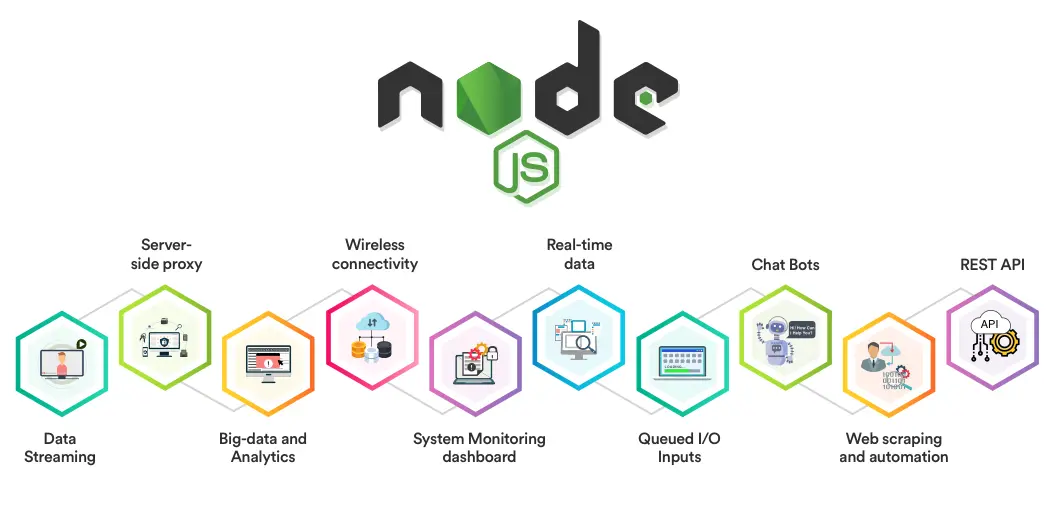
In which areas is the node used?

Node can be used in a variety of applications, including:
- Web applications
- Real-time applications (e.g. chat, gaming, live updates)
- Internet of things (IoT) applications
- Network tools and utilities
- Command line tools and scripts
- Microservices and serverless architecture
- Cross-platform desktop applications using Electron
- Backend development for mobile applications.
Node's versatility makes it a popular choice for developers and companies looking to build scalable, fast, and efficient applications.
Advantages and disadvantages of using nodes
Advantages of using Node:
-
Fast performance: Node uses non-blocking I/O and an event-driven model, which makes it fast for data-intensive real-time applications.
-
Full-stack JavaScript: Node allows developers to use JavaScript on both the frontend and backend, making it easier to build and maintain full-stack applications.
-
Large and active community: Node has a large and active community, which provides a wealth of resources, libraries, and tools for developers.
-
Scalability: Node's architecture makes it easy to scale applications horizontally by adding more nodes to the network.
Disadvantages of using Node:
-
Callback Hell: Due to its asynchronous nature, Node code can become difficult to read and maintain if callbacks are not managed properly.
-
Limited threading: Node uses a single thread and does not support multi-threading, which can limit its performance on CPU-bound tasks.
-
Package maintenance: Since Node has a large number of packages and dependencies, managing and updating packages can become challenging.
-
Security: As with any software platform, Node is vulnerable to security risks, and it is important to follow best practices and stay up-to-date with security updates.
Is node usage related to blockchain?
Node is not inherently related to blockchain technology. However, Node is often used in the development of blockchain applications due to its fast performance, scalability, and support for real-time data-intensive applications. Many blockchain platforms, such as Ethereum, provide JavaScript libraries and tools for developing decentralized applications (dApps) using Node.
Node can be used to build the backend of a blockchain application, which handles the storage and processing of blockchain transactions. The combination of Node and blockchain technologies provides a powerful toolset for building secure, decentralized applications that can run across a distributed network.






