
With Donald Trump's four-year term as President of the United States coming to a close, we can take a look back at his administration's actions in regard to the cryptocurrency community and blockchain technology, and look forward to the future.
Go After Bitcoin
Treasury Secretary Steven Mnuchin, around the time investors were cheering a 33% rise in price against the U.S. dollar, is said to have had a tense conversation with President Trump in May 2018 regarding trade negotiations with China. During the encounter, Trump was insistent that Mnuchin not be a trade negotiator focusing on tarrifs and sanctions, but instead to "go after bitcoin" for fraud.
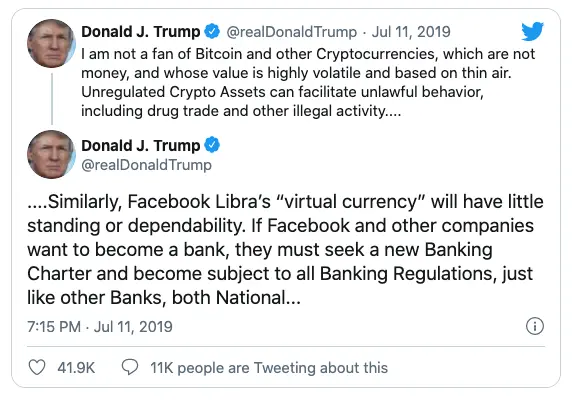
Trump wants to maintain the U.S. dollar hegemony, and he correctly feels that Bitcoin is a threat to that dominance. However, as with his stance on climate tech, Trump appears to want to simply pretend that it doesn't exist, or that it doesn't matter.
Glen Goodman, a financial author and trading veteran who made a name for himself by successfully navigating stock markets during the 2008 global financial crisis, writes, "After several years of development, China is now within spitting distance of achieving a fully operational digital yuan. Meanwhile, America doesn't even have a project in development. By the time the U.S. gets off the starting blocks, China may have already won the race." Donald Trump Could Be About To Lose U.S. Dollar Hegemony To China, Forbes
Cryptocurrency Enforcement Framework
U.S. Attorney General William Barr was appointed by President Trump to the position in February 2019 after previously having held it under George H. W. Bush from 1991 to 1993.
Produced by the AG’s Cyber-Digital Task Force, the [Cryptocurrency Enforcement] Framework provides law enforcement with what Barr terms a “comprehensive overview of the emerging threats and enforcement challenges associated with the increasing prevalence and use of cryptocurrency.” US Government Moves to Regulate Cryptocurrencies After Attorney General Publishes Enforcement Framework, Bitcoin.com
Some have criticized the framework, including a section labelling use of anonymizing currencies such as Monero, Zcash and Dash "to be a high-risk activity that is indicative of possible criminal conduct." While the section about illicit activity dwarfed in size the somewhat lacking explanation of the more legitimate majority of cryptocurrency uses, the framework did at least seem to nod in the direction of the inevitable mainstream adoption of digital currencies.
Surprise: DOJ Is Not a Big Fan of Privacy-Preserving Cryptocurrencies, James Madison Institute
Similarities And Differences
The two primary candidates this election cycle, Donald Trump and Joe Biden, have unsurprisingly not been very focused on cryptocurrency. Biden's campaign has made no statement on the matter, and Trump's rant can hardly be taken as an official stance.
Democrats these last four years have been more focused in the anti-trust suits against big tech, criticizing the power where it actually exists. Three of the Democrat stimulus bills which were not passed earlier this year did include references to a potential digital currency, which may be an indication that they will be a little more open to the idea of some kind of CBDC or other official interaction with the blockchain space. It is unlikely in either case that much will happen these next four years, however, as the coronavirus, climate, and other issues take the main stage.
Senate votes may make a bigger difference when it comes to cryptocurrency regulation. Democrats are currently favored to take the senate, which means the Senate Banking Committee will change heads. Sen. Sherrod Brown is expected to take the committee's reigns. He appears to be interested in looking into Blockchain technology more deeply, and he has talked about the concerns we mentioned of China getting ahead of the U.S. in the digital currency space.
‘At the height of this pandemic we must do more to protect the financial wellbeing of hardworking Americans and consumers. They are on the front lines of this crisis and are already feeling the effects of the economic fallout. My legislation would allow every American to set up a free bank account so they don’t have to rely on expensive check cashers to access their hard-earned money.’ - Sherrod Brown; Digital Dollar And Digital Wallet Bill Surfaces In The U.S. Senate, Forbes
Brown has also been blisteringly critical of Facebook's Libra project, calling the company dangerous and saying that Facebook "doesn't deserve our trust."
Conclusion
Is Bitcoin or cryptocurrency the most important thing happening in 2020? No, probably not. Will it dominate our lives anytime in the next four years? I doubt it. However, this election and the decisions and actions of governments will always have some impact. Laws will be written with implications in the crypto space which could go undiscovered for years. Government positions will be filled for terms anywhere from a couple of years to life, and these people will likewise have decisions to make in the future.
If you love the ideal of a currency free of these things, I think it's necessary for you to recognize we are not in that world yet. Your decisions are not free of impact to the wider world, and many things are yet to come in this great evolving technology.
Please leave a like and tip at the bottom of the page if you enjoyed this post! Follow me for more!






