The scientific name of the species, carduelis, is a tautonym, as it is a repetition of that of the genus: it became such when the species was segregated from the genus Fringilla to be moved into a genus in its own right. Carduelis was the name by which these birds were known in ancient Rome, deriving from the thistle plant, of which goldfinches are notoriously greedy.
It measures 10.5-13.5 cm in length, for 9.5-30 g of weight: the size of the goldfinches follows a growing trend in the SW-NE direction, from the small Macaronesian breeds to the large Siberian goldfinches.
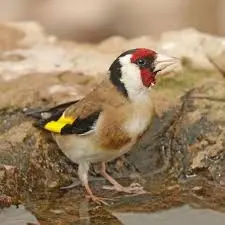
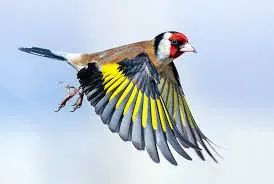
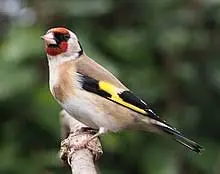
These are small birds with a rounded head, equipped with a conical and pointed beak, large eyes, pointed wings and a slightly forked tail. The livery is unmistakable. The goldfinches, in fact, have in both sexes the characteristic dark red facial mask, with a small blackish band that goes from the sides of the beak to the eye: the red mask is edged by a wide white band that covers the throat, ears. and forehead, in turn edged with black. Back, flanks and chest are of a warm brown color in the European populations and ash gray in many of the Asian ones: in the center of the chest there is a white circular spot, which joins below the white of the belly and of the undertail. White is also a crescent-shaped area between the nuchal black and the dorsal brown, as well as white are the rump, a circular spot on the tip of each of the flight feathers and the central part of the tip of the tail: the latter, as well as the wings. , is black, with the presence of a wide yellow wing band on the coverts.
Sexual dimorphism is present, although it is not very evident. The red mask in fact completely exceeds the eye in the male, especially on the eyebrow, while in the female the extension of the facial red hardly exceeds half of the eye: the colors of the male are also generally more accentuated than those of the female, in particular way on the nape and wings. Finally, males generally have a more slender appearance than females, who tend to be heavier at the same age. In both sexes, the beak is ivory with a blackish tip, the eyes are dark brown with a naked peri-ocular rim and a flesh-and-greyish color, and the legs are flesh-colored with dark and slightly curved nails.
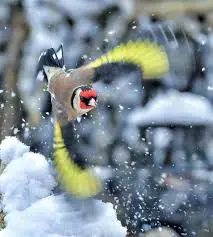
The goldfinch is a very lively and lively bird, with essentially diurnal habits, which spends most of the day looking for food, generally staying in tall grass or on the ground, and then returning in the evening towards predefined perches at the shelter in the branches of trees, where you can rest. Outside the mating season, goldfinches move in small flocks, which are kept in almost constant contact with each other by means of chirping calls, while during the mating season the couples tend to isolate and withdraw.
Goldfinches are mainly granivorous birds, whose diet consists mostly of the seeds of a large quantity of herbaceous plants: in addition to thistles, the predilection for which these animals have given both the common name and the scientific name, these birds they are also used to feed on seeds of sorrel, agrimony, chicory, dockyard, senecio, dandelion, barberry and sunflower, as well as the seeds of small-seeded tree plants, leaves, sprouts, berries and ripe fruit. Especially during the mating season, when the energy requirement is increased due to courtship and offspring breeding operations, goldfinches feed on insects and other small invertebrates, which are also supplied to the nestlings.
The breeding season runs from April to the end of August: during this period, 2 or 3 broods are carried forward, depending on the availability of food. Couples begin to form around February, with the two partners living in close contact until September and even after, generally joining the same flock: the males attract the females by singing at the top of their lungs with their beak open and the wings adhering to the body or with the tips. slightly pointing downwards, swaying the body to court them once they arrive. The females sway in turn to signal interest, crouching when the male approaches and moving the tail sideways to signal their readiness to mate, allowing him to mount them.
The nest has the shape of a cup and is built in about a week by the female alone, sometimes assisted by the male who finds part of the building material: it is generally located towards the final bifurcation of a tree branch, and is composed an external part of twigs and intertwined lichens and an internal part of vegetable fibers lined even more internally with down and fluff, all held together by cobwebs. Inside, 2-7 very light blue eggs are laid, with brown streaks of varying intensity particularly abundant on the obtuse pole. The eggs are hatched by the female only for about two weeks: during the hatching, the male stays near the nest, singing frequently, keeping an eye on the surroundings to chase away any intruders or identify the approach of any dangers and taking care of looking for the food for himself and his partner.
The pullets hatch blind and featherless. The parents take turns in parental care: while one stays at the nest, removing the droppings and keeping the brood warm and safe, the other goes in search of food, which he will use to feed his spouse and the young. In this way, the young goldfinches are ready for fledging around 13-18 days of life: however, they tend to stay still for about ten days at the nest, following their parents in their movements and asking them, although more and more sporadically, the cue. In this way, the young are weaned around the thirty-fifth day of hatching, when they are virtually independent and generally disperse. The life expectancy of the goldfinch in the wild is about 3-4 years, while in captivity these birds reach 10-12 years of age.
The goldfinch occupies a rather vast range with Palearctic diffusion, including the British Isles, most of continental Europe, Anatolia, the Levant, North Africa and a good part of the lower course of the Nile, as well as European Russia and western Siberia and central, Mesopotamia, Persia and Central Asia and the southern foothills of the Himalayas. The species was also successfully introduced during the 19th century to the Azores, Cape Verde, Bermuda, South Africa, the Falklands, in many areas of the United States, Canada, Mexico, vast areas of South America and in Oceania.
In Italy, the species is widespread and well represented throughout the national territory, resulting particularly widespread in Campania and Sardinia. Generally resident, especially the populations of goldfinch widespread in colder areas tend to make seasonal migrations, descending in altitude or going south during the cold periods. The goldfinch is very adaptable and can be observed in a great variety of habitats and at various latitudes, united by the presence of woods or thickets that are not excessively dense, open grassy or bushy areas and permanent sources of fresh water: it is therefore found in a wide range of environments ranging from Mediterranean scrub to taiga, cutting fields to pine forests, plantations and junipers, as well as in man-made areas, where it is seen in suburban planted areas, in rural areas and in abandoned fields with abundant weed growth.





