The gray heron (Ardea cinerea Linnaeus, 1758) is a bird belonging to the Ardeidae family. Native to the temperate regions of the Old World, as well as to Africa, it is the species of heron that goes further north, so much so that in summer it is easy to meet along the Norwegian coasts, well beyond the Arctic circle.

As an adult it reaches a stature of 90-98 centimeters and a weight between 1020 and 2073 grams. The wingspan can easily reach 1.70 meters. Its feathers are greyish in the upper part and white in the lower part. The legs and beak are yellow. The adult has black feathers on the neck and a very evident black nuchal tuft that departs from the posterior and upper crown of the eye. In young people the gray color predominates. There are no particular signs to distinguish females from males; males are usually a little older.

The gray heron feeds on fish, frogs, tadpoles, water snakes, crustaceans, molluscs, aquatic insects, small mammals and other birds. It is active both day and night, and it moves tens of kilometers from the nesting site or from the dormitory to feed.
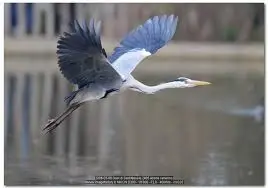
Populations of the Palearctic nest from January to March, while populations of tropical areas nest mainly during the rainy season. It nests in heronries, mixed colonies of different species of herons, which can host from a few to a thousand pairs. The nest is usually a platform of branches built high in the trees, although occasionally it can be built in a reed bed or on the ground. The eggs are 4-5 per nest and are hatched for about 25 days. The young are fed in the nest for about 50 days. It is estimated that 70% of them do not reach 6 months of life; however, once they have passed the sub-adult age, they can reach 24 years of life.
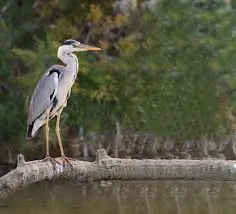
Some populations of gray heron, in particular the Eurasian ones, are migratory: between September and October they move towards the wintering areas, from where they return in February. It moves mainly at night, in groups that can reach a few hundred individuals. Other populations, on the other hand, are sedentary.
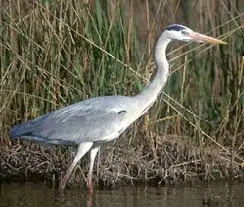
It is widespread in the temperate zones of the Old World, with the exception of the arctic zones and deserts. It lives in Europe, Africa and western Asia (A. c. Cinerea), eastern Asia (A. c. Firasa) and Madagascar (A. c. Jouyi). The estimated world population is a few million individuals. In Italy it nests in the Po Valley, in Tuscany and in Sicily. In the last decades in particular, there has been a notable increase in the population in Italy (as in the related species Ardea alba), so much so that various populations in the Po Valley and Tuscany have become resident. The gray heron can be found in many different habitats, with a preference for those rich in prey and with shallow waters. It is generally found in the plains, but occasionally it can push (and nest, in some parts of the world) even at more than 3000 m of altitude. It nests in heronries built in protected places, with trees and generally close to the water, even if we have seen heronries built in places far from water sources (a sign of a strong adaptation of the species in reclaimed areas and close to humans).





