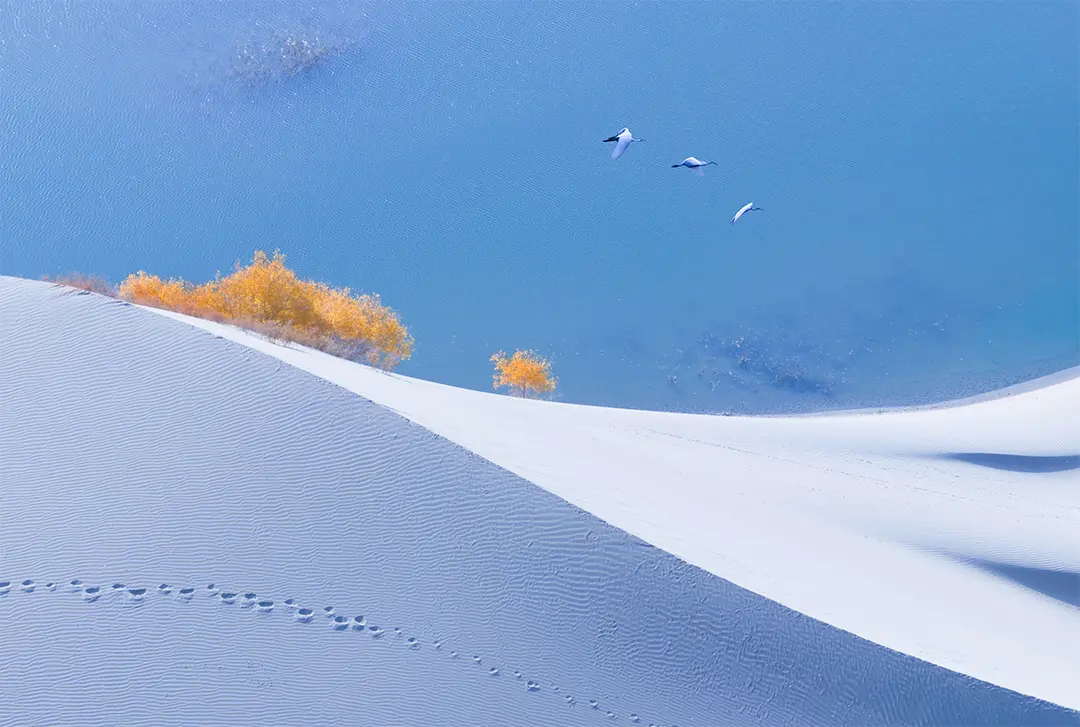
The footprints told a story before I ever understood what I was looking at.
Someone had walked this ridge where white sand curves like a frozen wave, separating two entirely different universes. On one side, the endless ripples of the desert stretched toward infinity—each grain of sand a tiny mirror reflecting the sky's impossible blue. On the other side, water so deep and still it looked like melted sapphire, holding secrets the desert would never know.
But what stopped me, what made me forget the heat on my neck and the weight of the camera in my hands, were the trees.
Golden-orange autumn trees, blazing with color, growing exactly where nothing should grow. One stood proud on the sandbar itself, roots somehow gripping that narrow strip of white earth between desert and water. Another, smaller but equally defiant, clung to the edge as if whispering: I am possible.
Three birds drifted overhead, their wings catching light as they glided between worlds. They didn't choose the desert or the water. They belonged to both, to neither, to the space in between.
I've spent years chasing photographs, trying to capture moments that matter. I've stood in forests where every tree looked identical, photographed oceans where each wave was the same as the last. But this—this collision of impossibilities—this was different.
Because here's what nobody tells you about the most beautiful things in life: they exist precisely where they shouldn't.
Think about it. That relationship that everyone said would fail. The career pivot that made no logical sense. The dream you pursued when every reasonable person told you to be practical. The moments when you felt most alive weren't when you played it safe in familiar territory. They were when you planted yourself, like those autumn trees, in the narrow space between what was and what could be.
The desert represents everything we know. It's safe, predictable, mapped. The patterns in the sand repeat like the routines we build, the comfortable paths we walk day after day. There's a certain peace in that—knowing where you stand, understanding the rules, seeing your footprints mark the path behind you.
The water represents everything we fear. Unknown depth, uncertain currents, the risk of being pulled under. It's vast and mysterious and absolutely necessary for life, yet we often keep our distance. We admire it from the shore but rarely dive in.
But look at where those trees are growing.
Not in the safe embrace of the desert. Not floating in the protection of the water. Right there, on that knife's edge between both worlds, exposed to every wind, every wave, every shift in fortune. That's where they've put down roots. That's where they're thriving.
And not just surviving—blazing with color.
When autumn comes to most trees, it's a gentle process. Surrounded by forests of their kind, they change together, supported by identical neighbors facing identical challenges. But these trees? They're turning gold and orange and fire-bright all alone, with nothing but sand beneath their roots and birds as their only witnesses.
That's not weakness. That's not isolation.
That's independence born from necessity. It's strength you don't know you have until you're the only tree on the ridge.
I followed those footprints with my eyes, watching how they curved along the sandbar, sometimes veering close to the water's edge, sometimes retreating toward the desert's safety. Whoever walked here before me didn't march in a straight line. They wandered. They explored. They probably stopped, just like I did, to marvel at the impossibility of autumn in a place where seasons shouldn't exist.
The birds circled again, their white wings stark against the blue. I wondered if they saw what I saw—the extraordinary ordinariness of it all. Because from up there, maybe this doesn't look miraculous. Maybe they see a thousand places where opposites meet, where life finds a way, where beauty insists on existing despite every logical reason it shouldn't.
Maybe we're the only ones who find it remarkable when trees grow in impossible places.
Or maybe that's exactly the point. Maybe we need to be reminded that the boundaries we see, the limitations we accept, the lines we refuse to cross—they're not as solid as we think. They're just sand and water, meeting at a place where something extraordinary has decided to bloom.
The wind picked up, sending small spirals of sand into the air. The trees didn't bend. They'd learned, somehow, to be flexible where they needed to be and unshakable where it mattered. The desert hadn't smothered them. The water hadn't drowned them. They'd taken what they needed from both worlds and ignored the rest.
I put my camera down for a moment, just to see it without the lens. Just to be present with this strange, beautiful collision of impossibilities. The footprints would fade with the next wind. The birds would fly on. The seasons would change, and these trees would transform again, as they always do.
But this moment, this perfect balance between desert and water, between what is and what could be, between safety and risk—this would remain.
Not in the photograph I'd take, but in the understanding that came with standing there, watching autumn trees refuse to apologize for existing in a place where autumn trees don't belong.
Because maybe that's what we're all doing, in our own way. Growing where we're not supposed to grow. Blooming in colors that don't match the landscape. Putting down roots in the narrow space between the familiar and the unknown, between who we were and who we're becoming.
And maybe, just maybe, that's not just okay.
Maybe that's exactly where we're meant to be.
The birds called out, their voices carrying across both worlds—desert and water, sand and sky, the known and the mysterious. The trees stood silent, their leaves catching the light like tiny flames, teaching the only lesson that matters:
Beauty doesn't ask for permission. It doesn't wait for the right conditions. It doesn't apologize for existing in impossible places.
It simply grows, blazes, and becomes.
And so can we.






