
There are moments in life when time seems to pause. Not because the world stops turning, but because something before us commands our full attention—a sight so pure, so unfiltered, that it cuts through the noise of our cluttered minds and speaks directly to something deeper within us.
This is what happened when I first witnessed the white horse.
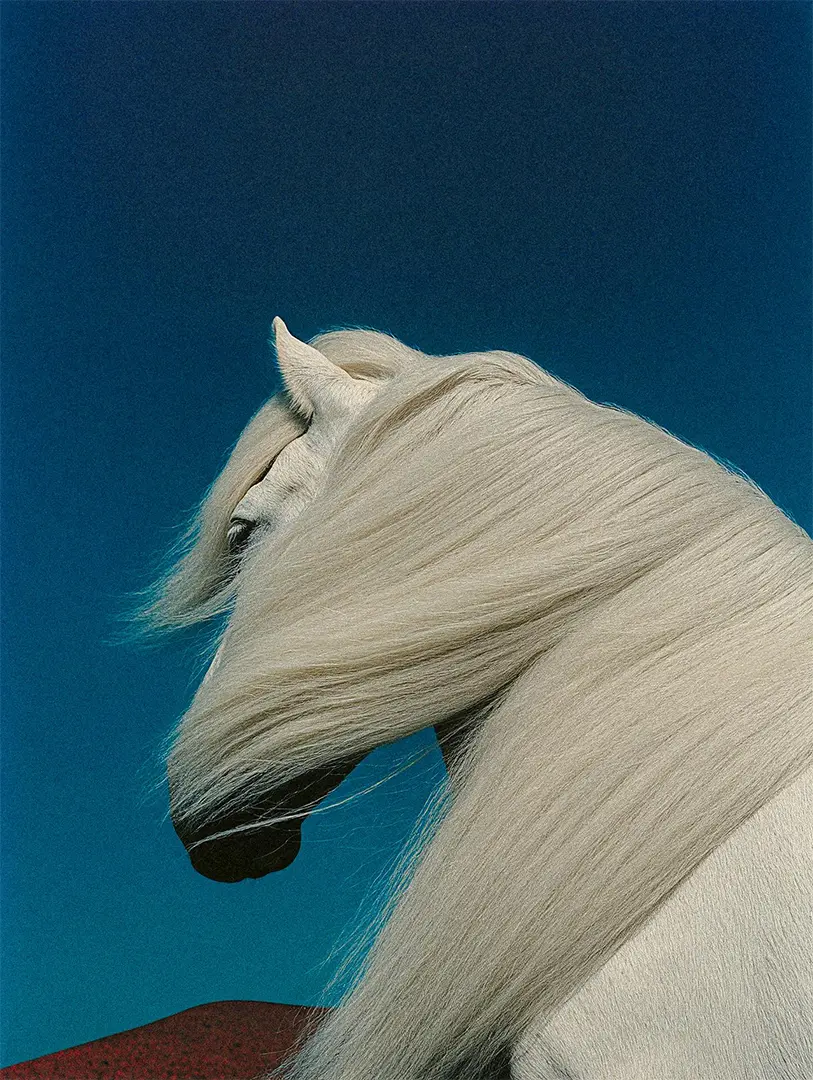
Against a canvas of deep indigo, the kind of blue that exists in that sacred hour between day and night, stood a creature of impossible elegance. Its mane, silver-white like fresh mountain snow, cascaded in waves that seemed to hold their own rhythm, their own music. Each strand moved as though conducted by an invisible maestro, flowing with a grace that defied the chaos we often associate with wind.
But it wasn't just the physical beauty that arrested my gaze. It was something else—something I couldn't name at first but felt in the marrow of my bones. The horse wasn't merely standing there; it was present. Fully, completely, unapologetically present. Its head held high, not in arrogance, but in quiet dignity. Its eye, though barely visible in the profile, held a depth that seemed to understand things we humans spend lifetimes trying to articulate.
I have often wondered why certain images stay with us. Why some moments etch themselves into our memory while thousands of others fade like morning mist. Perhaps it's because they show us something we've forgotten—something we once knew but buried under layers of compromise, fear, and the relentless pursuit of what we think we need.
The white horse reminded me of freedom. Not the freedom we talk about in abstract terms, not the freedom we claim to cherish while living in self-imposed cages of our own design. Real freedom. The kind that comes from knowing exactly who you are and refusing to apologize for it. The kind that allows you to stand tall even when storms gather on the horizon.
There's a particular vulnerability in being so fully yourself. In a world that constantly whispers—sometimes screams—that we should be smaller, quieter, more convenient for others, there's rebellion in presence. The horse doesn't try to hide its magnificence. It doesn't dim its white coat to blend with shadows. It doesn't cut its mane to appear more manageable. It simply is.
And in that simple act of being, it teaches us something profound.
I think about the wind in this image—the invisible force that gives movement to the mane, that transforms stillness into art. We cannot see the wind itself, but we witness its presence through what it touches. Isn't this how we experience so much of what matters in life? We cannot see love, but we feel its warmth. We cannot see courage, but we recognize its footprints. We cannot see faith, but we sense its quiet strength in the darkest hours.
The wind knows the horse's name. It knows the texture of each strand of hair, the curve of the neck, the strength held in elegant restraint. And the horse trusts the wind—allows it to play, to reshape, to reveal beauty that might otherwise remain hidden.
When was the last time you stood like that? When did you last allow yourself to be fully seen, mane flowing, head held high, unafraid of the wind that might tangle what you've carefully arranged? When did you last trust that the very thing that seems to disturb your peace might actually be revealing your true beauty?
We spend so much energy trying to control how others perceive us. We arrange ourselves, edit ourselves, present carefully curated versions of who we are. We become so practiced at this that we sometimes forget what lies beneath—the wild, untamed truth of our authentic selves.
The white horse stands as a reminder that there is profound strength in authenticity. Not the Instagram version of authenticity where we carefully photograph our "raw moments," but the real thing—the willingness to exist fully in your truth, regardless of who's watching or what they might think.
I notice, too, the darkness at the base of the image—the shadowed portion that grounds this ethereal creature. It's a reminder that beauty doesn't exist in the absence of darkness. Purity doesn't mean the erasure of shadow. The white horse is radiant precisely because it emerges from, stands against, and is defined by the depths behind it.
This is perhaps one of life's great paradoxes: we cannot appreciate light without darkness, cannot understand joy without sorrow, cannot grasp freedom without first knowing constraint. The contrast doesn't diminish the beauty; it amplifies it. It gives it context, meaning, depth.
In many traditions, horses symbolize power, nobility, and the untamed spirit. They are creatures of both earth and wind, grounded yet capable of flight, strong yet graceful. They carry us forward but never forget their own nature. They serve but remain sovereign.
The white horse, in particular, often represents purity of purpose, clarity of intention, and the courage to journey into unknown territories. It is the companion of those who dare, the mount of those who refuse to settle for safety when adventure calls.
But what does it mean to ride such a horse? To harness such freedom without breaking it? To partner with such power without dominating it? Perhaps this is the question the image poses to us—not how to control life's wild beauty, but how to move with it, to dance with it, to trust it enough to see where it might take us.
I wonder if we've forgotten how to do this. In our quest for security, we've built walls that keep out not just danger but also possibility. In our pursuit of comfort, we've padded our lives so thoroughly that we can no longer feel the texture of genuine experience. We've confused living with existing, motion with progress, noise with meaning.
The white horse doesn't make this mistake. It exists fully in each moment—not dwelling in what was, not anxious about what might be, but present in the magnificent now. Its mane flows because the wind blows, and the wind blows because that's what wind does. There's no resistance, no complaint, no attempt to make reality conform to preference. There's only the elegant dance between what is and what responds.
This is wisdom we desperately need. In an age of constant disruption, where change arrives faster than our ability to process it, where the future feels increasingly uncertain, we need to remember how to stand with grace in the wind. We need to recall that our strength doesn't come from rigid resistance but from flexible presence.
Think about trees in a storm. The ones that break are those that try to resist the wind completely, that refuse to bend. The ones that survive are those that move with the storm, that yield without breaking, that understand the difference between strength and rigidity.
The white horse knows this. Its mane doesn't fight the wind; it dances with it. And in that dance, it creates something more beautiful than stillness alone could ever be.
As I sit with this image, I realize it's asking something of me. It's asking if I'm willing to be that present, that authentic, that free. It's asking if I have the courage to let my own mane flow, to stand tall in my truth, to trust that the wind that seems to disturb me might actually be revealing my deepest beauty.
It's asking if I'm ready to stop performing and start being.
This is not an easy question. Because being fully ourselves—really, truly ourselves—means accepting that some people won't understand. It means acknowledging that the world might not always celebrate our particular beauty. It means risking judgment, criticism, and the pain of being misunderstood.
But what's the alternative? To live a carefully controlled life, mane forever smoothed down, head slightly bowed, presence dimmed just enough to make others comfortable? To spend our days managing others' perceptions instead of living our truth?
The white horse offers a different way. It shows us that there's nobility in being fully who you are. That there's power in presence. That there's beauty in authenticity so pure it needs no explanation or apology.
I think about all the roles we play, the masks we wear, the versions of ourselves we present to different audiences. And I think about how exhausting it is—this constant shape-shifting, this endless performance, this perpetual audition for approval we're not even sure we want.
What if we simply stood? What if we let the wind blow as it will, let our mane flow as it must, let our presence speak for itself? What if we trusted that the people meant to see us, really see us, would recognize something true and be drawn to it?
This doesn't mean being harsh or inconsiderate. The white horse isn't aggressive; it's simply itself. There's a difference between authentic presence and forceful imposition. One comes from a place of inner peace, the other from a place of insecurity. One invites, the other demands. One allows freedom for others, the other requires conformity.
The wisdom here is subtle but crucial: being fully yourself doesn't require anyone else to change. Your light doesn't diminish anyone else's. Your freedom doesn't restrict another's. Your authentic presence actually gives others permission to be authentic too.
This is the gift the white horse gives us—not just in what it is, but in what it allows us to consider for ourselves. It stands as a possibility, an invitation, a reminder of what we might be if we were brave enough to shed what we're not.
And perhaps that's the journey we're all on, whether we realize it or not. The journey from who we think we should be to who we actually are. The journey from performance to presence. The journey from fear to freedom.
It's not always an easy journey. There are storms to weather, winds that seem too strong, moments when staying small and safe feels infinitely more appealing than standing tall and exposed. But those are precisely the moments when we need to remember the white horse—standing graceful and strong against the deep blue, mane flowing, wholly and completely itself.
There's something sacred about this kind of presence. It honors the gift of life by living it fully. It respects the one who created us by being exactly what we were created to be. It acknowledges that each of us carries a unique beauty that the world needs, even if—especially if—it's different from everyone else's.
In the end, the white horse teaches us that freedom isn't something we achieve; it's something we remember. It's not a destination we reach but a reality we return to—the reality of our truest self, unburdened by others' expectations, undiminished by fear, unashamed of our particular glory.
The wind will blow. That's certain. The only question is whether we'll let it reveal us or spend our energy fighting to keep everything in place. Whether we'll trust that there's beauty in the flow or insist that safety lies only in stillness.
Look at the horse once more. See how magnificent it is—not despite the wind, but because of it. See how the movement brings it to life, how the flowing mane transforms a beautiful creature into a breathtaking vision.
This is what waits for each of us: the chance to be brought fully to life, to be transformed from merely beautiful to truly breathtaking, to discover that what we feared would undo us actually reveals our deepest glory.
All it requires is the courage to stand in the wind, to let it know our name, to trust that in the flowing and the movement and the glorious mess of being fully alive, we will find not chaos but our truest selves.
The white horse stands waiting, patient and knowing, inviting us to remember what we've forgotten: that we, too, were meant to be magnificent. That we, too, carry a beauty worth revealing. That we, too, can stand tall and free and wholly ourselves, letting the wind play with our mane while we remain grounded in the truth of who we are.
The only question that remains is this: Are you ready?






