
The Dance That Never Stops
There's something profoundly human about watching particles scatter into darkness. Not because we understand physics, but because we recognize ourselves in that dispersion—in that brief, brilliant moment when everything we are becomes visible before dissolving back into the void.
I've spent countless evenings thinking about movement. Not the kind you plan or choreograph, but the involuntary rhythms that pulse through us when life demands we either break or bend. The heartbeat that quickens before a difficult conversation. The tremor in your hands when you hold something precious. The way your breath catches when you realize a chapter of your life has ended.
This is what strikes me about the image before us: a dancer suspended mid-flight, surrounded by clouds of dust that catch the light like a thousand tiny stars. But this isn't just about dance. It's about the dust itself—those fragments that were settled, dormant, invisible until movement gave them life.
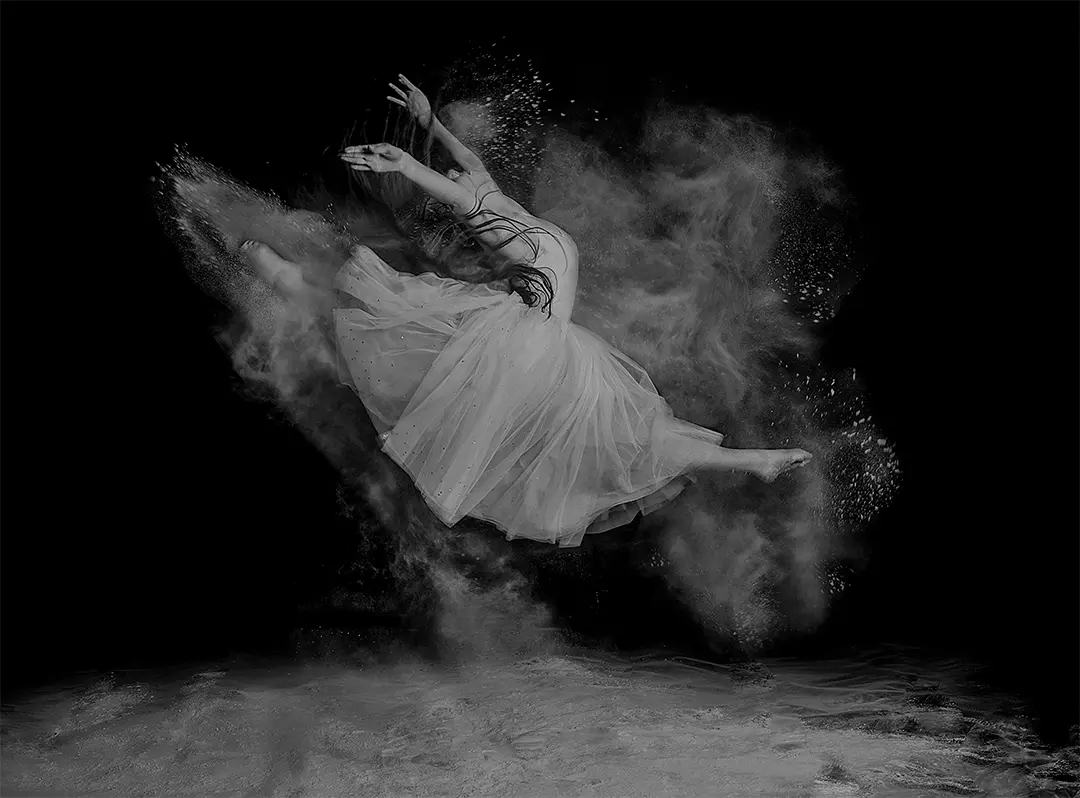
We are, all of us, kicking up dust as we move through life. Every step we take disturbs something that was still. Every choice scatters particles that may never settle the same way again. And here's what most people miss: the beauty isn't in the landing. It's in the chaos we create in between.
The Weight of Stillness
Before the leap comes the waiting. Before the explosion of motion, there's compression—muscles coiled, breath held, mind sharpened to a single point of intention. We don't talk enough about this part. The before.
I remember sitting in my childhood room during a particularly difficult summer, watching dust motes drift through a shaft of sunlight. They moved so slowly, so aimlessly, settling on surfaces that would remain undisturbed for weeks. It felt like watching time die. Everything was so still that even breathing seemed like a disruption.
That's what happens when we stop moving, when fear or exhaustion or disappointment pins us down. The dust settles. We become invisible. Safe, perhaps, but invisible.
The dancer in this frame understood something crucial: stillness is not peace. Sometimes stillness is surrender. Sometimes the only way to know you're alive is to leap into the chaos and see what scatters.
The Courage to Disrupt
There's a strange courage required to disturb your own peace. To take what's settled—your routine, your comfort, your carefully constructed version of who you're supposed to be—and shatter it into a million particles just to see if you're capable of something more.
I've watched people do this. Not dancers, necessarily, but ordinary people making extraordinary decisions. The woman who leaves a career she mastered because she feels called to something she doesn't yet understand. The young man who admits he's been living someone else's dream and starts the painful work of discovering his own. The parent who confesses they don't have all the answers and begins learning alongside their children.
These are all leaps. These are all moments of suspension where the ground is gone and the landing is uncertain, but the air itself becomes charged with possibility.
What the photograph captures—what all great art captures—is that instant of transformation. Not the before or after, but the during. The millisecond when you're neither who you were nor who you'll become, but something fluid and unfinished and achingly alive.
Light in the Fragments
Here's what fascinates me most: the dust only becomes visible in the light. In darkness, the dancer could spin forever, scattering particles that no one would ever see. But introduce light, and suddenly the invisible has texture and weight. The chaos has beauty.
This, I think, is why we create. Why we paint and write and dance and build. Not to add more things to the world, but to illuminate what was always there—the hidden patterns, the overlooked beauty, the quiet violence of simply existing.
Every human life is a disturbance. We're all displacing something. The question isn't whether we'll create chaos—we will, simply by being here—but whether we'll do it in the light. Whether we'll own the mess we make. Whether we'll have the courage to look at the particles we scatter and call them beautiful.
The Mathematics of Falling
Let me tell you something about gravity: it doesn't care about your technique. It doesn't applaud elegant form or forgive awkward landings. What goes up comes down, whether you're ready or not.
But here's the secret every dancer knows: falling is just flying with a deadline.
The body in flight follows laws that feel almost spiritual in their precision. Momentum, arc, the inevitable pull earthward. But between the launch and the landing, there's this space—this brief rebellion against the fundamental forces of the universe—where something impossible happens. Where a human being defies what bones and blood should reasonably allow.
We spend so much time preparing for landings. Making plans, building safety nets, ensuring we have somewhere soft to come down. But what if the point isn't the landing at all? What if the point is that moment of suspension, that split second when you're weightless and the rules have temporarily released you?
I'm not suggesting we live recklessly. I'm suggesting we live consciously. That we recognize the difference between a leap and a fall. One is intentional; the other is what happens when you stop choosing.
The Audience We Never See
Every performance has witnesses, even if they're not in the room. Even if they won't arrive until years after the dust has settled and been swept away and replaced by new dust that will scatter for new reasons.
This is the strange mathematics of influence: you never know which moment will matter. Which leap will inspire someone else to try. Which scattering of dust will catch the light in exactly the way someone else needed to see.
I think about this often—the invisible audience of our lives. The people who will never know they were watching, who will never realize they were changed by witnessing your refusal to stay still. Your insistence on movement, even when movement meant risking everything you'd carefully arranged.
The dancer doesn't know who will see this image. Doesn't know whose breath will catch at the sight of suspended motion. Doesn't know who will look at the chaos of scattered particles and think, "Yes. That's what I need to do. I need to leap."
That's the gift of art that captures truth: it gives permission. It says, "This is possible. This is allowed. You are allowed."
The Sound of Landing
Eventually, inevitably, we come down. The leap ends. The dust settles. The moment passes and becomes memory, and we're left standing on ground that feels both familiar and forever changed.
This is the part no one photographs. The after. When your chest is heaving and your muscles are screaming and you're suddenly aware of how much effort it took to create that single moment of grace. When you look around at the settling particles and wonder if anyone saw, if it mattered, if you can do it again.
Here's what I've learned: the landing is never the point. The landing is just the permission to leap again.
Every person I've known who lived a life worth telling stories about understood this. They didn't wait for perfect conditions or guaranteed outcomes. They didn't need certainty about where they'd land. They just needed to know that staying still would cost them something they weren't willing to pay: the chance to see what they were made of when the ground disappeared.
Dust to Dust
There's an ancient phrase that reminds us we're made of elements that will return to elements. Dust to dust. It sounds morbid until you understand it properly. Until you realize it's not about death—it's about transformation. About the constant cycling of matter and energy, the way nothing ever really ends, it just changes form.
The dust in this photograph was once something else. Will be something else again. Right now, in this frozen instant, it's catching light and creating beauty. Tomorrow it will settle, be swept away, become invisible again. But the image remains. The proof that for one moment, stillness was disturbed and something remarkable happened.
This is what we all are: temporary arrangements of borrowed atoms, catching light for a brief time before returning to the darkness from which we came. The tragedy isn't that this is true. The tragedy is living as if it's not—as if we have infinite time to decide when we'll finally leap, when we'll finally disturb the careful order of our lives and see what scatters.
The Invitation
So here we are, at the end of this meditation, and I want to ask you something: What dust are you leaving settled? What leap are you postponing? What version of yourself exists only in that moment of suspension, waiting for you to have the courage to jump?
I'm not telling you to be reckless. I'm not suggesting you abandon reason or ignore consequences. I'm saying that there's a kind of living that's really just a slow death—a preservation of what is at the cost of what could be. And every day you choose safety over truth, you're choosing a life that will never need a photograph, because nothing worth capturing will ever happen.
The dancer in this image didn't know if the light would hit right. Didn't know if the dust would scatter beautifully. Didn't even know if there would be someone there to witness it. The leap happened anyway. The risk was taken. The dust was disturbed.
And now, years or moments later, we're looking at the result. We're seeing what's possible when you stop protecting the stillness and start creating the chaos that reveals who you really are.
That's the lesson hidden in these swirling particles, in this suspended body, in this captured instant of transformation: Beauty doesn't come from staying perfectly still. It comes from having the courage to move, even when you can't see where you'll land. Especially then.
The dust will settle eventually. It always does. But first, it gets to catch the light. First, it gets to be seen. First, it gets to be part of something beautiful and brief and utterly unrepeatable.
Just like you. Just like me. Just like this single, sacred moment we call a life.
So leap. Scatter. Catch the light while you can.
The landing will take care of itself.






