There's a peculiar magic that descends upon a city when rain begins to fall. The concrete jungle transforms—its harsh edges softened, its bright lights diffused into something gentler, almost tender. In these moments, between the first drop and the last, the urban landscape becomes a canvas where human stories are written in reflections and shadows.
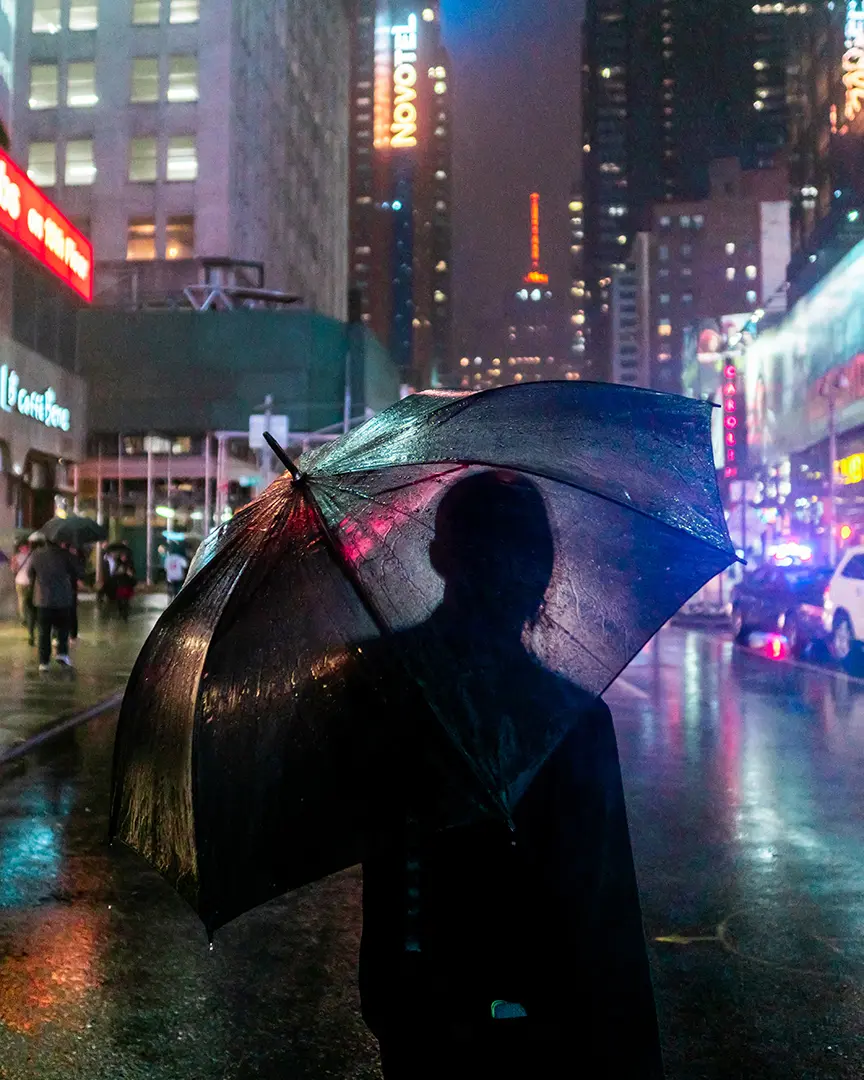
Stand here for a moment. Let the scene unfold before you.
A solitary figure holds an umbrella against the evening rain, its surface catching the city's neon glow like a prism separating light into possibility. The umbrella becomes more than shelter—it becomes a world unto itself, a small dome of personal space in the vast openness of urban anonymity. Behind this silent guardian, the city pulses: taxis blur past, their red taillights bleeding into the wet pavement; towers rise like sentinels, their windows glowing with a thousand untold stories.
This is not loneliness. This is solitude—a distinction as subtle and profound as the difference between silence and quiet.
In our hyperconnected age, we've forgotten the value of standing still while the world rushes past. We've lost the art of being alone without feeling lonely. Yet here, in this rain-drenched moment, there's a lesson waiting to be learned: sometimes the greatest clarity comes not from the noise of connection, but from the whisper of introspection.
The rain doesn't discriminate. It falls on the tourist and the local, the businessman and the artist, the lost and the found. It creates a temporary democracy of dampness, reminding us that beneath our different umbrellas and varied destinations, we're all walking the same wet streets, seeking the same dry havens.
Notice the colors. The way neon signs—those modern hieroglyphs—turn raindrops into tiny lanterns. Red bleeds into blue; yellow dances with green. The city, usually so defined by its stark contrasts and sharp boundaries, becomes fluid. Everything melts into everything else, creating a world where edges blur and possibilities expand.
This is where art lives—in the spaces between what is and what could be.
I've spent countless evenings chasing these moments with my camera, seeking not just images but truths. Each photograph is a question posed to the viewer: What do you see when you look beyond the obvious? When you strip away the rush and the routine, what remains?
The umbrella-holder doesn't turn toward us. They don't need to. Their story isn't in their face but in their posture—the slight hunch of shoulders accepting the rain's inevitability, the steady grip suggesting neither resistance nor surrender, just acceptance. There's grace in this acceptance, a quiet dignity in continuing forward despite the downpour.
In many ways, isn't this the human condition? We can't control the weather—literal or metaphorical—but we can choose how we stand within it. We can rail against the storm or we can find beauty in its cleansing. We can curse the disruption or we can marvel at how it transforms the ordinary into the extraordinary.
The city teaches us this, if we're willing to learn. Every rain-slicked street is a mirror reflecting not just light but truth. Every puddle holds an inverted sky, reminding us that perspective is everything. What seems like chaos from one angle becomes poetry from another.
There's a photographer's adage: "Bad weather makes good pictures." But I'd argue it goes deeper than aesthetics. Difficult conditions—whether in photography or in life—force us to see differently, to work harder, to find meaning in circumstances that seem inhospitable to it.
When I captured this moment, I wasn't just documenting a person in the rain. I was witnessing resilience. I was seeing beauty choose to exist despite difficulty. The neon lights don't shine less brightly because of the rain; if anything, the moisture in the air amplifies their glow, spreads their radiance further.
Perhaps this is the greatest lesson: our light shines brightest not in perfect conditions, but when conditions challenge us to keep glowing anyway.
The modern city can feel overwhelming. Millions of souls navigating the same grid, yet each profoundly alone in their journey. We pass thousands of people daily, yet rarely truly see them. The umbrella becomes a symbol of this—a necessary barrier, a protective shell, but also a divider. It keeps us dry but keeps others out.
Yet there's comfort here too. In knowing that we're not the only ones seeking shelter. That every umbrella in the street represents another person making their way through the storm. We're alone together, separate yet united by shared experience.
This duality—isolation and connection, loneliness and independence—defines urban existence. The city gives us anonymity when we need it and community when we seek it. It's a place where you can disappear into the crowd or stand out in the spotlight, sometimes both in the same evening.
As artists, we're observers of these contradictions. We stand in the rain not despite the discomfort but because of what the discomfort reveals. When conditions are easy, people wear masks of convenience. When the rain falls, those masks slip. What remains is more honest, more raw, more real.
The technical challenges of shooting in rain—the droplets on the lens, the difficult lighting, the unpredictability—mirror life's challenges. Nothing goes exactly as planned. The image you envisioned becomes something else entirely. And sometimes, that something else is better than what you imagined.
This is where creativity lives—in the space between intention and accident, between control and surrender. The best art, like the best moments, can't be forced. They emerge when we're open to possibility, when we're willing to stand in the rain and see what the storm brings.
As I look at this image now, I see more than I saw when I took it. Time has added layers of meaning. The umbrella holder has become every person who's ever felt alone in a crowd. The neon lights have become every hope that refuses to dim. The rain has become every challenge that makes us question whether to keep going.
And the answer, always, is yes. Keep going.
Because on the other side of the rain is a clearer sky. And even if the clouds return tomorrow—and they will—you'll know you've walked through storms before. You'll know that rain doesn't last forever, but the strength you gain from walking through it does.
The city will still be there, with its towers and taxis, its neon and noise. The streets will dry, and the umbrellas will fold away until next time. But something will have changed—not in the city, but in you. You'll have learned to find beauty in difficulty, poetry in chaos, grace in simply continuing forward.
This is what these urban moments offer us: not escape from reality, but deeper immersion in it. Not fantasy, but truth rendered visible through rain and reflection. Not answers, but better questions about how we choose to exist in spaces that can feel alternately magnificent and overwhelming.
So the next time rain catches you in the city, pause. Don't rush immediately to shelter. Stand for a moment under your umbrella—your small dome of possibility—and look around. See the colors bloom in the wetness. Watch the reflections multiply reality. Feel the weight of your solitude and the comfort of shared experience.
You're alone, yes. But you're alive. And in a city of millions, in a world of billions, you're choosing to be present in this moment, this place, this particular falling of rain.
There's profound courage in that choice. There's beauty in that presence.
And there, in the space between the raindrops, in the glow of neon reflected in puddles, in the steady grip on an umbrella handle—there, you'll find the quiet magnificence of simply being human in an urban world.
The city weeps. We stand. The lights glow on.
And that, perhaps, is enough.
Photography and Digital Art by DaveKruguman
This essay explores urban solitude through the lens of rain-soaked city streets, examining how weather transforms our relationship with public space and how moments of isolation can become opportunities for reflection and growth.






