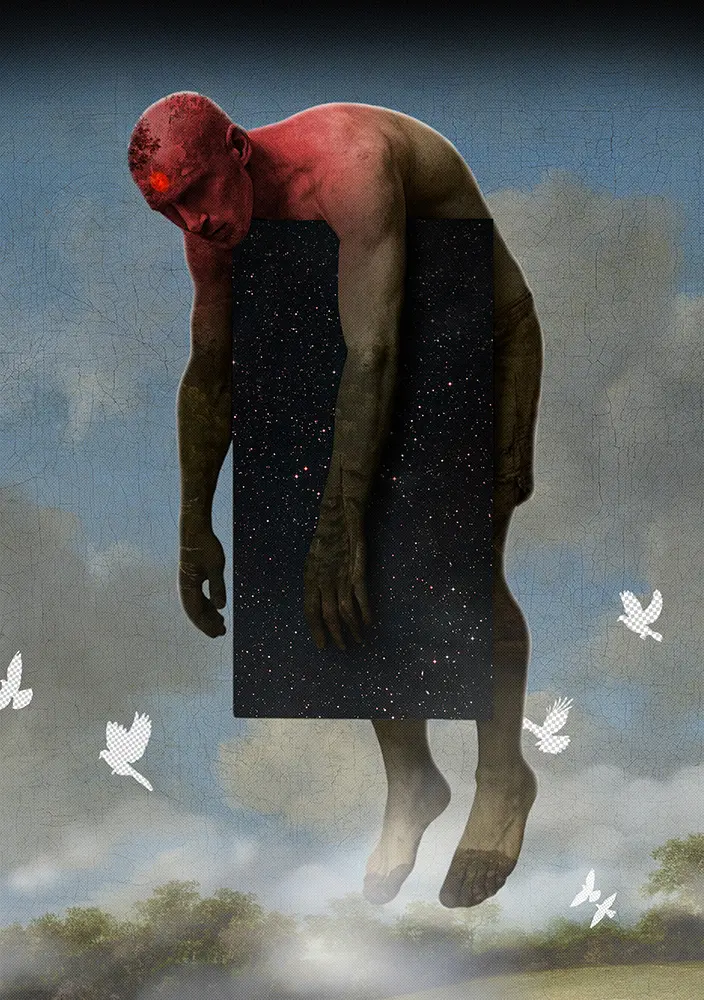
The man had forgotten how to look up.
Thirty-seven years Marcus had walked this earth with his eyes trained on pavement cracks, on scuffed shoe leather, on the gray accumulation of ordinary days. His life moved in spreadsheets now—columns of numbers marching left to right in a fluorescent-lit office where even the air tasted recycled. He shepherded figures into their proper places with the resigned patience of someone who'd stopped asking why any of it mattered.
His routines were small and certain: the 7:15 train that smelled of coffee and defeat, the corner shop with its burnt beans and cheerful lies about "fresh" pastries, the careful nods exchanged with colleagues whose names blurred together into a single forgettable syllable. There was safety in this narrowness, he'd told himself. Comfort in keeping expectations modest and eyes down.
Then the doctor said six months.
"Perhaps less," he added, his voice carrying that particular gentleness reserved for the condemned.
Marcus nodded. Thanked him, even. Then walked out into a world he'd been sleepwalking through for decades. His feet carried him through familiar streets, but everything looked different now—sharper, somehow, as though someone had adjusted the focus on a lens he hadn't known was blurred.
For the first time in years, he looked up.
The sky was putting on a performance. Amber bled into violet, clouds caught fire at their edges, and the dying light turned the river into molten gold. Marcus stood on a bridge he'd crossed a thousand times without seeing, and something inside him cracked wide open.
He stopped going to work. Let the numbers find their own way home, wherever that was. Instead, he began to walk—not toward anything in particular, but with the aimless wonder of a child who's just discovered the world extends beyond their backyard fence. He walked through parks where children played games with rules that changed every five minutes. He walked past street musicians whose melodies seemed to contain every human feeling ever felt. He walked until his feet blistered and then kept walking, because stopping felt like returning to sleep.
And the strangest thing began to happen.
The more he looked—really looked—at the world, the heavier he became. Not his body, exactly, but something else. Something he'd been starving without realizing it. Each sunset witnessed, each small kindness observed between strangers, each moment of startling beauty seemed to add weight to a part of him that had been hollow for so long he'd mistaken the emptiness for normal.
His chest felt full now. Uncomfortably full, like he'd swallowed stars.
One morning he woke to find he couldn't touch the floor.
His body remained solid—he could see his own hands when he held them up, could feel his heart beating—but gravity had apparently lost interest. He floated six inches above his bed, arms trailing like afterthoughts. When he drifted to the window and looked down at the city spreading itself across the horizon, he felt a peculiar doubling, as though he were simultaneously here and everywhere.
That's when he saw it: the opening in his chest.
Where his heart should have been—or maybe where it had always been, just hidden—there was a window into somewhere else. Through his own skin he could see galaxies wheeling, ancient stars burning themselves to nothing, the infinite dark between worlds. The universe had found a way inside him. Or perhaps he'd finally found his way inside the universe.
He should have been terrified. Should have called someone, or screamed, or questioned his sanity. Instead, he felt only a strange recognition, like remembering a dream from childhood that had been trying to tell him something important.
Marcus floated out onto his balcony, then higher, above the rooftops and their satellite dishes, above the reaching fingers of buildings that had always seemed so permanent and now looked fragile as matchsticks. The city spread below him like a constellation, each window a small sun burning against the dark. And he understood then—understood in his bones—that this had always been there. This vastness. This staggering, incomprehensible beauty. Hidden beneath fluorescent hums and train schedules and the careful art of keeping one's head down.
Birds began to circle him. White as prayers, as hope, as all the things he'd stopped believing in. They weren't surprised to find a man floating in their territory. Perhaps they'd always known about the universe inside human chests. Perhaps they'd been waiting for someone to finally acknowledge it.
Below him, the world continued spinning its stories. People rushed to appointments, checked their phones with the urgency of bomb disposal, worried about mortgages and whether they'd locked the door. And Marcus, suspended between earth and sky, felt an overwhelming tenderness for all of them—for the brave, foolish way they carried their own cosmos while pretending to be nothing more than flesh and blood and tax returns.
He thought about his years in the office. All that careful pruning, cutting his life down to manageable dimensions. How desperately he'd tried to make himself small, as though smallness could keep him safe from heartbreak or disappointment or the terrible responsibility of being alive in a world this beautiful.
He'd been afraid of this. This bigness. This breaking open. This unbearable intimacy with the infinite.
But fear seemed beside the point now, floating here with the clouds and the birds and the impossible weight of stars pressing against his ribs.
A woman stepped onto a rooftop below. She looked up, and their eyes met across the distance. She didn't scream. Didn't grab her phone to document the impossible. She simply stood there, one hand shading her eyes, as though she'd been expecting him. As though she, too, carried her own secret universe and recognized the symptoms in someone else.
🎁 A special gift for readers: download the wallpaper version of this artwork. [Get this wallpaper]
Marcus raised a hand. The woman nodded—understanding passing between them without need for words. Then she went back inside, returning to whatever small certainties structured her days. And Marcus floated higher.
He didn't know what came next. Whether he'd eventually drift beyond the atmosphere and dissolve among the stars his body now contained, or whether gravity would remember him and pull him gently back to earth. It seemed unimportant, somehow.
What mattered was this: he had looked up. He had allowed himself to see and be seen. He had stopped fighting the enormousness inside him.
The birds wheeled around him, their wings catching light like blades. The city hummed its ancient song of life and loss and stubborn hope. And Marcus hung suspended in the in-between space, his head bowed not in defeat but in wonder, contemplating the universe that had always been his truest home—the one that beat beneath his ribs, sang in his blood, dreamed behind his eyes.
He was dying. Six months or less, the doctor had said. But for the first time in thirty-seven years, Marcus felt fully, terrifyingly, magnificently alive.
And maybe that was the only thing that had ever mattered.
Maybe we're all just walking galaxies, pretending to be ordinary. Until the day we finally look up and remember: we were always vast. Always infinite. Always full of stars.
This story is for anyone who has ever felt too small for their own life, or too large for the boxes the world tries to fit them into. You are not what you pretend to be to make others comfortable. You are vast and strange and full of mysteries even you don't understand. And that is exactly as it should be.






