
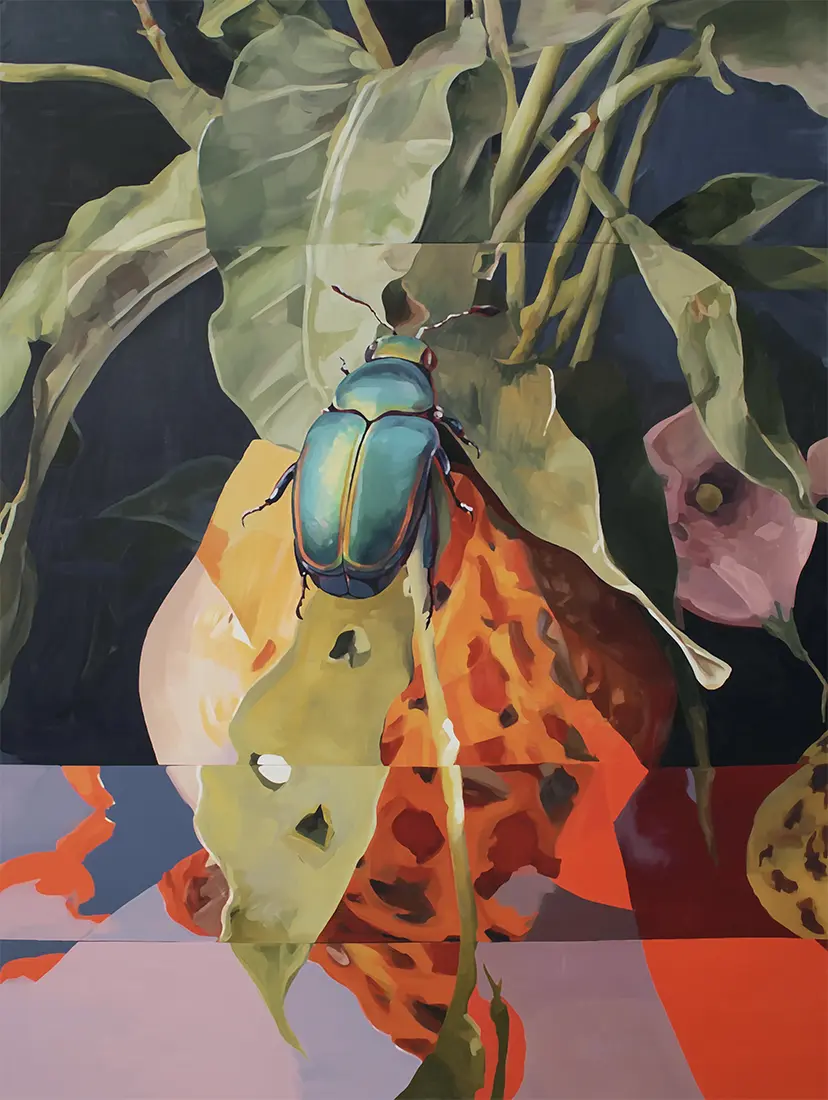
There's a moment that happens in gardens, in forgotten corners, in the spaces between what we tend and what we abandon. It's the moment when a creature lands on something dying, and the whole world holds its breath.
I saw it last autumn.
Not in a garden, but on my studio table—a rotting pear I'd forgotten about, its yellow skin collapsing into rust and shadow. And there, impossibly luminous against all that decay, sat a beetle. Not just any beetle. One wearing the color of tropical seas on its back, a blue-green so vivid it seemed to pulse with its own light.
The beetle didn't care that the fruit beneath its feet was surrendering. It walked with the confidence of someone who understood something I was only beginning to learn: that endings and beginnings share the same ground.
The Language of Leaves
My grandmother used to say that leaves tell three stories. First, they whisper of spring—tender, green, full of innocent promises. Then they shout of summer—bold, established, certain of their place in the world. Finally, they confess the truth of autumn—that all glory fades, that surrender is not defeat, that falling can be beautiful.
But she never mentioned the fourth story, the one I discovered while watching that beetle: the story of what happens during the fall, in that suspended moment between letting go and landing.
Look closely at decay, really look, and you'll see it's not just destruction. It's transformation wearing a mask we've been taught to fear. The yellowing leaf, spotted with age, creates patterns more intricate than any designer could conceive. The bruised fruit develops gradients of color—sunset trapped in flesh—that no painter could precisely replicate.
And in the middle of it all, life doesn't flee. It arrives. Six legs. Iridescent armor. Ancient purpose.
The Geometry of Now
What struck me most wasn't just the beetle's beauty against the decay. It was the contrast beneath—that geometric surface I'd placed the fruit on, all clean lines and modern colors. Orange. Gray. Red. Precise. Unnatural.
We spend our lives constructing these surfaces, don't we? These neat boundaries between what we consider beautiful and what we deem worthy of the trash. We make straight lines in a world that prefers curves. We impose order on a universe that operates on cycles.
The beetle knew better. It moved between worlds effortlessly—from the geometric perfection below to the organic chaos above, from manufactured precision to natural dissolution. It made no distinction between the modern and the ancient, the preserved and the rotting.
It simply existed, fully present in the now.
What the Beetle Saw
I imagined myself small, beetle-sized, walking across that landscape of decay. What would I feel beneath my feet? The soft give of flesh that once held firmness. The texture of leaf veins, now brittle and exposed. The moisture seeping from cellular walls that no longer held.
Would I recoil? Or would I recognize it for what it truly is—generosity?
Because that's what decay is, at its essence. It's matter keeping its promise, refusing to hold onto what it no longer needs, releasing nutrients back into the world. It's the wealthy giving away their fortune. It's the teacher becoming the lesson.
The beetle wasn't walking on garbage. It was walking on gifts being wrapped for the next generation of life.
The Blue Testament
Why blue-green, though? Why did nature dress this tiny creature in colors that stop us mid-step, that make us reach instinctively for our cameras, that lodge themselves in memory?
Maybe it's a reminder. Maybe in a world of constant change—of leaves falling, fruit rotting, seasons turning—we need witnesses who carry permanence in their appearance. The beetle's metallic sheen doesn't fade like flower petals. Its color doesn't drain like autumn leaves.
It moves through decay untouched by decay itself, like hope walking through despair, like faith navigating doubt, like beauty refusing to be defeated by entropy.
That blue-green is a testament: even in endings, especially in endings, there is splendor.
The Art of Seeing
I've learned something from spending hours trying to capture this scene, translating it from three dimensions to two, from reality to representation. The act of creating art isn't about preservation—it's about attention.
When you really look at something, I mean truly look—not just glance and categorize, but observe and wonder—you become changed by it. The subject doesn't stay external. It enters you. It rearranges your understanding.
Before the beetle, decay was something I avoided. Now it's something I seek out. Not because I've become morbid, but because I've learned to see it differently. Where I once saw only loss, I now see transition. Where I once saw endings, I now see doorways.
The fallen leaf isn't dead. It's teaching the soil how to dream new leaves.
The Weight of Wings
Scientists tell us there are over 400,000 species of beetles on Earth—nearly one quarter of all known animal species. They've survived ice ages, asteroid impacts, the rise and fall of dinosaurs. They were here long before us, and they'll likely be here long after.
And yet, despite their evolutionary dominance, they remain small. Humble. Easy to overlook.
There's something profound in that. The most successful creatures on Earth aren't the ones who demanded attention, who grew larger, who shouted louder. They're the ones who learned to adapt, who found niches in the overlooked places, who thrived in silence.
The beetle on the rotting fruit isn't there by accident. It's there by design—millions of years of design, of refinement, of learning exactly where to be and when.
It's there because it knows something we often forget: that the overlooked places are often the richest. That what society discards is sometimes exactly what nature needs.
The Green Paradox
Above the rot, in my painting, fresh green leaves still reach upward. They haven't begun their descent yet. They're still caught in the illusion of permanence, still believing in their own endurance.
And that's beautiful too—that necessary naivety that lets us live fully in each moment without being paralyzed by future loss.
The beetle doesn't judge the green leaves for their innocence or the decaying ones for their surrender. It navigates between them, serving both, belonging fully to neither and completely to both.
This is the paradox: we need both the green faith of spring and the honest decay of autumn. We need to believe in our own continuance while accepting our eventual dissolution. We need to grow while learning to let go.
The beetle, with its jeweled back catching light that filters through both living and dying leaves, embodies this paradox. It doesn't choose between life and death. It chooses both.
The Dark Canvas
Notice what surrounds this scene: darkness. Deep, almost velvety darkness that makes the colors more vivid by contrast. The background isn't just absent of light—it's actively dark, present in its emptiness.
We fear the dark. We fight it with streetlamps and screens, with constant activity and noise. But darkness is where seeds germinate, where healing happens unseen, where rest becomes restoration.
The beetle and its rotting fruit float in this darkness like a small world unto themselves. The darkness doesn't threaten them—it cradles them, gives them definition, makes their colors sing.
Sometimes the most illuminating moments of our lives are held by the darkest times. The contrast creates the clarity. The shadow defines the light.
What We Leave Behind
I think about my own life as I observe this scene. The things I've let decay—relationships, certainties, versions of myself I once thought permanent. The things I clung to until they rotted in my hands because I couldn't accept that their time had passed.
And I think about what grew from those endings. New understanding. Different relationships. Versions of myself I couldn't have imagined when I was busy gripping the old.
We are not so different from leaves, you and I. We have our seasons of green glory, our moments in the sun. And we have our autumns, when the world asks us to let go, to fall, to feed what comes next.
The beetle reminds me that even in those seasons of letting go, we are not diminished. We are transitioning. And transition is not tragedy—it's necessity dressed in inevitability.
The Invitation
So I invite you to look differently at decay. Not just at fallen leaves and rotting fruit, but at the decay in your own life. The dream that didn't materialize. The relationship that ended. The certainty that crumbled. The youth that slipped away.
What if these aren't failures but transformations? What if they're not endings but doorways? What if your life's decay is as necessary and natural as autumn's, and just as likely to feed new growth?
And I invite you to notice the beetles—those small, luminous witnesses who show up precisely when things are falling apart. They might be friends who appear in dark times. They might be unexpected insights that land on your grief. They might be moments of beauty that pierce through your pain, impossible and undeniable.
They're there. I promise you they're there.
We just have to learn to see them.
The Testament of Small Things
In the end, perhaps that's what this tiny jeweled witness teaches: that significance isn't about size, that beauty doesn't require permanence, that life's deepest truths are often carried by its smallest creatures.
The beetle will leave the rotting fruit eventually. It will fly to another ending, another transformation. And the fruit will continue its surrender, returning to the earth that grew it, completing the promise it made when it was just a flower.
And somewhere, someone else will see this cycle and stop. Really stop. They'll pull out their camera or their sketchbook, or they'll simply stand and stare. And in that moment of attention, something will shift.
They'll see what I saw: that decay is not defeat, that small lives carry large truths, that beauty and rot can occupy the same space, that endings are always somebody else's beginnings.
They'll see that even as we fall, we can still catch the light.
Artist Credit: Artwork created by @kaelivanfossen - a digital artist exploring themes of transformation, impermanence, and the hidden poetry of natural cycles.
A Final Thought
My grandmother was right about leaves telling three stories. But the beetle taught me there's a fourth: the story of the witness. The one who sees the green promise and the autumn confession and doesn't choose between them. The one who walks on decay wearing the colors of forever. The one who reminds us that even when things fall apart, something beautiful is always paying attention.
That witness isn't just the beetle.
It's you.
It's anyone who stops to truly see, who dares to find beauty in unexpected places, who learns the language that decay is speaking.
In a world that moves too fast, that discards too quickly, that fears endings too much, we need more witnesses. More people willing to pause at the forgotten fruit, the fallen leaf, the overlooked corner.
Because transformation doesn't happen in the spotlight. It happens in the shadows, in the quiet, in the space between what was and what will be.
And it always, always deserves a witness.
May we all learn to see with beetle's eyes—finding splendor in surrender, beauty in decay, and the eternal in the ephemeral.






