
Black holes are one of the most mysterious objects in the universe. As the name suggests, the detection is rather difficult and relies on phenomena like gravitational influence on nearby stars and protostellar objects. In addition to that, there is a method which looks out for TDE´s. This is the short version for Tidal Disruption Events and describes the process of stars getting too close to black holes resulting in the disruption of the star because of the tidal forces and a high energetic jet coming out of the black hole. This jet can then be detected in a characteristic spectrum.
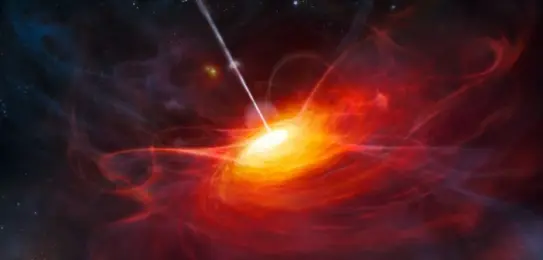
So how does this process happen? Black holes sitting in the centre of galaxies are supermassive. These supermassive Black Holes (SMBH) build a so called AGN (Active Galactic Nuclei). The Masses reach up to a few billion times the mass of our sun. In order to be disrupted, a star has to come close enough to a SMBH. The distance where tidal forces start to overwhelm binding forces of the star itself is called the Tidal Disruption Radius. From this point on, the gravitational influence of the SMBH is so huge, that the star starts to dissolve into a flow of debris flying towards the central force.
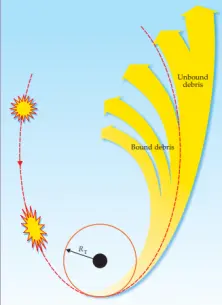
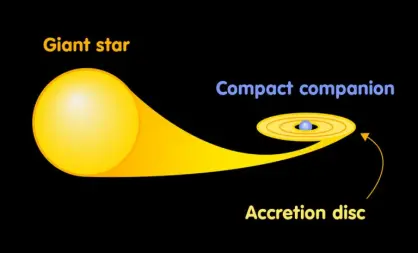
As the debris fly towards the black hole, half of them get ejected in to the interstellar space with speeds up to 1000 km/h (621,12mp/h). But the other half is now bound to the central SMBH and flies around it in Keplerian orbits. After a specific time, the remaining debris settle on to a stable radius, building a so called accretion disk. This disk now cointains all of the bound debris. Because of hydrodynamical influences and stability issues, objects flying on the outer circles of the disk are being pushed closer on the inner regions, while angular momentum is being transported outwards. When potential energy is decreasing enough, the debris are forced to fall in to the black hole. Magnetic fields coupled to all of the small objects also collide resulting in enormous energy being spitted out of the black hole. This ejection of energy consists of plasma (electrons, ions...) which travels near the speed of light through intergalactic gas and dust, also known as the jet.
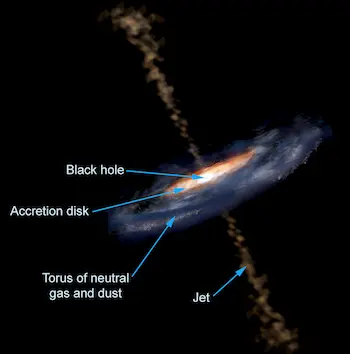
Depending on the observational angle of the AGN and its to the accretion disk perpendicular jet, the light can now be detected from the earth. The spectrum contains information not only about the intensity of the event, but also about mass and size of the SMBH and disrupted star, details about the galaxy in which this happened and many other things.
First proposed and found in the early 80`s, this whole process is still very young and leaves many questions on the table. With the help of upcoming technology like quantum computers (Article comming), we hope to learn more about the fascinating process of Tidal Disrupion Events.
TL;DR: TDE stands for Tidal Disruption Event which happen when a star gets too close to a supermassive black hole. The disruption of the star because of tidal forces leads to debris being accreted in to the hole resulting in enourmous flares and Jets coming out powered by the binding energy of the star.






