When I was a teenager I picked up and read my dad's dog-eared copy of Dune by Frank Herbert. At the time, my view of the world was pretty simple. I had all the normal trials and tribulations that any child growing up in a 'low to middle' class suburban environment might encounter. School sucked, homework sucked, chores sucked... etc. Then I read Dune and I experienced a perspective shift. The story opened my mind to the concept of grand narratives.
Grand narrative refers to a broad, overarching story or metanarrative that attempts to explain the nature of human existence, history, and culture. It is a story that attempts to provide a comprehensive and unified view of reality, and to explain the meaning and purpose of human life.
I bring this up because it's somewhat analogous to what happened to me when I found out about crypto and decided to commit to using and understanding it.
In my mind and I assume most other people's mind, crypto was just 'mining', buying and selling digital tokens. That's true to a point, but it entirely misses the bigger picture.

Is this TradFi or DeFi? I can't tell...
By way of example, let's look at the first true use-case for Crypto. Finance.
There is something truly profound happening in the world of finance. It's bifurcating into "Traditional Finance"
Traditional finance refers to the sources of financing obtained from the banking system and/or capital markets, such as bank loans, bond issuance, and stock issuance
and "Decentralized Finance."
Decentralized finance (DeFi) is a financial ecosystem based on blockchain technology that allows users to buy and sell assets and financial services without relying on intermediaries such as banks, brokerages, or exchanges.
DeFi is the Dune of the crypto world. If you spend the time to read it, your eyes will begin to glow blue and you'll begin to see the future.
The reason 'Traditional Finance' sucks is because it's completely captured and controlled. It's opaque and esoteric. There are giant sandworms that produce and consume all of the spice. Only a tiny fraction of people know how it works and have 'permission' to harvest it.

This is simply Too Big To Fail.
Decentralized Finance is different. It's open and permissionless and because of that everyone can see how the financial machinery works. In fact, everyone can build or fork their own version of it.
“A process cannot be understood by stopping it. Understanding must move with the flow of the process, must join it and flow with it.”
― Frank Herbert, Dune

Some degens in DeFi riding the Sandworm
To that end, this essay is my summary of an in-depth article by Angela Lu analysing the decentralized order flow landscape in DeFi. The work that has gone into her article is monumental and I highly recommend reading it if you want to go deep.
https://writings.flashbots.net/illuminate-the-order-flow
Order flow refers to the mechanism that facilitates a price movement in an open auction market. It is the matching of competitive bids from buyers and competitive offers from sellers
I will explore the various participants and mechanism designs that help facilitate trading across different platforms. I am trying to shed light on how DeFi works when compared to traditional finance and show how we're just in the prologue of the grand narrative that crypto is weaving.
I aim to concisely capture the complex ecosystem described by Angela and highlight both opportunities and challenges around sustaining an open and competitive market structure.
DeFi order flow is more 'decentralized' than 'traditional finance.'
Defi order flow is more decentralized than in traditional finance due to the many players that can compete to route trades in a permissionless manner.
In traditional markets, retail order flow is concentrated amongst a small number of wholesalers through practices like payment for order flow. In contrast, DeFi has no central intermediaries and instead relies on a network of various "solvers", "market makers", "searchers", and "block builders" all using open protocols to participate. I'll explore what those are next, but here's a taste of how wildly complex this can be.
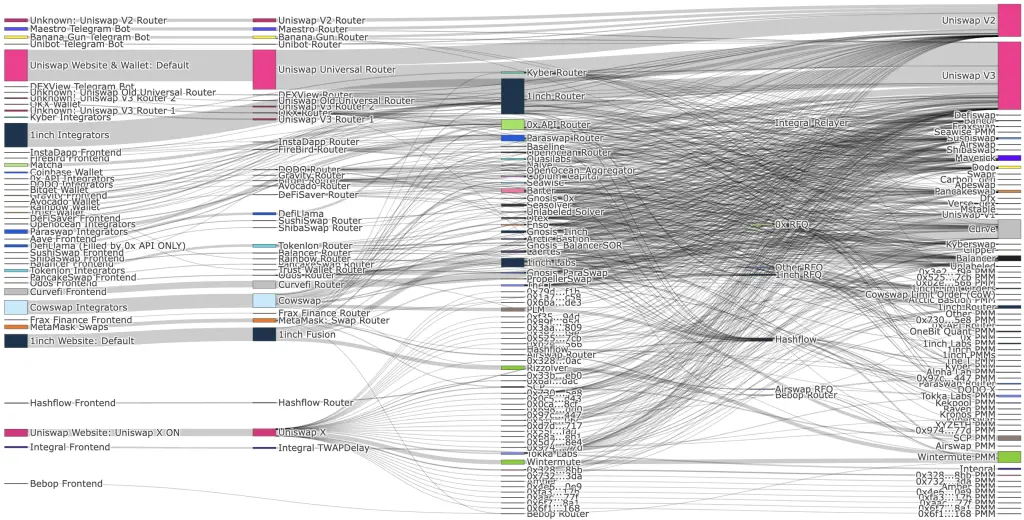
If you want to nerd out on interactive diagrams check out orderflow.art
The above chart shows over 30 solvers, 12 market makers, 90 order flow auction participants, and 41 block builders actively competing on Ethereum to route trades across over 12,000 token pairs. I challenge you to get this kind of data from your broker dealer in the tradfi world.
This degree of global participation from a large number of entities is not possible in the traditional financial system and has allowed DeFi to serve user desires that centralized players are unable or unwilling to fulfil.
Solver auctions allow different "solvers" to compete to find the best route for a trade.
Solver auctions are a key innovation that has helped increase decentralization and competition in DeFi order flow.
In a solver auction, different "solver" entities can compete to find the best route for executing a trade proposed by a Decentralized Exchange (DEX) frontend like Uniswap. Each solver will analyse the numerous liquidity sources across various DEXes and market makersto determine an optimal way to split up a trade and route it through different pools and platforms to obtain the best price.
By allowing any participant to act as a solver and profit from optimizing trade routing alone, solver auctions have significantly lowered the barrier to entry for competing to access order flow. This has incentivized the rise of many new specialized "solver" players, increasing the total number of participants working to deliver better prices for users.
Market maker auctions give market makers access to order flow on many platforms.
Market maker auctions help further increase competition and decentralization in defi order flow. In a market maker auction, any participant can integrate with a system like Hashflow to compete to provide liquidityfor trades routed through it. This significantly lowers the barrier for market makers to access order flow across multiple platforms.
Through just one integration with Hashflow, eight different market making entities were able to compete to fill over $1.45 billion in trades from sources like Cowswap, 1inch Fusion, and Paraswapin November 2023.
By enabling market makers to tap into order flow from various sources through a single integration, these auctions incentivize greater participation from market makers and drive more competitive pricing through increased competition, benefiting end users.
Ennio Morricone soundtrack intensifies.
Order flow auctions allow "searchers" to bid on trades to capture arbitrage opportunities.
Order flow auctions introduce another layer of competition and decentralization to defi trading.
In an order flow auction, the entity facilitating a trade can auction off the right to trade directly to "searchers" looking to capture arbitrage opportunities. Searchers may be "atomic" traders hoping to benefit from short-term price differences across exchanges,
This involves simultaneously buying and selling a crypto asset across multiple exchanges to profit from temporary mismatches in the asset's price. By doing so in a single transaction, or "atomically", they can capture these small arbitrage opportunities before prices equalize.
or "signal" traders reacting to new information like order sizes.
Signal traders react to new information like the size of user orders. If they observe an order that is larger than usual, for example, they may take a position anticipating a price impact. Or if they see an order for an asset with low liquidity, they may be willing to hold inventory of that asset.

This is a searcher. He's better than you.
By competing to bid the highest percentage of their potential profits to the user, multiple searchers incentivize each other to find more arbitrage opportunities, driving better prices through increased efficiency.
Block builders incorporate searchers' arbitrage trades into blocks for a fee.
Block builders are an important part of incorporating arbitrage trades into the Ethereum blockchain in a decentralized way.
In defi, block builders compete to construct new blocks by including as many profitable trades from "searchers" as possible. This process, also known as a "mev-boost auction", involves block builders working to quickly merge together non-conflicting trades from numerous searchers.

There's a reason why it's called a Blockchain.
By decentralizing block creation and enabling any participant to act as a block builder, this mechanism helps maximize efficiency of the Ethereum network by including beneficial trades and provides incentives for builders to do so.
Uniswap, 1inch, and Cowswap are popular platforms for routing trades.
Popular DeFi order flow platforms like Uniswap X, 1inch fusion, and Cowswap each play an important role in routing trades in a decentralized manner.
Uniswap is the largest DEX by volume, processing over $4 billion in trades through its website and mobile app in November 2023 alone.
The 1inch protocol provides aggregation services that help route flows to many liquidity sources, facilitating around $4 billion in volume that month across its frontend and APIs.
Meanwhile, Cowswap has grown as a popular trading interface with its use of solver auctions, competing to route over $1.5 billion in volume.

I for one am in love with our new financial overlords.
By providing open-source infrastructure that allows anyone to build upon or interact with their protocols, these platforms have helped drive decentralization by allowing a wide range of participants to compete and innovate in order to serve global user needs for trading various crypto assets.
Market makers like Wintermute and SCP dominate some order flow sources.
While increased participation and competition is a goal of defi, market makers like Wintermute still dominate some order flow sources.
In November 2023, Wintermute (under the name Rizzolver) filled 24% of volume on 1inch Fusion.
Due to economies of scale, market making tends to centralize over time unless mechanism design addresses this risk. Centralized liquidity provision goes against the ethos of decentralization, so DeFi mechanism designers must consider how to sustain competition among market makers while still benefiting from the efficiencies they provide end users.
Privacy is important to prevent "frontrunning" of trades by other players.
Privacy is a key consideration for DeFi order flow mechanisms as it helps prevent strategies like "frontrunning" that could undermine the competitive process.
Front running, also known as tailgating, is the practice of entering into an equity trade, option, futures contract, derivative, or security-based swap to capitalize on advance, non-public knowledge of a large pending transaction that will influence the price of the underlying asset.
Without privacy measures, other participants may be able to use information revealed through the execution process to identify trades and interject their own transactions ahead, capturing profits at the expense of users and other searchers.
Both MEV-Blocker and Flashbots Protect have implemented privacy techniques to mitigate this, with MEV-Blocker removing signatures and adding dummy transactions, and Flashbots Protect only revealing limited details of trades.

We are legion
As DeFi trading volumes increase, maintaining robust privacy that can scale in a decentralized manner will become increasingly important to upholding high execution quality and maximizing the potential of competitive mechanisms like order flow auctions.
Mechanism design impacts how centralized or decentralized the system becomes.
Mechanism design is an important consideration as the rules and protocols that govern DeFi order flow can significantly impact the level of decentralization achieved over time.
Centralized mechanisms tend to advantage large, established entities and concentrate power in their hands. However, properly designed protocols that lower barriers to participation, enable competition, and align stakeholder incentives can better sustain decentralization as DeFi grows.
Going forward, it will be important for new mechanisms to disincentivize concentration of control while maintaining the efficiencies that benefit users, in order to fulfil DeFi's vision of robust, permissionless systems.
Overall DeFi shows promise but decentralization requires ongoing work.
Much like the complex political and environmental dynamics of Arrakis that Herbert depicted, fully realizing the DeFi vision will require navigating challenging terrain.
DeFi is currently in a phase similar to when the Atreides first took control of spice mining and had to balance economic demands with social and ecological stability. While early successes have been achieved, centralized forces akin to the Harkonnens still lurk and could reassert control if unchecked.

“The willow submits to the wind and prospers until one day it is many willows - a wall against the wind.” -Frank Herbert
Ongoing cooperation within the DeFi community, like that between the Fremen and Atreides, will be vital to preserving the open and competitive system for all. With coordinated stewardship and adaptations to changing conditions, DeFi may mature into a decentralized model as integral and sustainable as Arrakis became for the Federated families.
But vigilance against threats to an equitable order will remain essential in the years ahead.
If you have read this far, I thank you. If you liked it please like and follow for more.
Here's a picture of a delicious spiced latte as a reward.