
Running a DCA Bot with 3commas.io
In a recent article I mentioned that I would be doing a more detailed analysis of my attempts at trading using a 3commas.io DCA trading Bot. Well, the 14th Jan 2024 was the anniversary of switching on my strategy and letting her run. Let's see how it went.
Before we get to the juice, lets make sure we're on the same page. DCA? Trading Bot? 3Commas? wut?
Dollar-cost averaging (DCA) is an investment strategy that aims to minimize the impact of volatility when investing or purchasing a large block of a financial asset or instrument. It involves regularly investing a fixed dollar amount of a specific investment, regardless of the price, on a periodic basis.
What is a trading bot? Basically, it automates the process of buying and selling crypto assets, as well as doing the analysis and interpretation of the market statistics. Usually, the trading bot can collect data, analyze it, calculate potential market risk, and execute purchases or sales.
3commas.io is a subscription platform that provides tools like a trading terminal and hosts the customizable trading bots that this article is reviewing.

This is what I imagine a trading bot would look like.
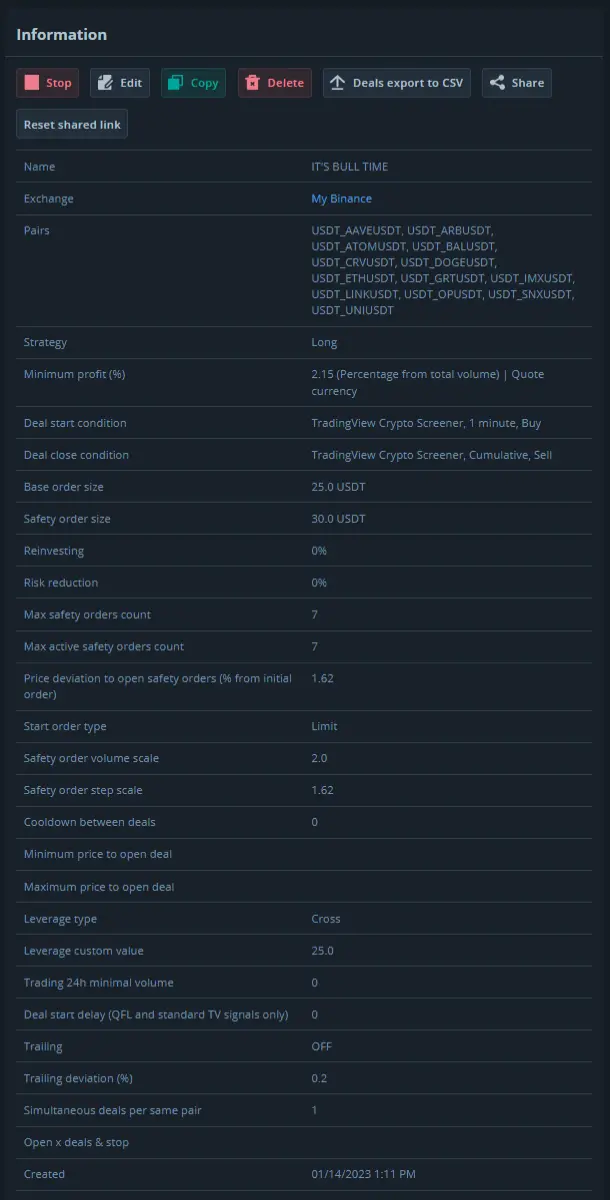
This is what they really look like.
A Year in Review:
January 2023 marked the start of the current crypto bull run. To celebrate the trend reversal I created a new bot on 3commas, named it "It's Bull Time" and resolved to let it run for a full year to test out the latest iteration of my automated trading strategy.
What Strategy is that you may ask?
If you have a degenerate gambler in your life, ask them about the Martingale System.
In theory it aims to allow you to eventually recover your losses if you have enough money to continue doubling your investments. It assumes that with enough trades, the outcome you predict (in this case a positive trade) will eventually happen. However, it significantly increases your risk of large losses. You typically need a lot of capital available to withstand a string of ever larger losses, and most exchanges have a limit on order sizes.
Show me your data!
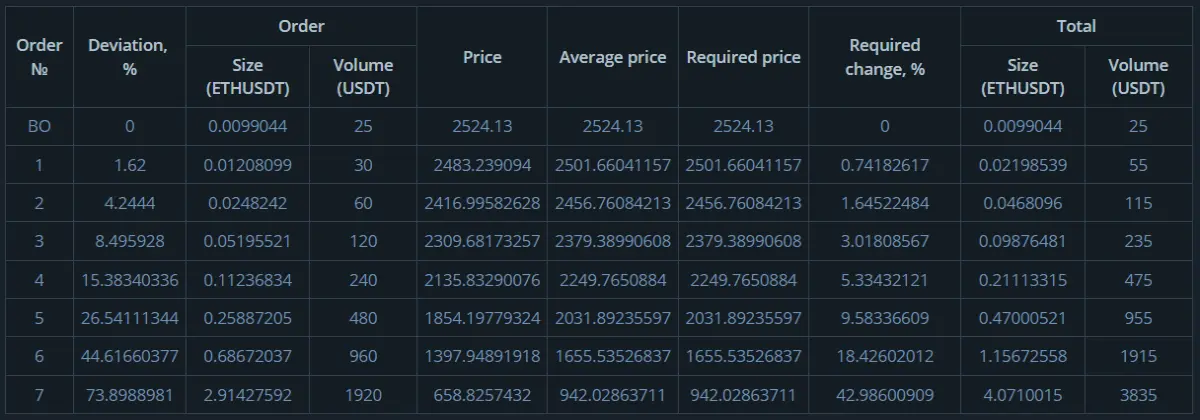
This is what I call data porn.
The above chart is a detailed view of the meat and potato's of this strategy. This example is targeting an $ETH trade.
In the first column we have the 'Base Order' or starting trade followed by a series of safety orders (1 through 7).
The second column shows the percentage 'Deviation' from the 'Base Order' price. This 'Deviation' column is what tells the bot when to execute each safety order. I have configured the bot to use a price deviation in multiples of 1.62% (see Fibonacci Ratio's if you want to know why)
At the time of writing this article $ETH was trading at a spot price of $2524.13 as shown in the 'Price' column. I configured the bot to start with a $25 Base order. If I start the bot it will place a $25 order for $ETH . The exchange I use is Binance (I like to live dangerously)
Looking at the chart 'order' column you can see that this equals roughly 0.0099 Eth. If the price of $ETH drops by 1.62% to $2483.24 the bot will then trigger the first safety order '1.'
The buy price I have set for the 1st safety order is $30. You may have noticed that this is not $25 x 2 which is what it should be if this was a pure Martingale trade. Well, I hold off from starting the Martingale part of the strategy this soon because I want to temper the exponential effect of doubling each order. That said once the price of $ETH drops more than 4.2% ($2416.99) thus triggering the 2nd safety order, the strategy of doubling each buy order kicks in and it creates a nice parabolic chart.
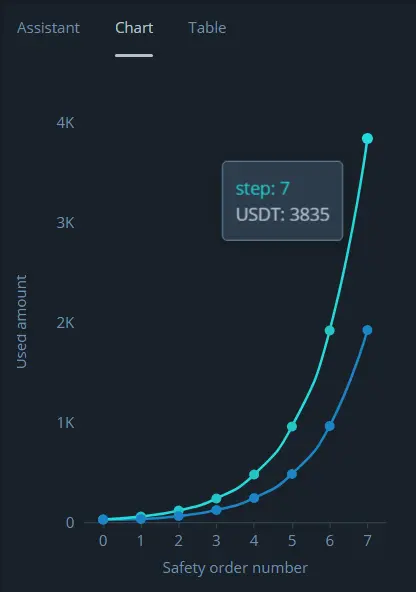
Curvy!
The reason why you would want to do something like this is because you are lowering the 'Average Price' that $ETH needs to hit for you to break even on the trade. That's where the 'Average' in Dollar Cost Average comes from. This strategy is essentially a bastard love child of Martingale and DCA. I want the price to be volatile. The more the price drops the more the bot buys and with each doubling of the order size the average price comes down. Thus keeping the trade alive.
Okay. So what's the catch?
The catch, loyal reader is that this is risky as hell. The Base order starts out small enough at $25, but once the price has dropped over 50% you're staring down the barrel of large safety orders. $1000 and $2000 for orders 6 and 7 respectively. That's pushing the limits of what most exchanges will allow you to do in a single order unless you've got a privileged account. Not to mention it's a massive amount of money to have sitting idle in your account on the off chance the market shits the bed. Oh and that's not even the worst part. Did I mention that this bot is using 25x leverage? No? Well it is. There is a high risk that your margin balance will be liquidated if there is a black swan event and prices drop 80% or more.
I vote we rename black swan events to Sex Panthers.

That doesn't make sense.
I eat risk for breakfast.
$ETH had an amazing year. The price is up around 75% from where it started in 2023, but during the course of the year there were multiple times that the price dropped anywhere from 15% to 25%.
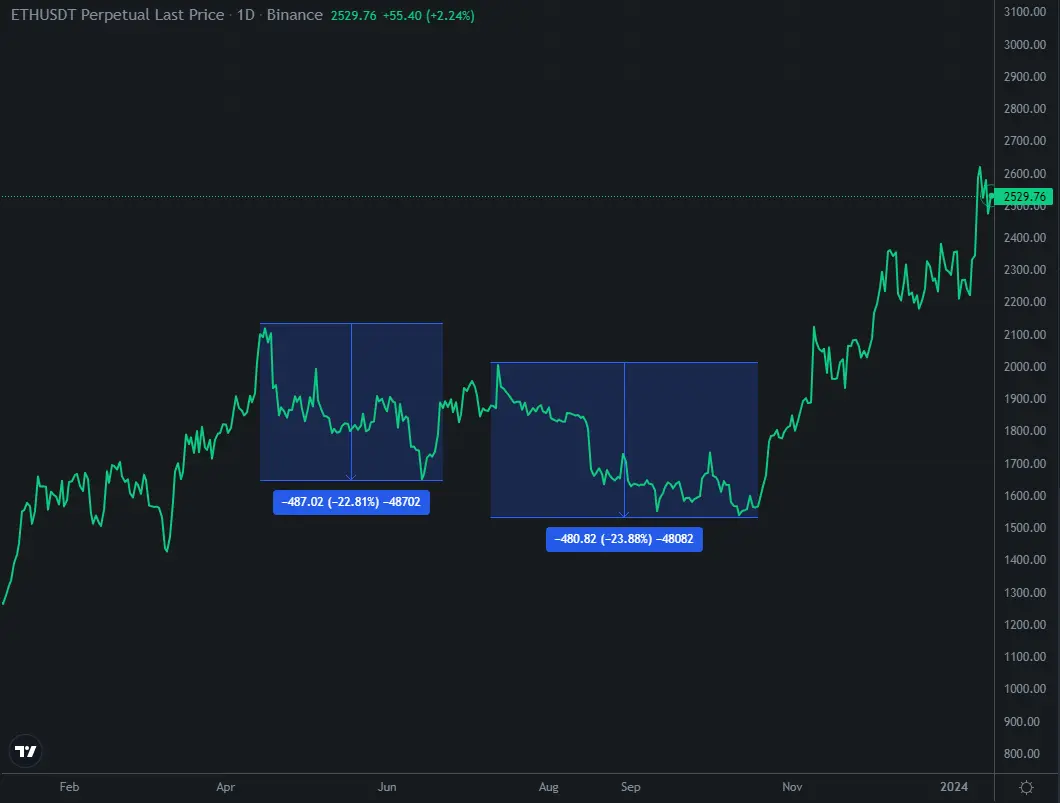
Those are called buying opportunities.
This strategy is designed to take advantage of this roller-coaster of a chart. The bot keeps buying more and more $ETH as the price drops and then sells once the price goes back up and crosses the average. Technically the bot can cope with a 70% price drop before things start getting scary, because once you start getting into the 6th or 7th safety order, the deals can take a lot longer to close. That's where you start to find yourself obsessing over the charts. Don't obsess over the charts! Your fancy little lines ain't gonna do shit!
Show me the Money!
So how did this little bot do? Well, at the start of the year my trading account had roughly $8,000 margin available and as of yesterday it was sitting on a balance $10,849. According to the 3commas dashboard I'm up $2,648.33 on the year.
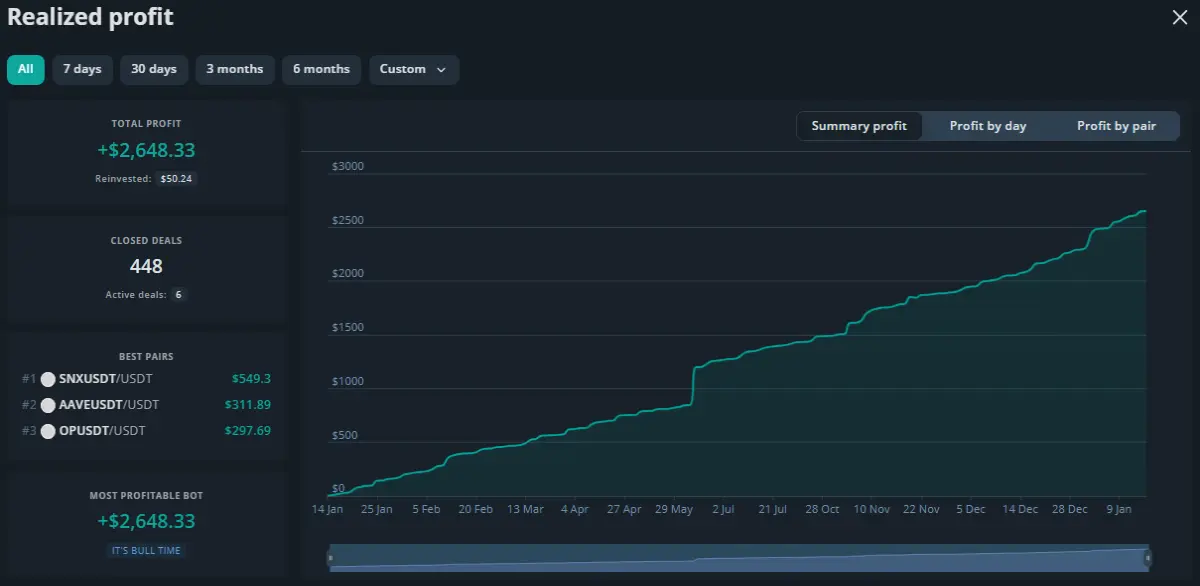
It's not parabolic, but that is definitely up only!
I'm no maths wiz but that seems north of 20% which is not too shabby in my book. However, and this is a very important 'however.' If I had just taken that 8k and bought and held $ETH I would have been looking at an 80% profit. Crypto is weird. The bot wasn't just set to trade $ETH any way. I have it configured to play with a small basket of my favourite tokens. All of which had a stellar 2023.
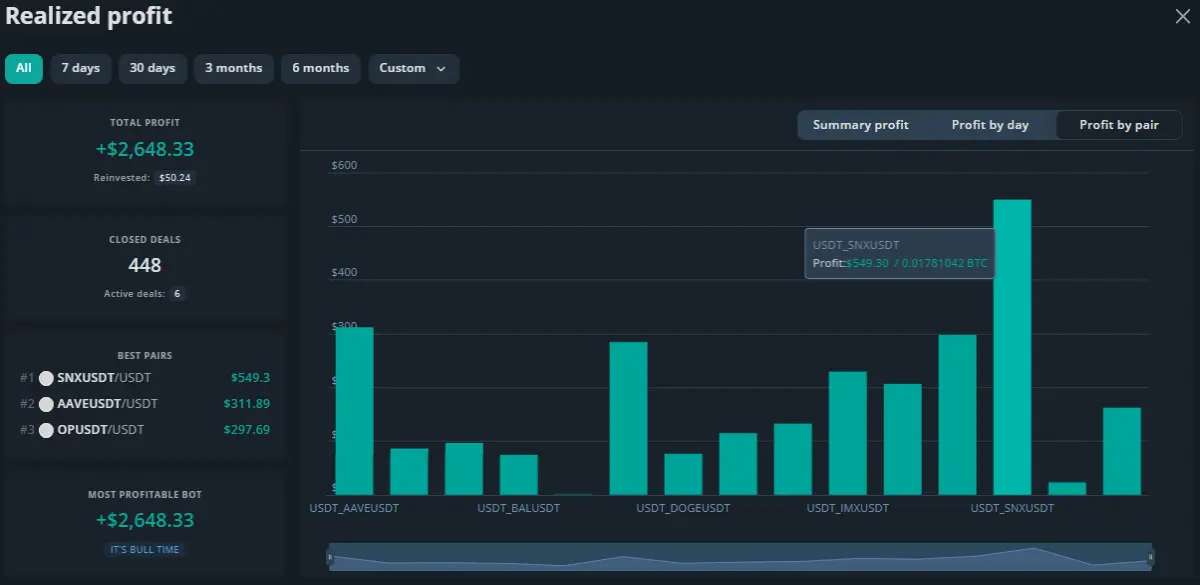
The stand out token is Synthetix (SNX)
In fact the bot did so well that there was only 1 day that closed out in the red and this was because I decided to cancel the BNB (Binance token) trade that was getting close to being in profit but was making me nervous because Binance was going through some legal stuff with the SEC and the US Department of Justice. You may have heard about that in the news. Annoyingly, if I'd just let the bot do it's thing and kept going with the strategy it would have closed that trade in profit. BNB price has rallied recently. Note to self. Stick to the plan. But I can't be too hard on myself. Binance did get smacked by the biggest fine in history.
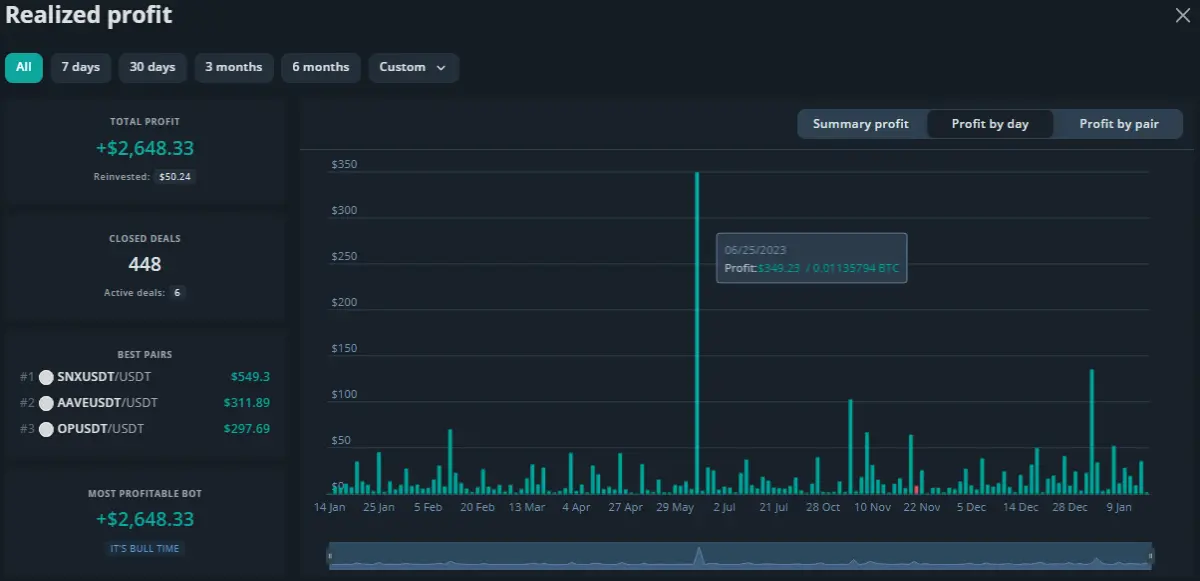
If you squint you can't even see the red day. June was when my Sex Panther kicked in.
So what did I learn?
To be honest, I can't say that this was a resounding success. Yes, the bot made me a tidy profit over the course of the year, but we're in a bull market. Everyone is a genius during a bull market. Just buying and holding the underlying assets would have made me more money.
I'm going to keep the bot running for another year. More data will be useful for making a more robust argument in favour of this strategy. Check in with me in 2025.
If you've read this far, I thank you. Here's Ron Burgundy as a reward.

He's kind of a big deal.





