Introduction
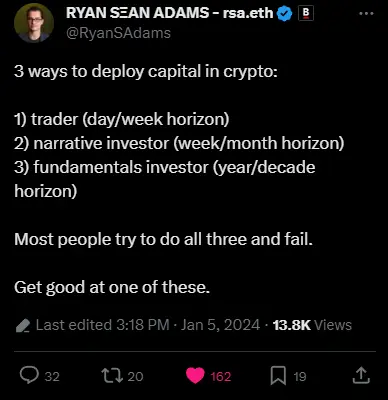
Over the past few years as a crypto investor, I have experimented with different trading strategies (character classes) to build my portfolio. Initially I tried to day trade and capitalize on short term price movements using technical analysis. While the potential returns seemed attractive, I found it difficult to consistently profit with the high risks involved. Through many trials and losses, I realized my strengths were better suited to longer term investing based on fundamentals.
More recently, I have taken a multi-pronged approach, allocating my capital (class points) to each of the three main strategies mentioned: trader(10%), narrative investor(30%), and fundamentals investor(60%).
- As a trader, I have built a small portfolio of actively managed crypto trading bots using the 3commas.io platform to try capturing short term gains. I talk about this experience in this article but only superficially. I am writing another article that will really get into the blood and guts of this experience. So stay tuned!
- For narrative investing, I focus on emerging trends in the crypto market like NFTs, decentralized finance applications, and other innovations that could see growth over weeks to months. I find that being subscribed to https://www.bankless.com/ has been the most valuable resource for keeping up with all of the crazy stuff that happens in crypto.
- Finally, I invest for the long haul based on project fundamentals, holding assets like Ethereum that I believe have strong adoption potential and governance over the next decade. I think of Eth and more specifically Staked Eth as an analogue for a bond.
By diversifying my approach, I aim to benefit from upside across timeframes while mitigating risks. Each strategy plays an important role. While trading carries high risk, it also allows potential for outsized returns. Narrative investing lets me capitalize on medium term opportunities. And holding fundamentals-based assets provides stability for the long run. Through trial and error, I have built a balanced portfolio that leverages my strengths across these three disciplines.
Trader (10%)

As a trader, my focus is on capturing short term price movements over periods ranging from days to weeks. I deploy actively managed crypto trading bots to open and close positions based on technical analysis of market signals. The potential upside of this approach is being able to profit from volatility and generate returns far greater than holding long term. However, day trading also carries significant risks that come with the short time horizon.
When I first started experimenting with trading, the prospect of doubling or tripling my money on a large leverage position within a few hours seemed incredibly enticing. I studied charts endlessly, convinced I had spotted patterns that would predict the market. However, in reality I struggled to consistently make profitable trades. More often than not, my analysis would prove wrong, liquidations would wipe out my account, and I found myself chasing losses. It became a vicious cycle that left me with nothing to show except lessons in humility.
Through many such failures, I realized my strengths were not in predicting short term price fluctuations but rather fundamental analysis of long term trends. Still, there is value to be found in trading if done strategically with discipline and risk management. In rebuilding my approach, I focused on developing trading bots with automatic stop losses, position size limits based on account balance, and a system that aims to realize many small wins rather than chasing a few big ones.
Even with these safeguards, day trading remains a high risk endeavour that is not for everyone. It requires an almost full-time commitment to monitoring markets, adjusting strategies, and improving one's system continuously based on outcomes. For most, the stress likely outweighs any potential rewards. But for me, maintaining a small allocation to trading allows me to benefit from upside volatility while managing my risks through a systematic process rather than emotional decision making. Over time, with experience and refinements to my methods, I plan to keep trading as a piece of my overall portfolio strategy.
Narrative investor (30%)
As a narrative investor, my focus is analyzing emerging trends and opportunities in the crypto market that could play out over weeks to months. In 2020, I was deeply engaged in analyzing the budding decentralized finance (DeFi) narrative. At the time, Ethereum-based projects like Uniswap and DyDx were pioneering a new era of open financial applications on the blockchain.
I was fortunate to receive airdrops of governance tokens from some of these early DeFi protocols as they launched. This allowed me to experiment freely with providing liquidity to their automated pools without risking any of my own capital. Through yield farming various asset pairs on Uniswap and DyDx, I gained first-hand experience with how these novel DeFi applications functioned while also earning attractive yields in the process.
By actively participating in DeFi's earliest iterations, I could closely track discussion forums to understand which projects and ideas were generating the most excitement. I saw narratives beginning to form around concepts like liquidity mining, governance tokens, and decentralized exchanges disrupting traditional finance. Analyzing social metrics and on-chain activity, some protocols like Uniswap.org - Curve.Fi - Compound.Finance & Aave.com clearly emerged as leaders in their categories.
Based on the strong narratives developing and the early success I observed, I decided to invest some of my profits back into top-performing DeFi projects like Uniswap and Maker. Over subsequent months, their ecosystems and valuations grew exponentially as interest in the new DeFi economy surged. This strategic narrative-based investing allowed me to generate substantial returns that ultimately enabled me to quit my job and pursue crypto as a full-time career path.
While narratives do not guarantee success (don't ask me about 2022), by actively participating in emerging trends from the earliest stages, a narrative investor can gain valuable on-chain experience and insights to make more informed investment theses over the medium term. The DeFi season of 2020 highlighted for me the power of analyzing crypto narratives as they form and positioning oneself accordingly.
Fundamentals investor (60%)

As a fundamentals investor, my focus is on long term projects with strong underlying technologies and adoption potential that could yield returns over years or decades. My initial experience mining Bitcoin in 2013 first exposed me to the revolutionary blockchain concept, though I regretfully lost track of the project during the following years. However, by late 2017 the markets had grown exponentially and rekindled my interest when Bitcoin surged to $10,000.
I was determined not to repeat past mistakes and committed myself to deeply researching the burgeoning crypto ecosystem. The decentralized world computer vision of Ethereum particularly resonated with me more than Bitcoin's digital gold narrative. I spent countless hours learning about the ground-breaking applications being built on Ethereum like decentralized exchanges, stablecoins, and the growing DeFi movement.
Analyzing the Ethereum blockchain itself, it was clear that developer activity and the number of projects and users being onboarded were growing at an unprecedented pace each year. This reinforced my belief that Ethereum had the potential to reshape technology globally in the coming decades. Beyond just price speculation, I was truly fascinated by the implications of open, trustless networks and their ability to disrupt legacy industries.
Armed with extensive research into the technologies, communities and real-world uses of various blockchain projects, I began allocating my portfolio for the long term based on fundamentals. My largest holdings centered around Ethereum for its first-mover advantage and lead in applications.
Taking a long view informed by technical understanding allows me to look past short term volatility and focus on projects strategically positioned for long term growth. As a fundamentals investor, my goal is identifying blockchain networks most likely to still be transacting ten years from now and building my portfolio accordingly for the coming decades.
Conclusion
In conclusion, my journey into crypto investing has taught me the importance of specialization and focus. While trying my hand at trading, narrative investing, and fundamentals investing, I have come to realize that each strategy has its own unique benefits and drawbacks.
Trading, for example, allows for the potential of high returns in short periods of time, but it also comes with high risks and requires a significant amount of time and effort to master. Narrative investing, on the other hand, allows for a more passive approach, but it also requires a deep understanding of the crypto market and the ability to identify emerging trends. It also requires you actively participate in the crypto eco-system. You need skin in the game.
Fundamentals investing, which is the approach I have decided to focus on going forward, allows for a long-term perspective and the ability to identify blockchain networks that are most likely to still be transacting ten years from now. This approach also requires a deep understanding of the technology and the teams behind the projects, as well as the ability to analyze on-chain data and identify trends.
In the end, I have learned that specializing in one approach is better than dabbling in all three. By focusing on fundamentals investing, I can build a portfolio that is aligned with my strengths and goals, and that has the potential for long-term growth. I encourage all crypto investors to reflect on their own investment strategies and consider specializing in an approach that aligns with their strengths and goals.
If you have read this far, I thank you. Here is a picture of a bunny as a reward.