
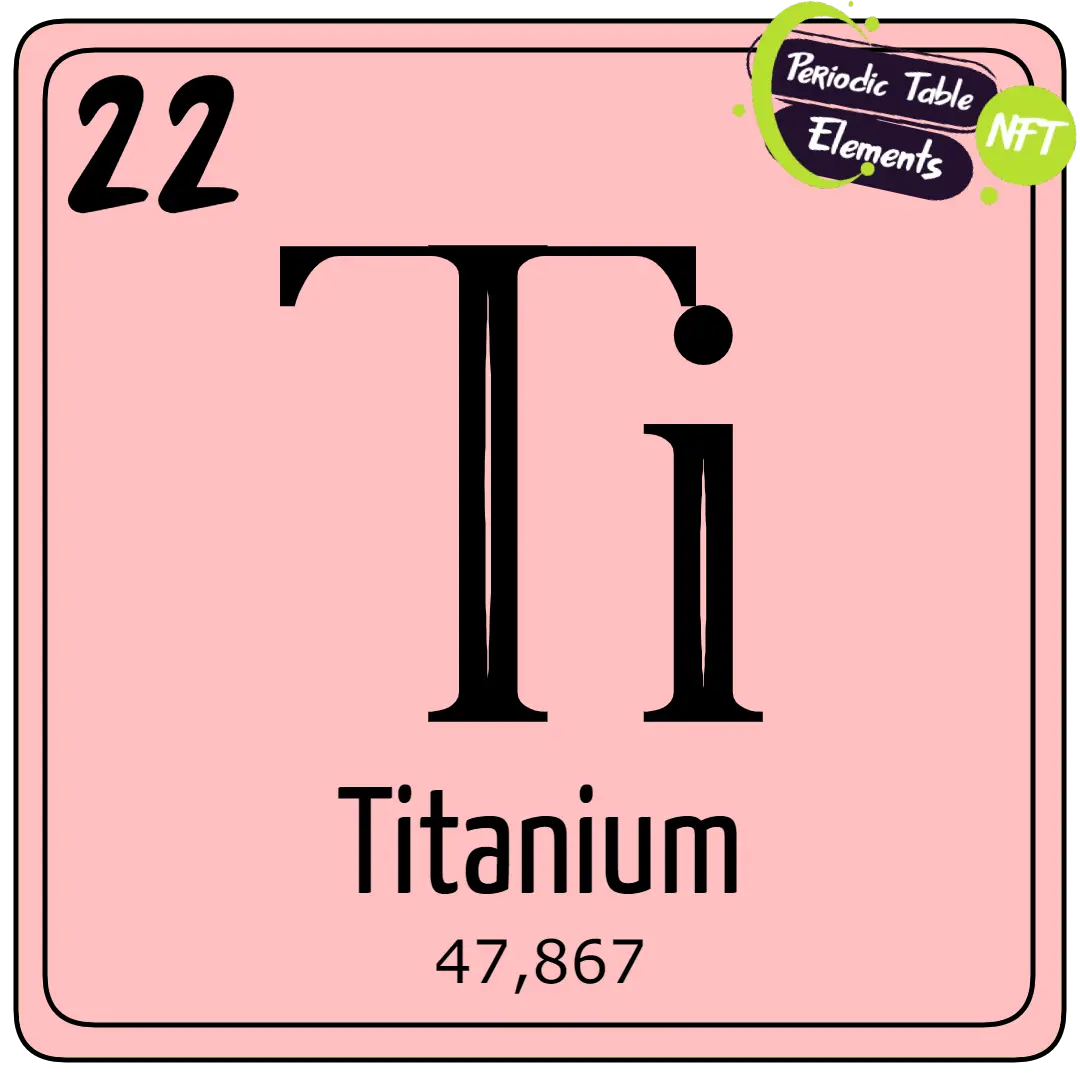
Titanium is the chemical element of the periodic table of the elements which has as its symbol Ti and as its atomic number 22. It is a light, resistant, metallic white, shiny, corrosion resistant metal. It is found in numerous minerals, the main ones being rutile and ilmenite, and is used in strong light alloys and white pigments. Titanium is non-toxic, and is not essential for any living species.
A bit of history: it was discovered in 1791 by Reverend William Gregor who managed to locate it but not isolate it in the Cornish ilmenite rocks. In 1795 the German chemist Heinrich Klaproth succeeded in isolating it from rutile minerals. Titanium metal was not used outside laboratories until 1946 when William Justin Kroll demonstrated that titanium could be commercially produced by reducing titanium tetrachloride with magnesium.
Titanium is a metallic element that is well known for its corrosion resistance and its high strength / weight ratio. It is light, hard, with a low density. It is not found free in nature, but it is the ninth most abundant element in the earth's crust (0.6% by mass) and is present in many igneous rocks and in the sediments deriving from them.
The rocks brought from the Moon during the Apollo 17 mission were composed of 12.1% TiO2. Titanium is also found in coal ash, plants and even in the human body.
Approximately 95% of titanium is consumed in the form of titanium dioxide (TiO2), in paints, paper, cements to make them brighter and in plastics. Paints made with titanium dioxide reflect infrared radiation very well and are therefore widely used by astronomers.
Titanium tetrachloride (TiCl4), a colorless liquid, is used to obtain the iridescence of the glass, and because it emits a thick smoke in humid air, it is also used for the manufacture of smoke bombs.
Its inertness and attractive coloring make it a popular metal for use in piercings. Titanium is used for eyeglass lenses.
In 1970, after the moon landing, Parker briefly produced the T-1, an all-titanium fountain pen, in homage to the materials used in the space mission.
The giveaway
Was the last item's giveaway reduced in terms of the number of NFTs available? This time we increase, keeping the same ways of winning.
65 NFTs were dedicated to the giveaway:
- 20 NFT for the fastest to comment
- 45 NFTs randomly assigned among all the others who will comment within 3 days (deadline December 8 at 17:00 CEST)
We take advantage of this to remind you that the contest for the creation of the third molecule is underway: Calcium Carbide. All instructions in this article (deadline: Monday 7 at 14:00 CEST).
The Periodic Table NFT project
The Periodic Table NFT project aims to raise awareness of chemical elements in a modern key, basing the approach on blockchain and Non Fungible Token.
Day after day it will be possible to know the single elements that make up the table, to collect curiosities about each of them and about the table in general.
We are working to be able to learn, in a playful way, also what happens by combining the various elements.
The whole project is based on the collection of NFTs that can be bought on the site https://wax.atomichub.io/market?collection_name=periodicelem&order=desc&sort=created&symbol=WAX or by participating in simple giveaways published on publish0x.
Elements released
- #1 Hydrogen (max supply 200)
- #2 Helium (max supply 200)
- #3 Lithium (max supply 200)
- #4 Beryllium (max supply 99)
- #5 Boron (max supply 99)
- #6 Carbon (max supply 200)
- #7 Nitrogen (max supply 200)
- #8 Oxygen (max supply 299)
- #9 Fluorine (max supply 149)
- #10 Neon (max supply 200)
- #11 Sodium (max supply 299)
- #12 Magnesium (max supply 99)
- #13 Aluminiun (max supply 299)
- #14 Silicon (max supply 200)
- #15 Phosphorus (max supply 200)
- #16 Sulfur (max supply 200)
- #17 Chlorine (max supply 299)
- #18 Argon (max supply 149)
- #19 Potassium (max supply 249)
- #20 Calcium (max supply 200)
- #21 Scandium (max supply 99)
- #22 Titanium (max supply 200)
Molecule released
- H2O - Water (max supply 37)
- NaCl - Salt (max supply 64)





