
A new step in the discovery of the elements of the periodic table, but first an important announcement.
We are proud to announce that the Periodic Table NFT collection has successfully passed the verification. The efforts to make the collection more and more widespread and the appreciation received from all of you have made it possible to achieve this result in just 8 days.
For this reason, this giveaway will be richer and the first 30 who comment on the article with their .wax address will be awarded. The previous giveaway sold out in less than a day, let's see if we can break a new record. Two new features are planned for next week, of which we will not anticipate anything. Get ready to fly.
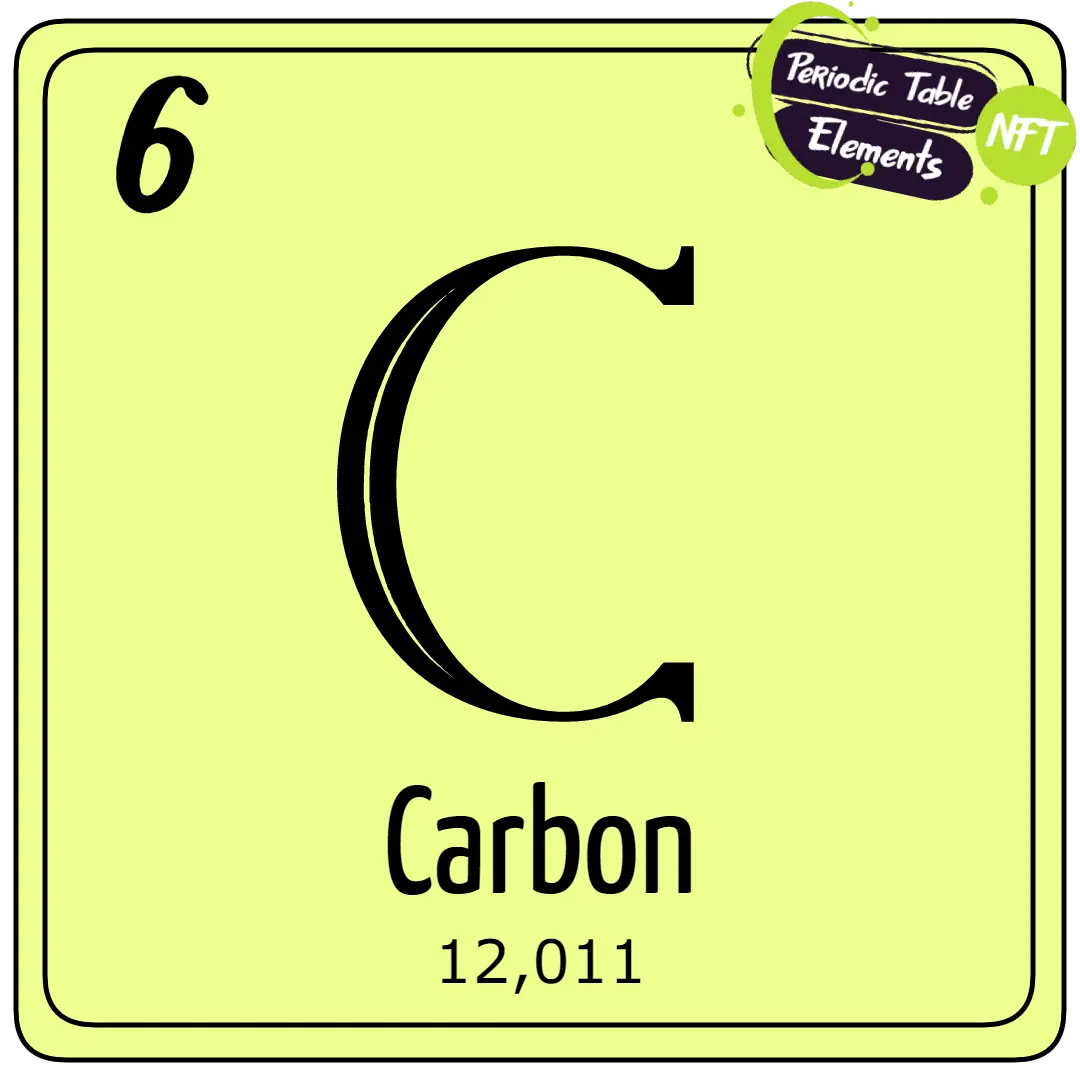
Let's find out more now about the chemical element with atomic number 6 and symbol "C": the carbon. It is a non-metallic element, tetravalent, insoluble in solvents, odorless and tasteless.
It can be graphite (soft carbon) or diamond (hard carbon). There are 10 million carbon compounds that form the basis of all life on Earth, and the carbon-nitrogen cycle provides some of the energy produced by the stars.
Applications
The main commercial use of carbon is in the form of hydrocarbons, mainly fossil fuels (methane gas and oil). [2] Oil is used in refineries to produce fuels through a fractional distillation process, from which, among others, gasoline, diesel and kerosene are obtained. Petroleum is also used as a raw material in the petrochemical industry for the production of many synthetic substances, including plastics, fibers, solvents and paints. [2]
Other uses of carbon are:
- The 14C isotope discovered on February 27, 1940 is used in radiocarbon dating and as a radioisotope tracer.
- Graphite is used in drawing pencils, electric motor brushes and as a refractory lining in ovens.
- Diamonds are used for ornamental purposes and also as piercing tips and in other applications that take advantage of their hardness.
- Carbon is added in low percentages to iron to make steel. Always bound to iron, but in percentages higher than 2%, cast iron is obtained which has excellent castability and resistance to wear.
- In the form of charcoal it is used for heating and as an adsorbent material (activated carbon) in the chemical industry and as a homeopathic remedy.
- Several scientific researches have highlighted the possibility of using carbon as a catalyst or support for a catalyst and as an electrocatalyst.
- It is also used as a primary material, or as a reinforcing fiber, combined with Kevlar, in the production of sporting goods (including field hockey sticks, tennis rackets, skis, fishing rods), in airplanes and in the upholstery (internal or external) of sports or racing cars, both for its resistance and for its lightness.
- Carbon is used in nuclear power plant control rods in the form of boron carbide, and as a moderator to slow fast neutrons down to energies of the order of one hundredth of an electron volts.
The Periodic Table NFT project
The Periodic Table NFT project aims to raise awareness of chemical elements in a modern key, basing the approach on blockchain and Non Fungible Token.
Day after day it will be possible to know the single elements that make up the table, to collect curiosities about each of them and about the table in general.
We are working to be able to learn, in a playful way, also what happens by combining the various elements.
The whole project is based on the collection of NFTs that can be bought on the site https://wax.atomichub.io/market?collection_name=periodicelem&order=desc&sort=created&symbol=WAX or by participating in simple giveaways published on publish0x.
Link to save





