
🟠 Introduction:
The headlines write themselves. “Bitcoin uses more energy than Argentina.” “Crypto mining is boiling the planet.” “Proof of work is an environmental disaster.” If you’ve spent any time in mainstream financial media, you’ve absorbed this framing and probably without questioning it.
I have. Because I’ve been mining Bitcoin since 2019. I’ve run an industrial scale operation and currently mine from a home setup. I’ve watched the energy narrative evolve from a fringe concern into a full blown ESG talking point, and I can tell you this: the conversation is dominated by people who’ve never plugged in a miner, never negotiated a power contract, and never once considered what energy consumption actually means in the context of securing a global monetary network.
This isn’t a defense brief for Bitcoin. It’s a correction. The energy debate around Bitcoin mining is riddled with myths, half-truths, and deliberate conflations. Some of these myths come from genuine misunderstanding. Others come from industries with every incentive to make Bitcoin look bad. And a few of the criticisms? They’re legitimate, and miners like me need to own them.
Let’s walk through the biggest myths and the realities behind them, then talk honestly about the problems that actually deserve attention.
I've been mining Bitcoin since 2019, from home mining to industrial scale. Every week I break down mining economics, fee markets, and what actually moves profitability. Subscribe to get new essays in your inbox.
🟠 Myth 1: “Bitcoin Uses More Energy Than Entire Countries”

This is the most commonly cited attack, and it’s technically true in the narrowest possible sense. As of late 2025, the Cambridge Centre for Alternative Finance estimates the Bitcoin network consumes roughly 138–211 TWh of electricity annually, depending on the methodology and time period measured. That puts it in the range of countries like Thailand or Poland.
Sounds damning. But this framing commits a fundamental error: it equates energy use with energy waste. These are not the same thing.
The global banking system (every branch, ATM, data center, card processing network, corporate office, and currency manufacturing operation) consumes an estimated 260–700 TWh per year, depending on how broadly you draw the boundary. Gold mining and refining accounts for roughly 240–265 TWh annually. Both of these figures dwarf Bitcoin’s consumption, yet neither triggers the same pearl clutching from editorial boards.
Why the asymmetry? Because we’ve collectively agreed that banking and gold “deserve” their energy budgets. We’ve decided that running 80,000 bank branches in the United States alone is a justified use of electricity, while securing a decentralized, censorship resistant, globally accessible monetary network is not. That’s not an engineering argument, it’s a values argument wearing a lab coat.
Here’s what the country comparison actually obscures: Bitcoin’s energy consumption represents roughly 0.5% of global electricity production and less than 0.1% of total human energy production. Of the approximately 160,000 TWh of primary energy generated worldwide each year, some 50,000 TWh is simply lost to inefficiency such as wasted heat, transmission losses, curtailed generation that nobody uses. Bitcoin’s entire annual draw is a rounding error against what we already throw away.
The question was never “does Bitcoin use energy?” Of course it does. The question is whether that energy purchases something valuable. If you believe that a monetary network that operates without permission, cannot be censored by any government, settles transactions globally in minutes, and has zero counterparty risk is worth securing, then yes, the energy is well spent. If you don’t, no amount of renewable adoption will satisfy you, because your objection was never really about kilowatt hours.
🟠 Myth 2: “Mining Is Killing the Planet”

The environmental narrative around Bitcoin mining has improved dramatically over the past several years, but media coverage hasn’t caught up. According to the 2025 Cambridge Digital Mining Industry Report (the most rigorous survey of actual mining operations available) 52.4% of Bitcoin mining’s energy now comes from sustainable sources. That breaks down to 42.6% from renewables like hydropower, wind, and solar, plus 9.8% from nuclear.
That 52.4% figure is up from 37.6% in 2022. The trajectory is clear, and it’s driven by economics, not virtue signaling. Miners are relentless cost optimizers. The cheapest electricity on earth tends to be either renewable or stranded such as hydropower in Paraguay and Canada, geothermal in Iceland, wind in West Texas, solar in the desert Southwest. Miners don’t chase green energy because they read an ESG report. They chase it because it’s cheap.
But the environmental story goes deeper than the energy mix. Bitcoin mining has emerged as one of the most effective technologies for monetizing stranded energy. Energy that would otherwise be wasted entirely.
Consider flared natural gas. Oil extraction produces methane as a byproduct. When there’s no pipeline infrastructure to capture it, producers either vent it directly into the atmosphere (catastrophic for greenhouse effects, since methane is roughly 80 times more potent than CO2 over a 20-year period) or flare it (better, but still wasteful). Companies like Crusoe Energy and others have built infrastructure to capture this gas at the wellhead and use it to power Bitcoin mining operations. The result is a direct reduction in methane emissions by turning a waste product into productive work.
Then there’s grid stabilization. This is the use case that most outsiders miss entirely, and it might be the most consequential. Bitcoin miners are uniquely suited to act as flexible load resources on electrical grids. Unlike a hospital, a factory, or a data center, a mining operation can power down in seconds with no consequence other than lost revenue. This makes miners ideal participants in demand response programs.
In Texas, where the ERCOT grid has faced repeated crises during extreme weather, Bitcoin miners have become critical infrastructure partners. During heat waves and winter storms alike, miners have voluntarily curtailed operations (sometimes shutting down over 95% of capacity) to release power back to the grid when residential consumers need it most. Riot Platforms earned $31.7 million in power curtailment credits during a single month in 2023 by doing exactly this.
ERCOT has formalized this relationship through voluntary curtailment programs for Large Flexible Loads. The arrangement is elegantly simple: miners consume cheap surplus power when the grid is oversupplied (which happens often with growing solar and wind penetration), and they shut off when demand spikes. They function, in effect, as a demand side battery absorbing excess generation that would otherwise be curtailed and giving it back when the grid is stressed.
Critics frame demand response payments as “subsidies to miners.” But that framing ignores a basic reality: ERCOT pays all demand response participants, not just miners. The grid operator has determined that paying flexible loads to curtail is cheaper than building additional peaking generation plants. Bitcoin miners just happen to be the most responsive flexible load ever connected to a power grid.
During Winter Storm Elliott in December 2022, Bitcoin miners across North America curtailed as much as 100 exahashes per second (roughly 38% of the entire network’s hashrate at that time) to keep residential power flowing during a life threatening cold snap. No other industrial load on earth can scale down that quickly, that voluntarily, with that little friction. A data center running cloud services can’t just power off its servers without cascading consequences for millions of users. A factory can’t halt its production line without breaking contractual obligations. But a Bitcoin miner? Flip the switch, lose some revenue, flip it back on when the crisis passes. The mining hardware doesn’t care.
This flexibility is also proving critical for renewable energy adoption. Solar and wind generation create periods of surplus electricity when production exceeds demand. Without flexible loads to absorb that surplus, grid operators have to curtail renewable generation, literally paying wind farms to stop producing clean energy because there’s nowhere for it to go. In ERCOT, about 3% of solar output was curtailed in 2023. Bitcoin miners can absorb that surplus, making renewable projects more economically viable and reducing the amount of clean energy that goes to waste.
🟠 Myth 3: “ASICs Are Inefficient Energy Hogs”
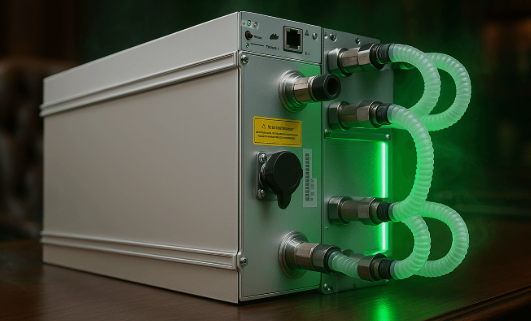
If you haven’t kept up with mining hardware since 2017, I understand why you might believe this. The Antminer S9 — the workhorse that dominated Bitcoin mining from roughly 2017 to 2020 — operated at approximately 98 joules per terahash (J/TH). It produced 13.5 TH/s of computational power while consuming about 1,323 watts. For the era, it was revolutionary. By today’s standards, it’s an antique that makes an amazing space heater. I should know, I still run one in the home office (noisy stock fans replaced with silent Noctua technology).
The current generation of mining hardware tells a completely different story. The Antminer S23 air-cooled model delivers 318 TH/s at approximately 11 J/TH (3,498W) (nearly nine times more energy efficient than the S9). The hydro-cooled S23 Hyd pushes that further to 9.5 J/TH at 580 TH/s (5,510W). And the rack-mounted S23 Hyd 3U achieves the same 9.5 J/TH efficiency while delivering 1,160 TH/s (11,020W). A ten fold improvement in energy efficiency in roughly eight years.
To put this in concrete terms: a single S23 air-cooled unit produces more hashrate than 23 Antminer S9 units combined, while consuming only about 2.6 times the electricity. The same amount of network security that once required a warehouse of S9s now requires a single rack of modern machines.
This efficiency curve follows semiconductor physics. Each new ASIC generation leverages smaller chip fabrication processes (from 16nm on the S9 to the latest nodes on the S23 series) extracting more computation per watt. Advanced voltage optimization and liquid cooling on the S23 Hyd models dramatically reduce waste heat compared to the S9’s higher-voltage design.
What this means for the network’s environmental footprint is significant. Even as Bitcoin’s total hashrate has grown from roughly 40 EH/s when I started mining in 2019 to over 1100 EH/s (1.1 ZH/s) today (a 27.5x increase) total energy consumption has grown far less than proportionally. The network is performing vastly more work per unit of energy consumed. Hardware efficiency improvements have absorbed a huge portion of hashrate growth.
The miners who are still running S9s in 2026 are doing so exclusively in environments with near-zero electricity costs: stranded gas, behind-the-meter solar, or waste heat applications where the S9 doubles as a space heater. In every commercial mining operation I’m aware of, older hardware has been phased out or is actively being replaced. The fleet is getting cleaner every quarter.
🟠 The Real Problems Worth Discussing
If I stopped here, I’d be doing exactly what I criticize mainstream media for doing. Telling only half the story. Bitcoin mining has real environmental challenges that the industry needs to address honestly.
🔸 E-waste is a legitimate concern
The ASIC lifecycle is relatively short. When a new generation of hardware renders older machines unprofitable at most electricity rates, millions of units become paperweights. An S9 has essentially no resale value in 2026 except as a novelty or a space heater. The specialized nature of ASICs (they can only perform SHA-256 hashing) means they can’t be repurposed for general computing the way a retired GPU can. Some companies are working on recycling programs, and the rare earth metals in these machines have recovery value, but the industry hasn’t built a mature circular economy for mining hardware yet.
🔸 The coal legacy is fading, but not gone
While coal’s share of Bitcoin mining energy has dropped dramatically (from 36.6% in 2022 to just 8.9% in 2025 according to Cambridge) it hasn’t reached zero. Some mining operations, particularly in parts of Central Asia and developing markets, still rely on coal-heavy grids. The industry’s migration toward natural gas (now 38.2% of the energy mix) is an improvement in carbon intensity, but natural gas is still a fossil fuel. The honest position is that the energy mix has improved substantially and the trend is strongly positive, but the job isn’t done.
🔸 Transparency remains incomplete
The Cambridge report’s 52.4% sustainable energy figure is based on survey data representing 48% of global mining activity. That’s the best data we have, and it comes from a credible institution. But it means we’re still extrapolating about the other half of the network. Self reported sustainability data from publicly traded miners is improving, but private operations (which still represent a meaningful share of global hashrate) remain a black box. More transparency would help the industry’s case enormously.w
🔸 Water consumption and local impacts deserve attention
Large scale mining operations require significant cooling infrastructure. Air-cooled facilities in hot climates consume substantial electricity just for thermal management. Hydro-cooled and immersion-cooled setups are more efficient but introduce water consumption as a variable. Local communities near mining operations have legitimate concerns about noise, grid impact, and resource competition that deserve engagement rather than dismissal.
🟠 What the Energy Debate Actually Signals
Here’s what mining since 2019 has taught me about the energy conversation: it’s an adoption signal, not a death sentence.
Every transformative technology goes through an energy panic phase. The internet was going to consume all available electricity. AI data centers are the current villain and by some estimates, they’re projected to consume more power than the entire Bitcoin network by the end of 2025. Air conditioning, automobiles, aluminum smelting; every energy intensive technology that became foundational to modern life was once criticized for its consumption.
The pattern is consistent: the technology improves in efficiency, the energy mix shifts toward cleaner sources, and society eventually accepts the trade off because the value delivered justifies the cost. Bitcoin is on that exact trajectory. The network’s energy efficiency improves with every hardware generation. The sustainable energy share grows every year. And the value proposition (a globally accessible, censorship-resistant, sound monetary network) becomes more apparent as traditional financial systems demonstrate their fragility.
Consider the efficiency gains in hard numbers. When I started mining in December 2019, the dominant hardware was the S17 and S9 generation. The network hashrate was roughly 90 EH/s. Today it exceeds 1100 EH/s, a twelve-fold increase. But total energy consumption hasn’t increased twelve-fold. Hardware efficiency improvements have absorbed the majority of that hashrate growth. If the network were still running on S9 era hardware at today’s hashrate, it would consume far more (roughly nine times) what it actually does. That gap between theoretical and actual consumption represents an enormous amount of environmental progress that never makes the headlines.
The loudest critics of Bitcoin’s energy use are rarely people who have considered what it would cost to replicate Bitcoin’s properties through any other mechanism. There is no low energy way to create a trustless, decentralized, immutable ledger that secures trillions of dollars in value. Proof of work is the energy cost of removing the need for trusted intermediaries. That’s not a bug. That’s the product.
Some critics point to proof of stake as an alternative that uses 99.9% less energy. That’s true in a narrow technical sense, but it misses the point entirely. Proof of stake and proof of work make fundamentally different security trade offs. Proof of stake reintroduces capital-based gatekeeping. The more coins you hold, the more power you wield over the network. Proof of work democratizes participation through energy expenditure, which anyone can access regardless of their existing wealth. Whether you prefer one over the other is a legitimate design debate, but pretending they’re equivalent systems with different energy profiles is intellectually dishonest.
The miners who will thrive through the next decade are the ones who understand this and who chase the cheapest, cleanest energy not because they want good PR, but because physics and economics demand it. The network rewards efficiency. Operators who can’t find sustainable competitive advantages in their energy sourcing will be priced out by those who can.
As someone who’s been stacking sats since the difficulty was a fraction of what it is today, I’ve watched this industry mature from garage operations to grid-scale infrastructure partnerships. The trajectory is unmistakable. Mining is getting cleaner, hardware is getting more efficient, and the energy debate is gradually shifting from “should Bitcoin exist?” to “how do we optimize its energy profile?”
That shift is the real story. And it’s one that only operators who’ve lived it can tell.
✅ Follow my socials:
Follow along on X or Bluesky.
- 🐦 X: @OrngeHorizonBTC
- 🦋 Bluesky: @orngehorizonbtc.bsky.social
✅Get these in your inbox:
I publish weekly operator breakdowns on mining economics, fee markets, and Bitcoin fundamentals. No hype, no price calls — just hands-on analysis from an operator mining since 2019.
- 📧 Free newsletter: orangehorizonbtc.substack.com
Disclosure: Some images of this story were created with assistance from DALL·E.





