
In this post, I want to document the strategy I am currently implementing within the opXEN ecosystem. This is not investment advice, but a transparent description of how I approach long-term accumulation, automation, and predictable cash flow using protocol mechanics rather than market timing.
1. Core Idea: Split Staking and a Daily Loop
The foundation of my strategy is split staking in opXEN.
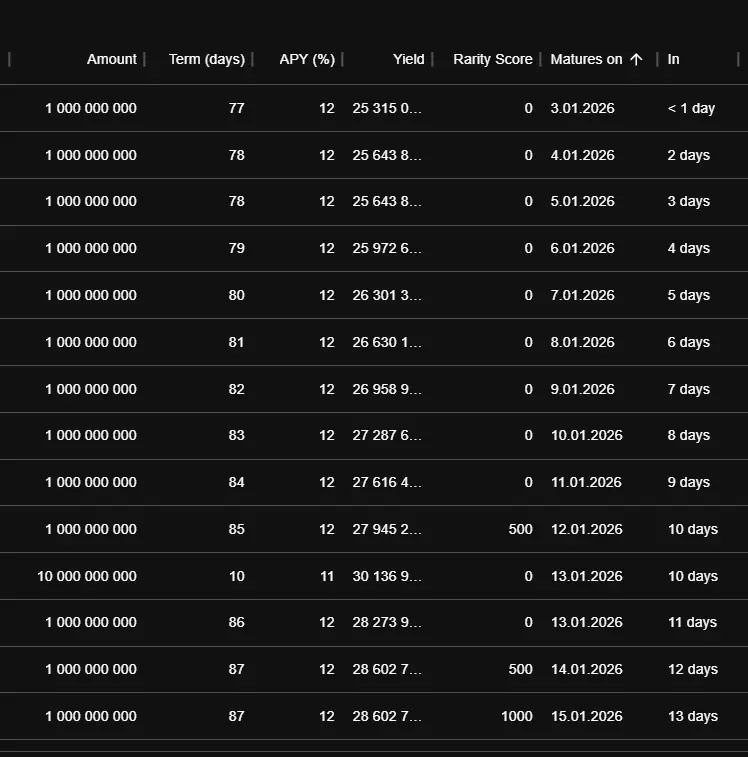
Instead of creating one large stake, I plan to create 1,000 separate stakes, each:
-
with a size of 1,000,000,000 opXEN,
-
locked for the maximum period of 1,000 days (protocol limit),
-
started sequentially, one per day.
After the initial 1,000-day buildup phase, this structure reaches a steady state where one 1,000-day stake ends every single day.
The result:
-
daily principal unlock,
-
daily staking rewards,
-
no need to time exits or make large, emotional decisions.
This creates a continuous, predictable daily reward stream, which can be allocated further according to market conditions.
2. Managing Staking Rewards
Rewards from mature stakes are split into several streams:
-
a portion swapped to USDC / ETH, realizing ongoing cash flow,
-
a portion held long-term, with the intention of building liquidity pools once a sufficient size is reached,
-
flexibility to adjust allocations depending on market cap, liquidity, and protocol maturity.
The key point is that staking is not treated as a locked vault, but as an engine producing daily optionality.
3. Automation: Minting opXEN at Scale
In parallel, I built a minting script for opXEN that:
-
always uses the maximum mint term,
-
executes minting when network costs are as low as possible,
-
allows systematic accumulation without manual intervention.
Minting is treated as a separate input stream, independent from secondary market purchases.
4. Mint Rewards Allocation: Burning via DBXEN
Rewards from opXEN minting are mostly not sold.
Currently, the most efficient use is:
-
burning via DBXEN, which at present offers the best cost-efficiency,
-
staking the resulting DBXEN,
-
using DBXEN staking rewards to mint additional opXEN.
This forms a closed loop:
opXEN mint → DBXEN → rewards → opXEN mint
Importantly, this loop operates without adding sell pressure to opXEN itself.
5. Protocol Phase and the Role of AMP
This strategy is built around the current phase of the opXEN protocol:
-
opXEN is already in a low-inflation phase, with new token issuance significantly reduced,
-
AMP is already at 1, meaning new mints no longer receive emission multipliers and will not decline further.
-
staking APY will continue to decrease over time until it reaches the permanent 2% level,
-
In this phase, advantage shifts toward strategies that are:
-
time-based,
-
automated,
-
and minimize selling pressure.
-
The period of “easy emission” is effectively over. The protocol now rewards participants who focus on structure, duration, and reinvestment, rather than short-term extraction.
6. Why This Approach
This strategy is:
-
capital-intensive upfront,
-
patience-dependent,
-
strongly reliant on automation and compounding.
In exchange, it offers something rare in crypto:
predictable, protocol-native cashflow with reduced decision fatigue.
If the assumptions hold, opXEN is not meant to be just a speculative asset for me, but infrastructure for long-term yield, liquidity, and optionality.






