
Yesterday, I wrote about how I automated minting opXENFT at the maximum allowed values and how my script worked flawlessly back then. Today, the story looks a bit different – some changes forced me to dig deeper into the mechanics of the contract and the Ethereum network itself.
Recently, I noticed that my transactions with vmu values that previously went through without issues started getting rejected or took significantly longer before the contract finally accepted them. I checked step by step what was happening:
Network Activity and Competition
Ethereum has undergone several significant updates in recent years that affected how transactions are processed and how data is handled: the Dencun upgrade (March 2024) introduced EIP‑4844, and Pectra (May 7, 2025) changed block data management and network efficiency. In practice, this means that higher network traffic and competition for blocks cause vmu values that were previously “safe” (vmu=128) to be rejected more often or processed more slowly.
Changes in xen.network UI
The developer updated the UI on the xen.network website, which now shows a maximum vmu value of 60 on Ethereum L1. The on-chain contract itself remains unchanged. On L2 (Optimism), the UI still shows the old maximum value of 128. In practice, this means that in both layers, previous maximum vmu values no longer behave as before – larger mints are more likely to be rejected or take longer to process.
Importance of Mint Length and VMU Values
In my script, I reduced the mint length from 528 to 520 and the vmu value from 128 to 50, which proved to be crucial. Longer mints or higher vmu values take more time and consume more gas – combined with higher network activity, this increases the risk of transaction rejection.
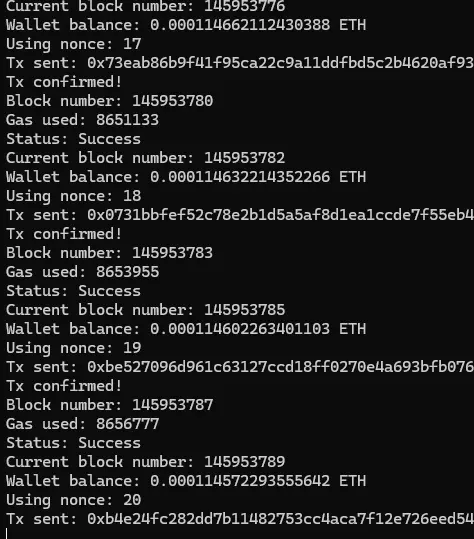
Now, my script not only sends transactions but also monitors the current block, on-chain status, and transaction success. This way, I immediately know whether the transaction went through or needs to be retried.
Practical Takeaways
-
Maximum
vmuvalues have become risky on Ethereum L1 – even if they worked before, they may now fail due to higher network activity. -
The UI shows a limit of 60 on Ethereum L1, while on L2 (Optimism) the maximum remains 128 – this difference only affects the UI presentation, not the contract’s behavior.
-
The script still works automatically, provided you use slightly lower
vmuand mint length values that are compatible with the current network and contract state. There’s no need for complex dynamic adjustments – just set values that have been tested and monitor transaction success. -
Mint length and
vmuvalues have a real impact on success – shorter or moderate values increase the chances of the transaction being included in a block.
In practice, this means that mint automation is still possible and stable, as long as you use vmu and mint length values that work under current network and contract conditions, and monitor transaction status to minimize rejections.






