
# You Don't Own That Nvidia Share: Stock Perps vs Tokenized Stocks
*Educational content, not financial advice. Mechanics only here — no signals, no targets.*
A trader in my group chat announced Friday night that he "bought Nvidia." On a crypto exchange. At 11 p.m. With 10x. Every word of that sentence deserves an asterisk, because whatever he opened, it wasn't a share of Nvidia.
Two products now put stock tickers on crypto screens equity perps and tokenized stocks and they grew faster than almost anything in the industry this year. Crypto venues processed **$1.32 trillion** in perpetual futures tied to traditional assets between January and May 2026, versus $104.21 billion in *all* of 2025 (CoinDesk, citing CoinGecko, August 2, 2026). Most traders touching them still can't say what they actually hold. Let's fix that.
## What you're actually holding
A **stock perp** is a derivative. A contract whose price chases an oracle feed of the underlying quote, with funding payments pulling it back toward the index when it drifts. No share behind it. No ownership, no voting rights, no shareholder protections. Typical leverage runs 2x–20x (DefiLlama research, August 20, 2026).
A **tokenized stock** is a claim. The token represents a real share held by a regulated custodian, 1:1, sometimes redeemable for the underlying depending on the issuer's terms. On-chain tokenized-equity market cap went from $22.6 million (April 2025) to $2.42 billion (August 2026) — ~107x in sixteen months, per DefiLlama — with the top-3 issuers holding about 77%.
Same ticker on screen. Different object underneath.
## Three myths doing real damage
- **"It's basically buying the stock."** For perps, flat wrong: you hold a leveraged bet on a price feed. For tokenized stocks, partially true at best the economic exposure follows the share, but governance and protections depend entirely on the issuer's terms. Read them before assuming.
- **"24/7 means safer."** It means the market never closes *and the risk never sleeps either*. When Nasdaq shuts for the weekend, the perp keeps printing on crypto-session flows while its oracle starves for fresh cash-market data. Tiger Research (via StrataMedia/Token Relations, August 14, 2026) found Samsung and SK Hynix perps matched the next open's direction about 85% of the time overall (conditional rates 78–96%) — good on average, but averages hide weekends, and reopen gaps don't care about your leverage.
- **"No expiry means no costs."** No expiry means the meter never stops. Funding bills arrive on schedule, calculated on your full notional, price cooperating or not.
## The side-by-side version
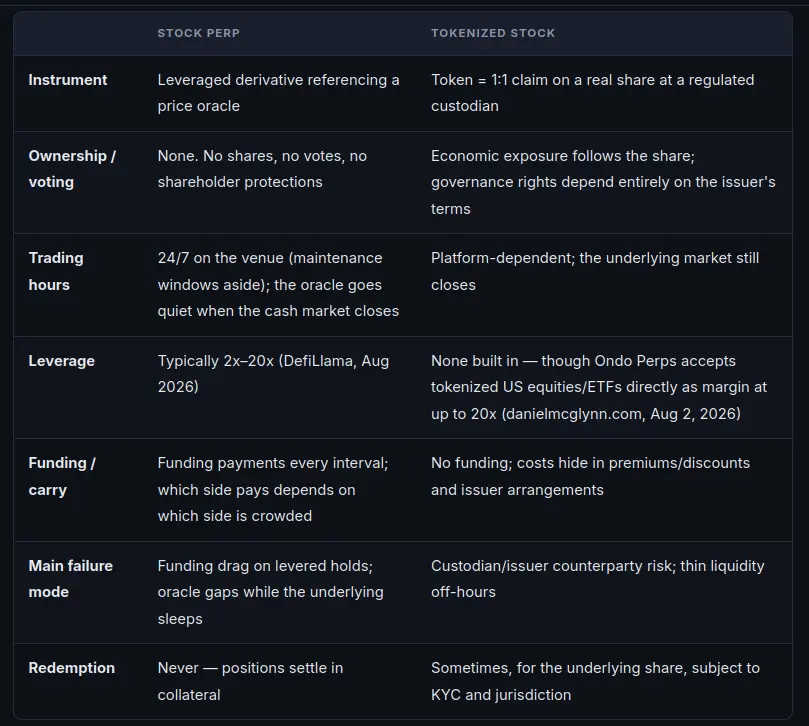
One more row worth adding mentally: **venue concentration**. Of ~$105.7B in 30-day notional across equity/index/ETF perp venues (~22% of all DeFi derivatives volume), Trade.xyz on Hyperliquid alone handled $93.5B — an 88.46% share, top-5 venues at 96.86% (DefiLlama, Aug 20, 2026). Nearly nine of every ten dollars run through one book.
## Why the sudden explosion
When SpaceX hit Nasdaq on June 12, 2026 CNBC covered the debut that day traders pushed roughly $1.4B in SpaceX perps through Hyperliquid on listing day; prints landed within dollars of the ~$150 open. S&P Dow Jones licensed the S&P 500 benchmark to Trade XYZ in March 2026 for the first officially approved onchain S&P 500 perp (non-US persons only). Coinbase pushed its "everything exchange" build-out with UK FCA/MiFID authorization, Binance added tokenized stock positions as derivatives collateral, ICE put $200M into OKX at a $25B valuation, and Kalshi filed with the CFTC for a "US500" perp tied to the MerQube US Large Cap Index. Institutional rails are being laid in public.
## The cost nobody models: funding drag
Before any multi-day hold on a levered perp, turn the funding rate into a dollar figure:
# funding_drag_stock_perps.py - approximate carry cost of a levered stock-perp hold.
# rate_pct: funding per 8h interval, in percent (0.01 = +0.01%). Swap in your venue's live rate.
# Approximation: constant rate, 3 settlements/day, billed on full notional.
# Venues that fund hourly or per-block accrue FASTER - treat results as a floor.
def funding_drag(notional, rate_pct, days, leverage):
intervals = days * 3 # 24h / 8h = 3 settlements per day
bill = notional * (rate_pct / 100) * intervals
margin = notional / leverage # capital you actually posted
return bill, 100 * bill / margin # dollars owed, % of your margin
NOTIONAL = 10_000 # e.g. $2,000 posted at 5x
LEVERAGE = 5
DAYS = 14
for rate in [0.005, 0.01, 0.05]: # illustrative levels, NOT observations
bill, pct = funding_drag(NOTIONAL, rate, DAYS, LEVERAGE)
print(f"rate {rate}%/8h | {DAYS}-day bill ${bill:,.2f} | {pct:.2f}% of posted margin")
# Output:
# rate 0.005%/8h | 14-day bill $21.00 | 1.05% of posted margin
# rate 0.01%/8h | 14-day bill $42.00 | 2.10% of posted margin
# rate 0.05%/8h | 14-day bill $210.00 | 10.50% of posted margin
What it does: converts a funding rate into dollars you can compare against your expected move *before* entering. How it works: `funding_drag` multiplies days by 3 for the number of 8-hour settlements, applies the per-interval rate to full notional (`notional × rate/100 × intervals`), then divides by `notional / leverage` so the second output shows damage as a percentage of *your* posted capital. To run it: save as `funding_drag_stock_perps.py`, execute `python3 funding_drag_stock_perps.py` no libraries, any Python 3. Adapt it by changing the three constants and plugging your venue's live equity-perp rate into `rate_pct`; the printed levels are placeholders showing scale, not observed market data.
At calm rates the bill is noise. At crowded rates it competes with your entire expected move and these markets are too young for anyone to have a long funding history that says how rates behave when a stock gaps.
## The one-line version
Neither instrument ever touches Nvidia itself. One references an oracle feed; the other references a custodian's ledger entry. Say what you hold precisely, and half the risk already gets managed.
---
*Suggested Publish0x tags: trading, perpetual futures, defi, tokenized stocks, education*






