INTRO
Every day, new crypto projects appear, and many come with big promises. For a beginner, it's hard to tell a real project from a scam. AI chatbots can help you understand things faster, but they can also make you overconfident if you use them the wrong way.
This guide shows how to use AI as a research assistant, not as a fortune teller, plus a simple framework and the red flags to watch for.
This article is educational only and is not financial advice. Crypto is risky, and you can lose everything you put in.
The golden rule: AI explains, you verify
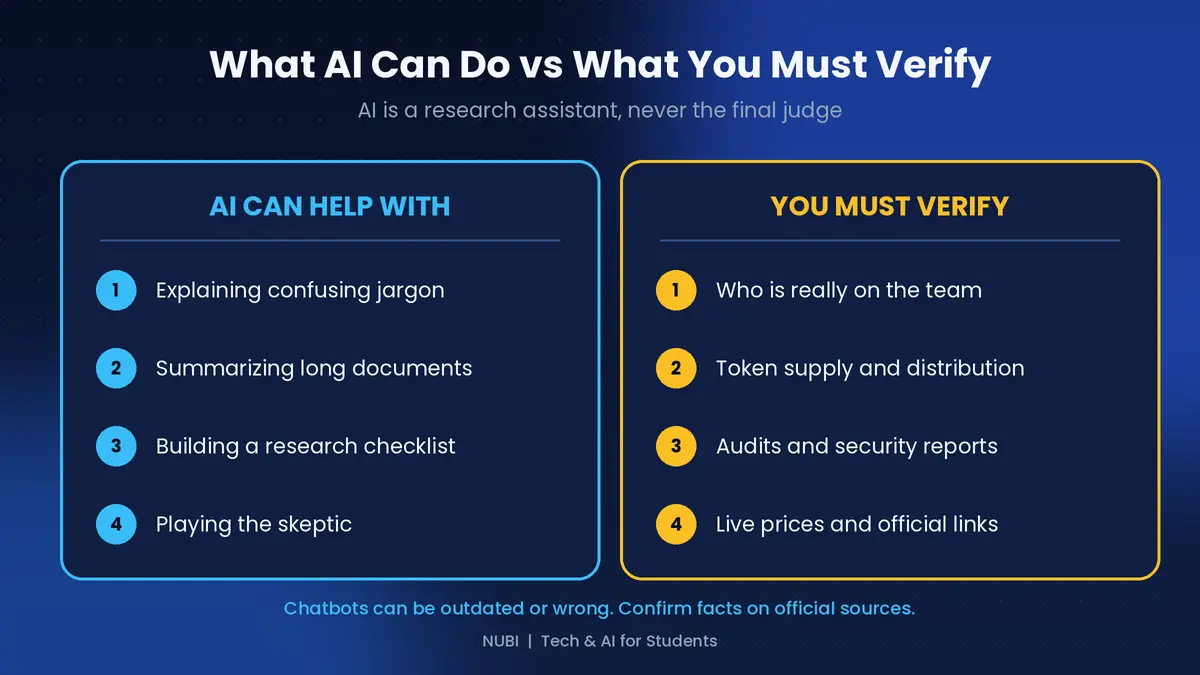
AI is useful for explaining confusing jargon, summarizing long documents, building research checklists and playing the skeptic. But it can't be trusted on its own for the important facts. Chatbots can be out of date, can make mistakes and sometimes invent details with total confidence.
So things like who is really on the team, how the token supply is shared, what audits exist and what the live price is must be checked on official sources. And never ask a chatbot "should I buy this?" It can't know your situation, and no one can predict prices.
The 5-step research framework
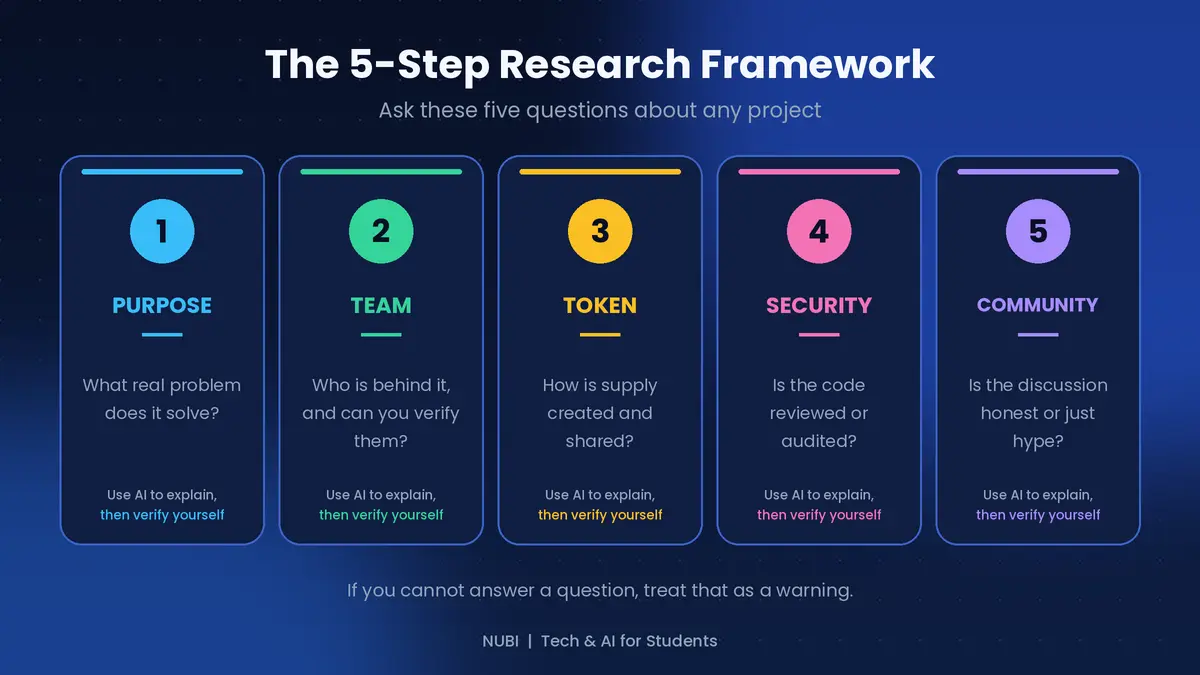
For any project, ask five questions:
Purpose: what real problem does it solve? If you can't explain it in one simple sentence, be careful.
Team: who is behind it, and can you verify them? Real people with real histories are a better sign than anonymous accounts making big promises.
Token: how is supply created and shared? If a small group holds most of it, that's a risk.
Security: has the code been reviewed or audited? Audits reduce risk but never remove it.
Community: is the discussion honest, or just hype and price talk?
For each question, ask AI to explain the concept, then check the answer yourself. If you can't answer a question, treat that as a warning.
5 prompts that keep you safe
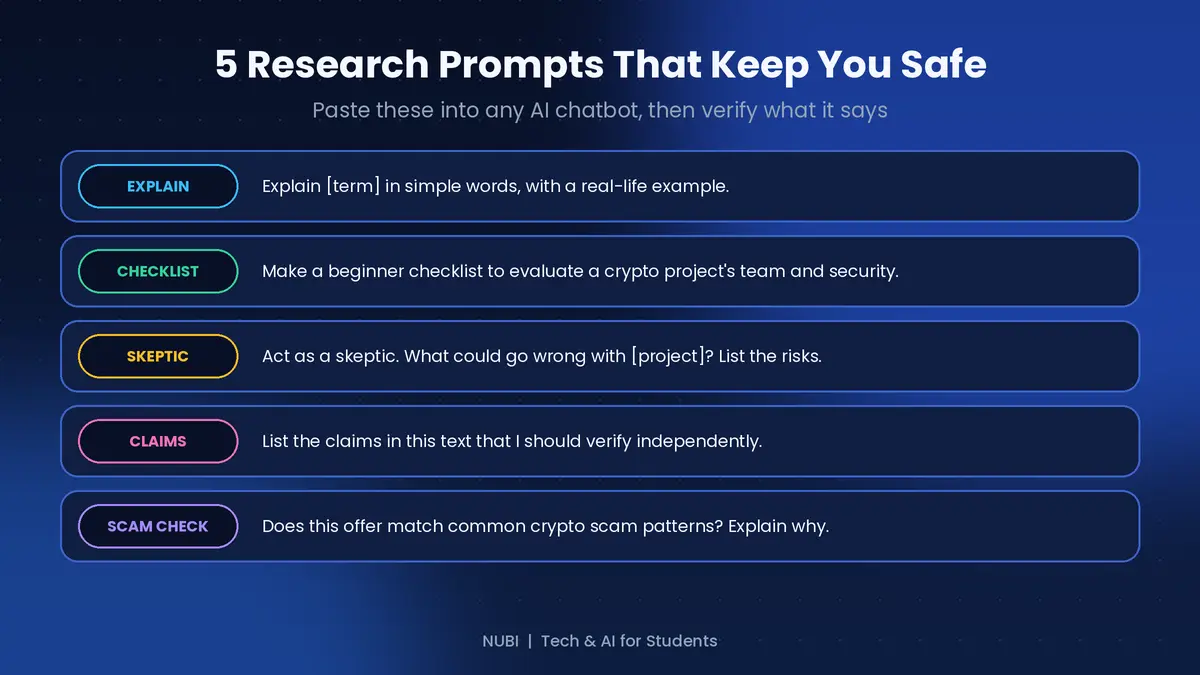
Explain: "Explain [term] in simple words, with a real-life example."
Checklist: "Make a beginner checklist to evaluate a crypto project's team and security."
Skeptic: "Act as a skeptic. What could go wrong with [project]? List the risks."
Claims: "List the claims in this text that I should verify independently."
Scam check: "Does this offer match common crypto scam patterns? Explain why."
The skeptic prompt is the most useful. Most people only look for reasons to believe, so asking the AI to argue against a project gives you the other half of the picture.
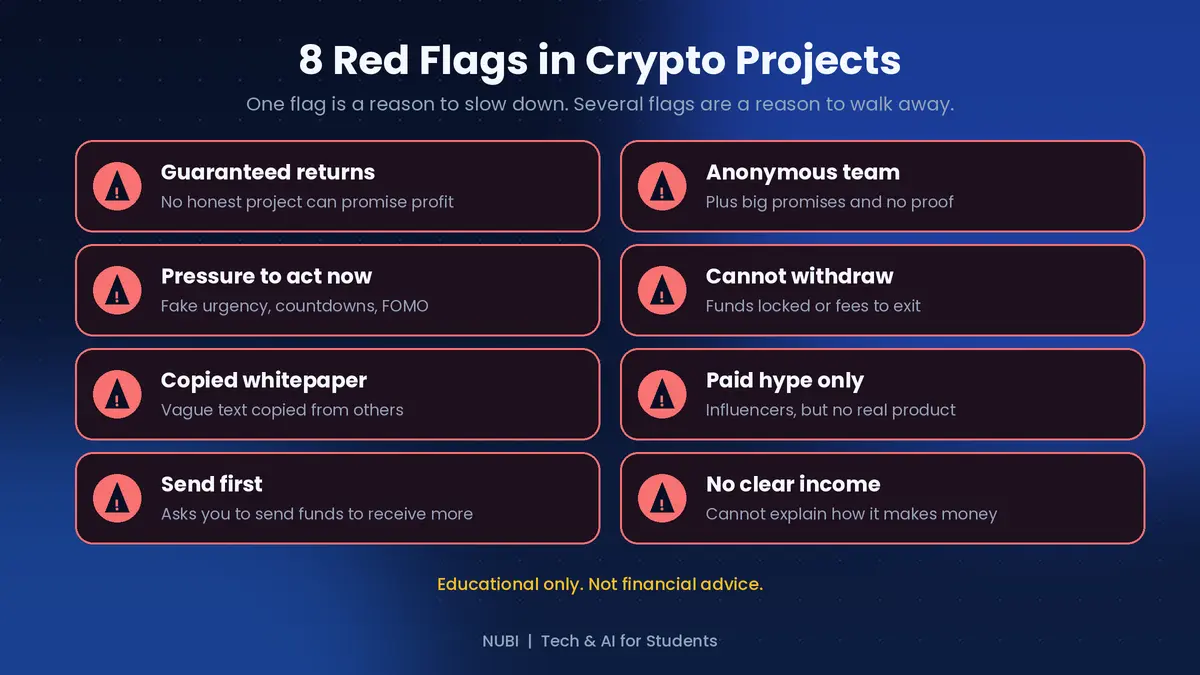
8 red flags
Guaranteed returns. No honest project can promise profit.
Anonymous team with big promises. There's no one to hold accountable.
Pressure to act now. Fake urgency and countdowns are classic tricks.
You can't withdraw. Locked funds or fees just to exit.
Copied whitepaper. Vague text lifted from other projects.
Paid hype only. Influencers promote it, but there's no real product.
It asks you to send first. Send funds to receive more? Walk away.
No clear income. The project can't explain how it makes money.
One flag is a reason to slow down. Several flags together are a reason to walk away.
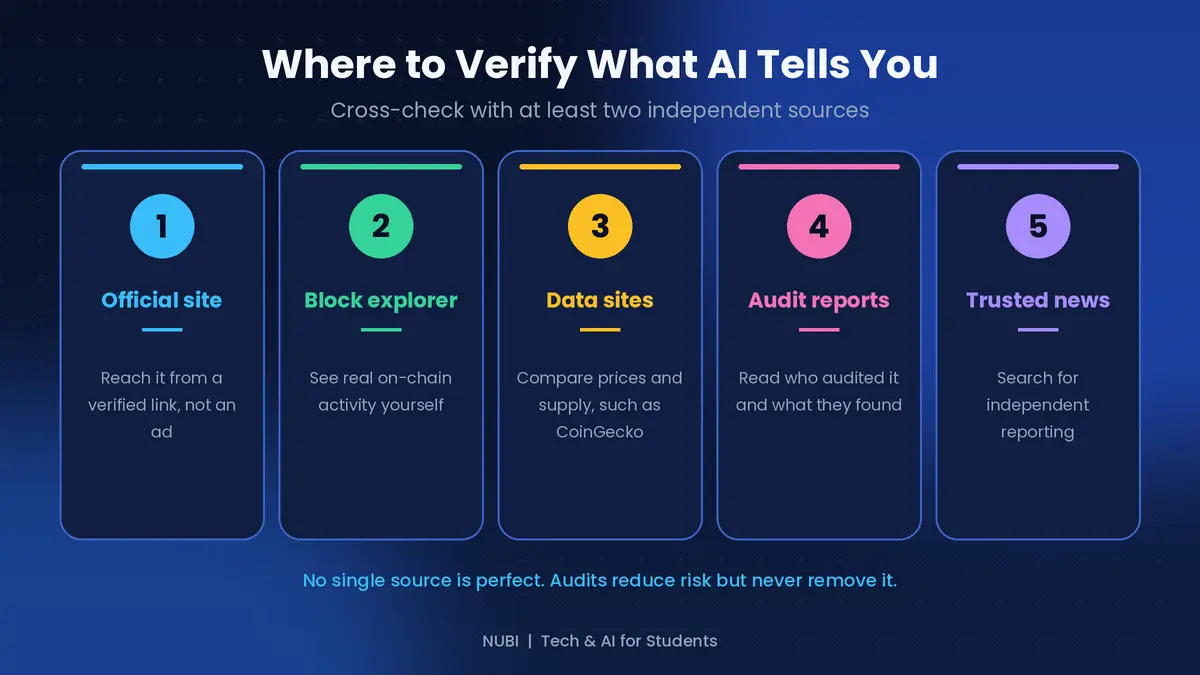
Where to verify what AI tells you
Always cross-check with at least two independent sources:
The official website, reached from a verified link and not from an ad or a message.
A block explorer, to see real on-chain activity yourself.
Data sites, such as CoinGecko, to compare prices and supply.
Audit reports, to see who audited the project and what they found.
Trusted news, to look for independent reporting.
No single source is perfect, which is why you use several. And remember the lesson from Day 10: fake accounts, fake videos and fake reviews are common in crypto, so check who is speaking before you believe them.
Protect yourself
Never share your seed phrase or private key with anyone, including "support" accounts that message you first.
Only ever risk money you can afford to lose completely, never school fees, rent or borrowed money.
If you're not sure, don't. Missing an opportunity costs far less than losing your savings.
Quick recap
AI is a research assistant, not an advisor
Verify every important fact on official sources
Use the 5-step framework: purpose, team, token, security, community
Ask AI to argue against a project, not only for it
Learn the red flags and never send funds first
Final thoughts
Good research is slow and a bit boring, and that's exactly why it protects you. AI makes the learning part faster, but the decisions and the checking are still yours. What would you like to understand better about crypto? Tell me in the comments and I'll cover it in a future guide.
Support this blog
If this guide helped you, you can tip me. Every bit helps me keep creating free guides for students. Thank you!
Next: how AI is changing education, and how students can use it honestly. Follow so you don't miss it.