INTRO
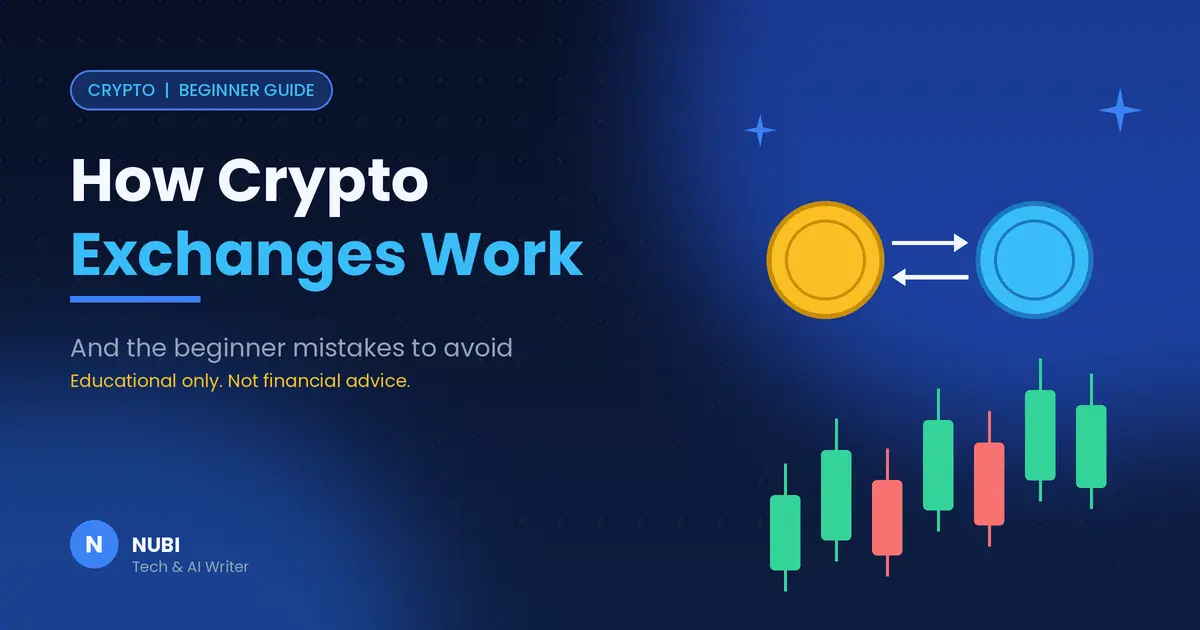
If you've read anything about crypto, you've seen the word "exchange." It's the place where people buy, sell and swap crypto, and it's usually the first stop for beginners. It's also where many beginners lose money, not because exchanges are all bad, but because small, avoidable mistakes are easy to make when everything is new.
This guide explains how exchanges work, what they cost and the mistakes to avoid.
This article is educational only and is not financial advice. Crypto is risky, and you can lose everything you put in.
What is a crypto exchange?
A crypto exchange is a platform that connects people who want to buy crypto with people who want to sell it. Think of it as a marketplace. You don't trade with the platform itself in most cases, you trade with other users, and the exchange matches the orders.
How an exchange works
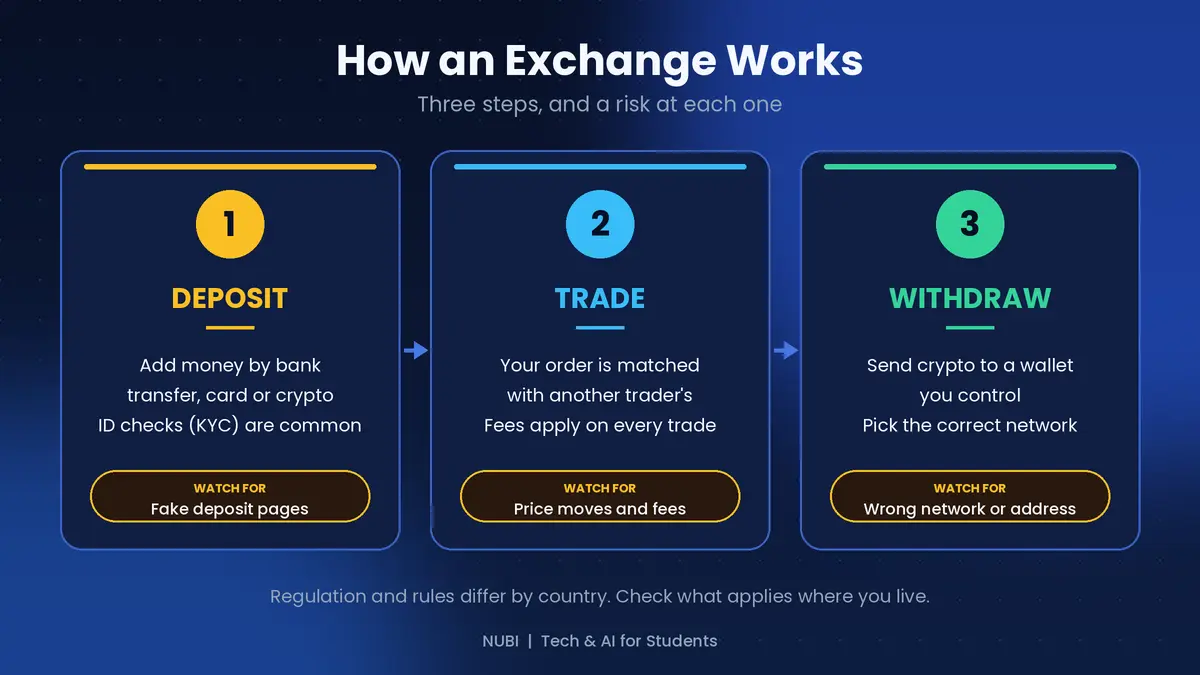
Deposit. You add money by bank transfer, card or crypto. Many platforms ask you to verify your identity first (often called KYC). Watch for fake deposit pages.
Trade. Your order is matched with another trader's order. Fees apply on every trade. Watch for price moves and fees.
Withdraw. You send crypto out to a wallet you control. You must pick the correct network. Watch for wrong networks or addresses.
Rules for exchanges differ by country, and in some places certain platforms or activities are restricted. Check what applies where you live before you sign up.
Centralized vs decentralized exchanges
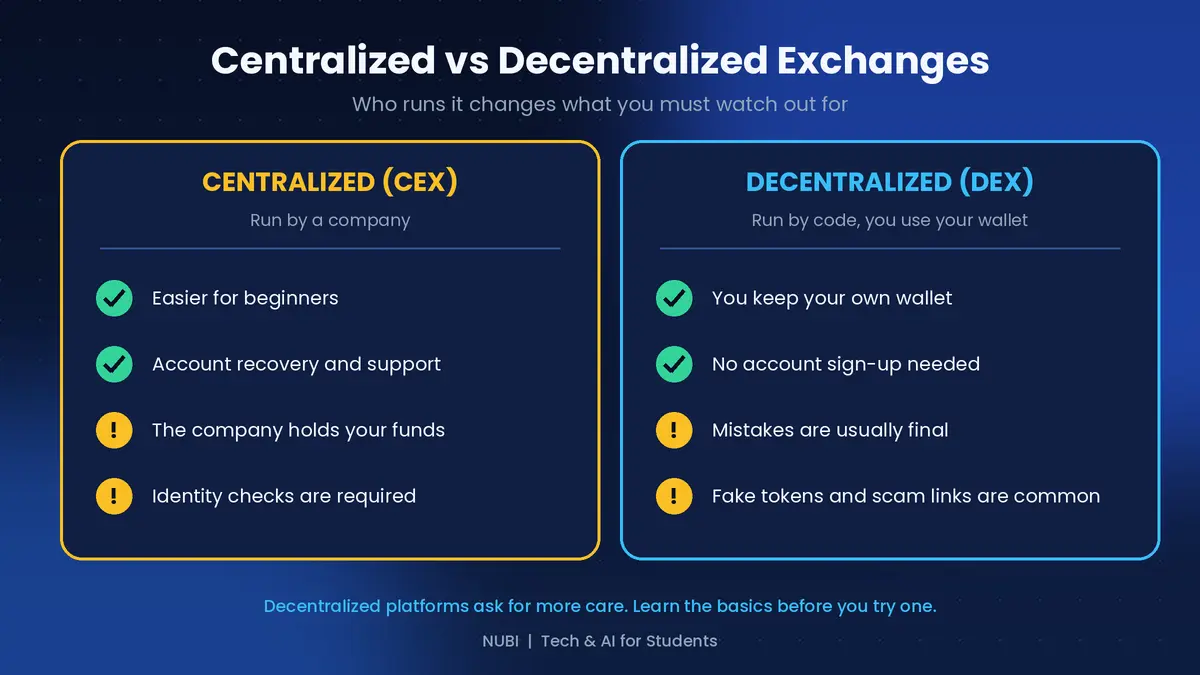
Centralized (CEX): run by a company. These are easier for beginners and usually offer account recovery and support. But the company holds your funds while they sit there, and you must pass identity checks.
Decentralized (DEX): run by code, and you use your own wallet. You keep control and don't need to sign up, but mistakes are usually final, and fake tokens and scam links are common.
Decentralized platforms ask for more care, so learn the basics before you try one. If you haven't read Day 13, it explains wallets and recovery phrases, which you'll need.
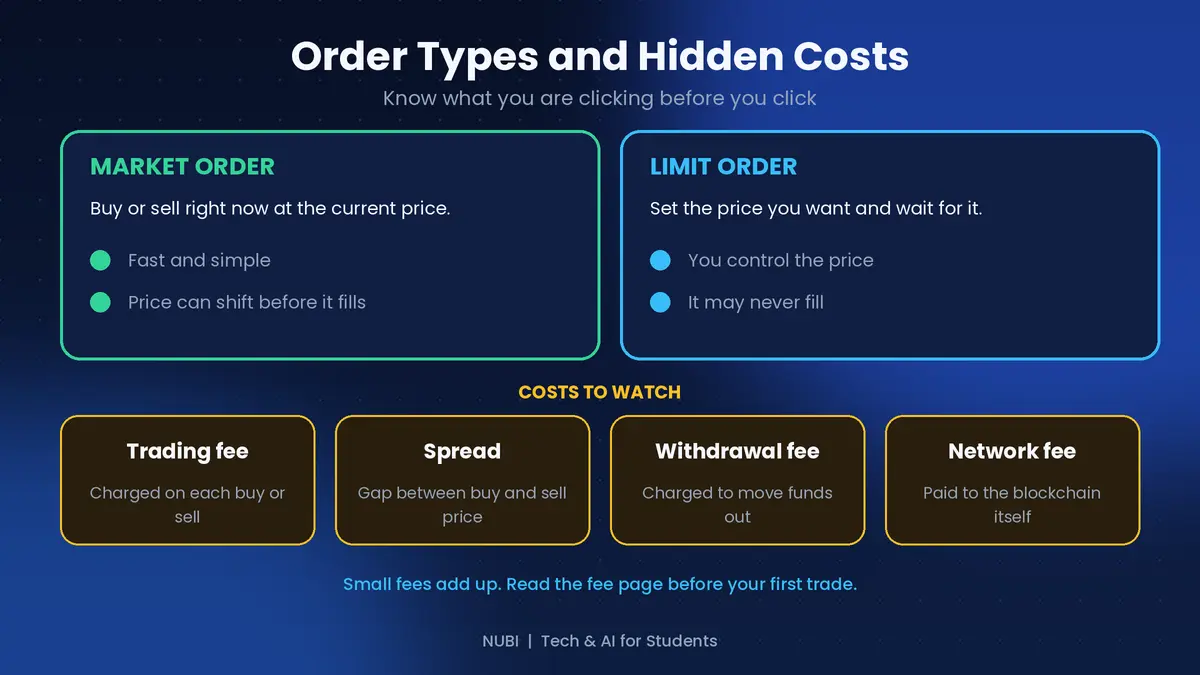
Order types and hidden costs
Market order: buy or sell right now at the current price. It's fast and simple, but the price can shift before it fills.
Limit order: set the price you want and wait for it. You control the price, but the order may never fill.
Costs you should watch for:
Trading fee: charged on each buy or sell.
Spread: the gap between the buy and sell price.
Withdrawal fee: charged to move funds out.
Network fee: paid to the blockchain itself.
Small fees add up, so read the fee page before your first trade.
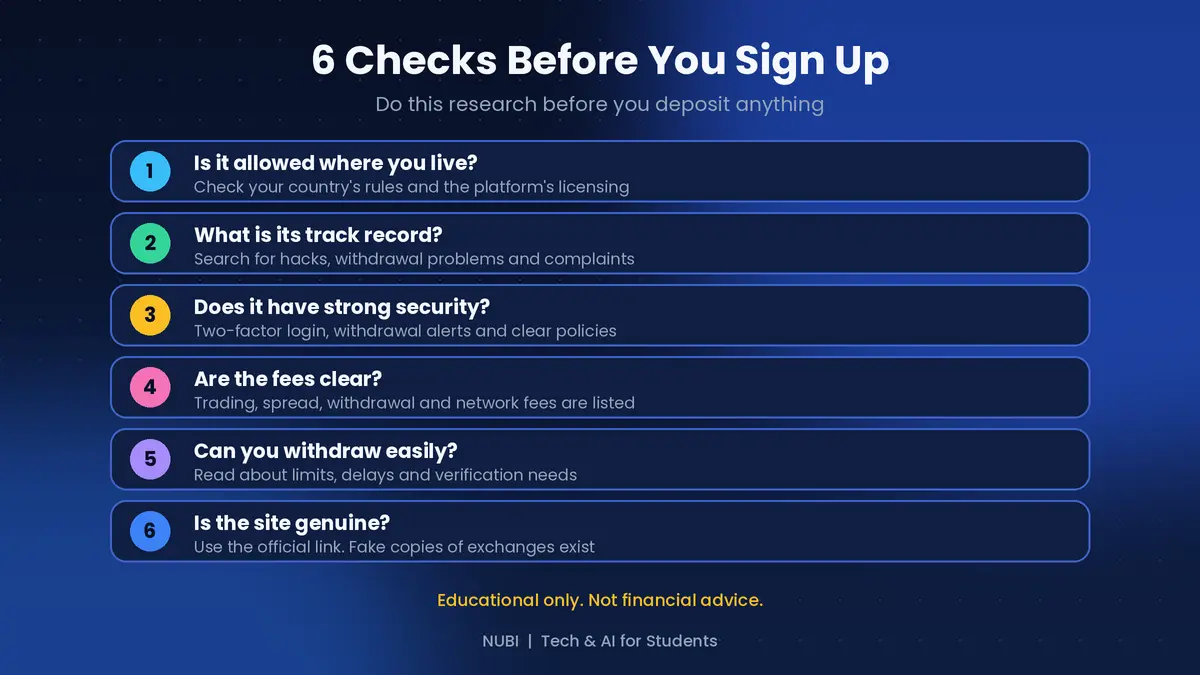
6 checks before you sign up
Is it allowed where you live? Check your country's rules and the platform's licensing.
What is its track record? Search for hacks, withdrawal problems and complaints.
Does it have strong security? Look for two-factor login, withdrawal alerts and clear policies.
Are the fees clear? Trading, spread, withdrawal and network fees should be listed.
Can you withdraw easily? Read about limits, delays and verification needs.
Is the site genuine? Use the official link, because fake copies of exchanges exist.
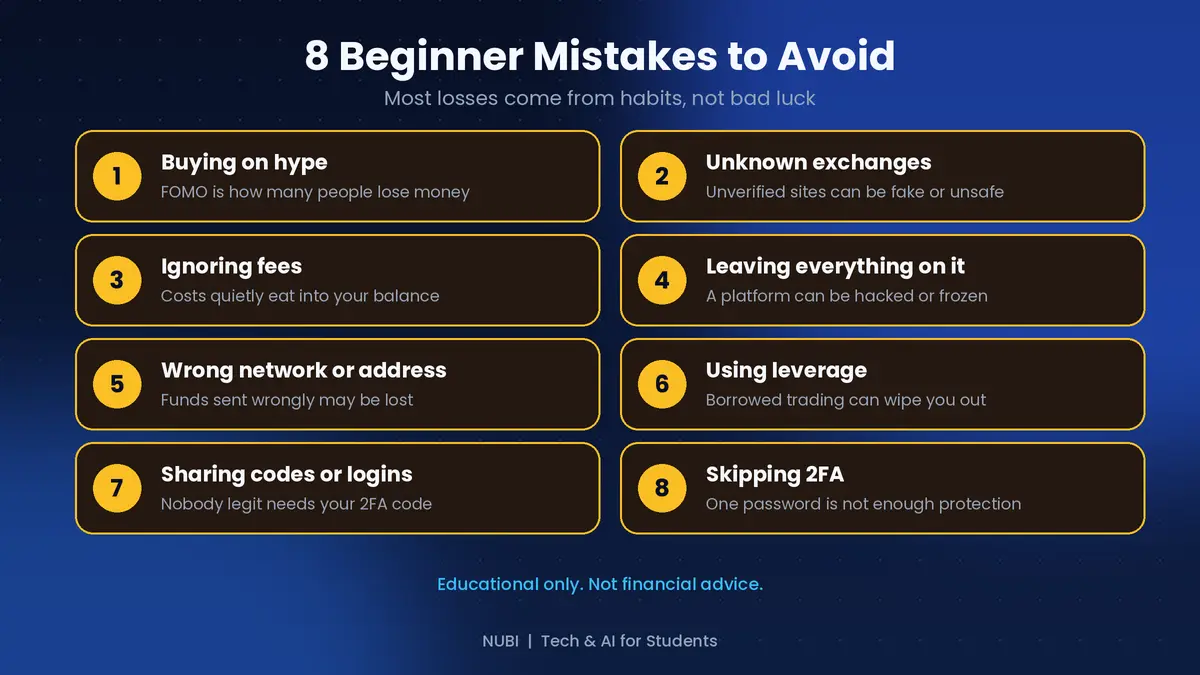
8 beginner mistakes to avoid
Buying on hype. FOMO, the fear of missing out, is how many people lose money.
Using unknown exchanges. Unverified sites can be fake or unsafe.
Ignoring fees. Costs quietly eat into your balance.
Leaving everything on the exchange. A platform can be hacked or freeze accounts.
Wrong network or address. Funds sent the wrong way may be lost.
Using leverage. Trading with borrowed money can wipe you out quickly.
Sharing codes or logins. Nobody legitimate needs your two-factor code.
Skipping two-factor login. One password isn't enough protection.
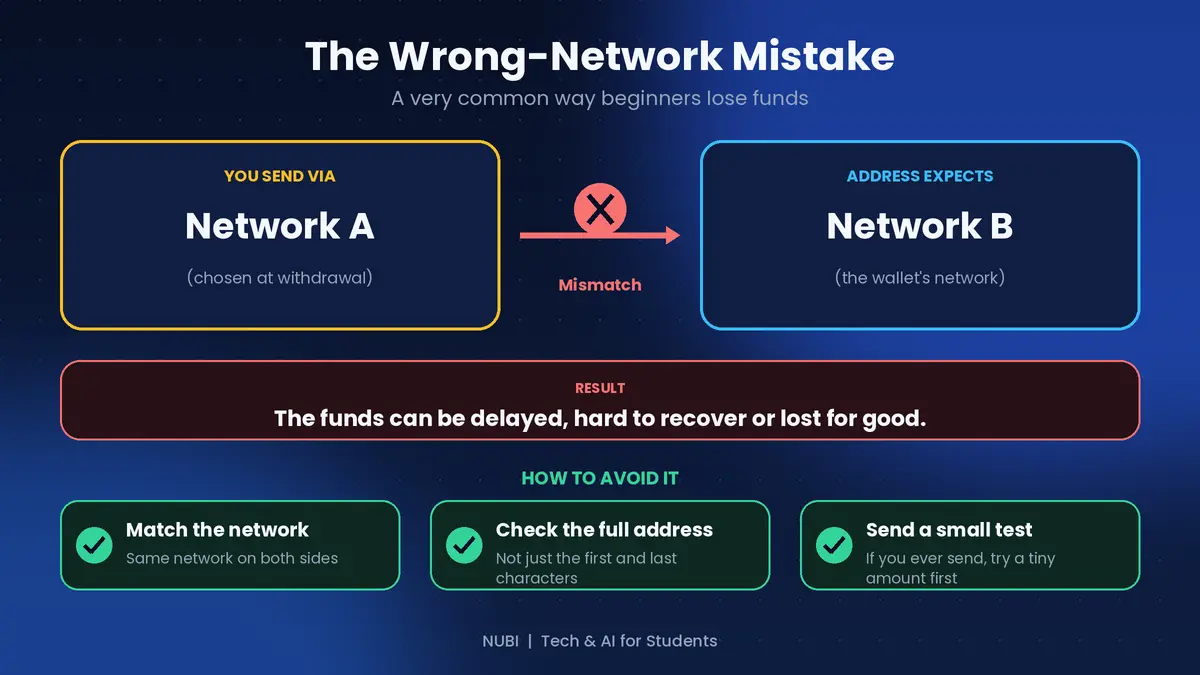
The wrong-network mistake
This one deserves its own section because it's so common. Many cryptocurrencies can be sent over more than one network. If you withdraw using one network but the receiving address expects another, the funds can be delayed, hard to recover or lost for good.
To avoid it:
Match the network on both sides.
Check the full address, not just the first and last characters.
If you ever send, try a very small test amount first.
Lock down your account
Before anything else, set up a strong, unique password and turn on two-factor login, preferably with an authenticator app. Be careful with emails or messages that claim to be from your exchange, since phishing is common. Open the platform by typing its address or using a bookmark you trust, and never share your two-factor codes with anyone.
Quick recap
An exchange is a marketplace that matches buyers and sellers
Deposit, trade, withdraw: each step has its own risk
Centralized platforms are easier, decentralized ones need more care
Fees and spreads are real costs
Research an exchange before you deposit anything
Never leave everything on one platform without understanding the risk
Match the network and verify the full address
Final thoughts
Nothing in crypto is urgent. Platforms that rush you are warning you. Take your time, learn the basics first and only ever use money you can afford to lose completely. What's your biggest question about exchanges? Tell me in the comments and I'll cover it in a future guide.
Support this blog
If this guide helped you, you can tip me. Every bit helps me keep creating free guides for students. Thank you!
Next: understanding crypto prices, and why they move so much. Follow so you don't miss it.