
Meta description: A clear, jargon-free explanation of blockchain: shared ledgers, blocks and hashes, why old records are hard to change, how a transaction travels, how networks agree and how to read a block explorer.
Intro
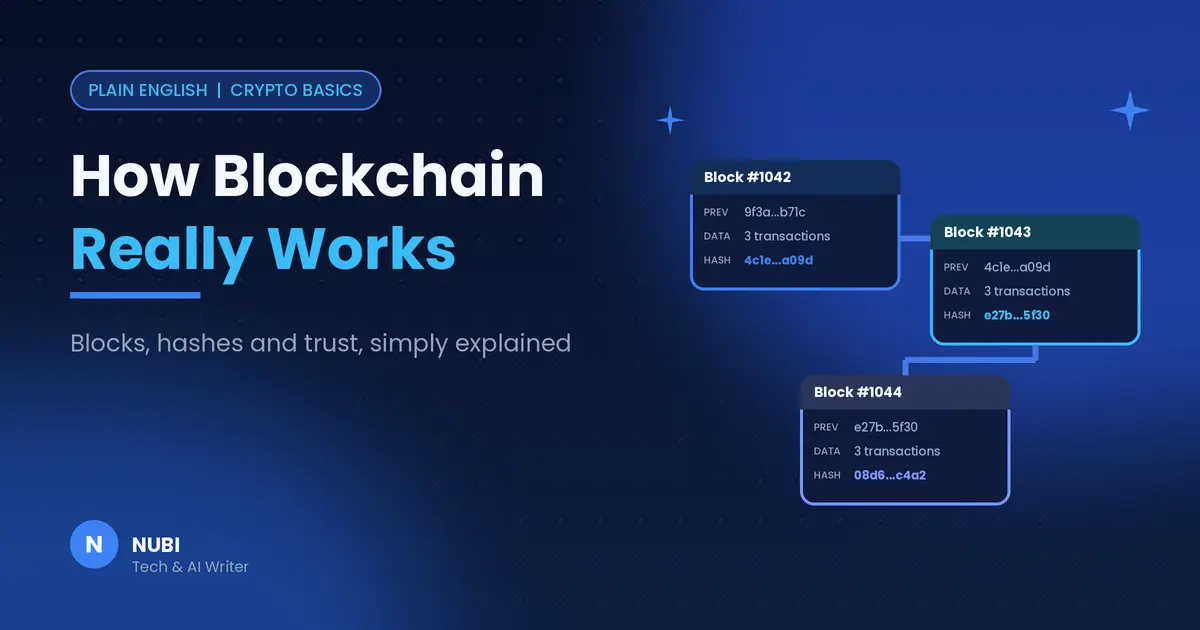
Almost every crypto guide uses the word "blockchain" and moves on as if everyone understands it. Most people don't, and that's fine. The idea is actually simple once you strip away the jargon, and understanding it makes everything else in crypto, from wallets to scams, easier to follow.
This guide explains blockchain in plain English, with examples you can picture.
This article is educational only and is not financial advice.
The core idea: a shared ledger
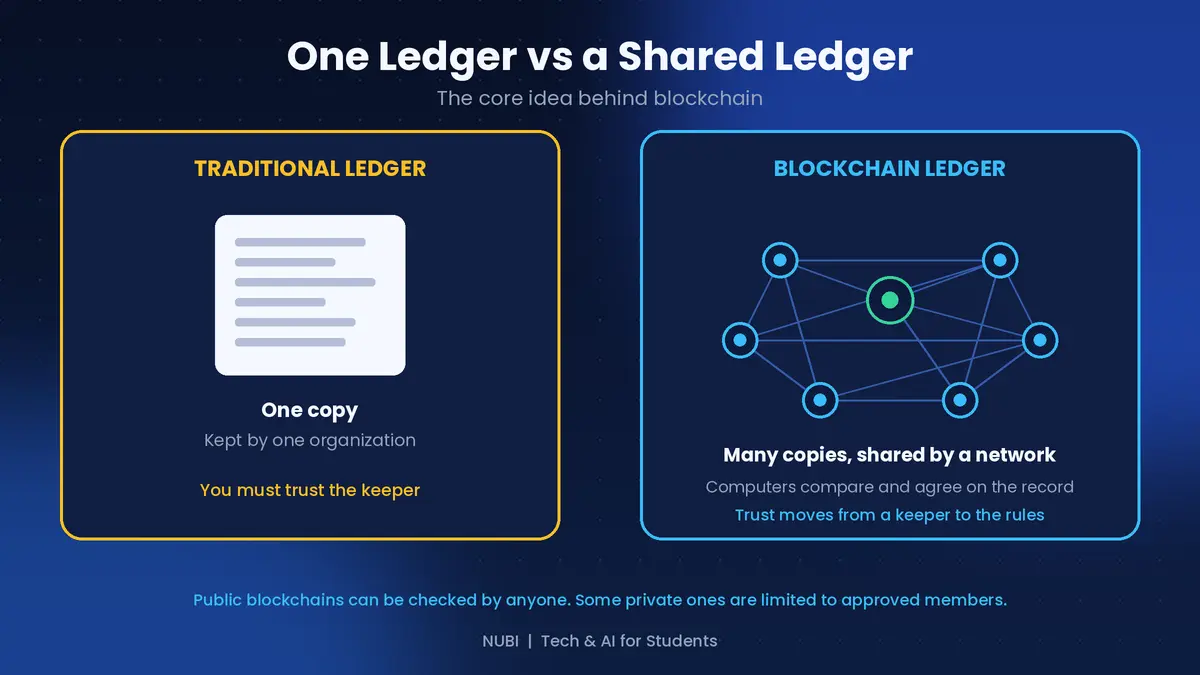
A ledger is just a record of who owns what. A traditional ledger, like a bank's records, is kept by one organization. You trust that organization to keep it accurate and not alter it.
A blockchain is a ledger that's shared across a network of many computers. Each one holds a copy, and the network follows rules to agree on what's true. Trust moves from a single keeper to the rules and the many independent copies. Public blockchains can be checked by anyone, though some private blockchains are limited to approved members.
What's inside a block
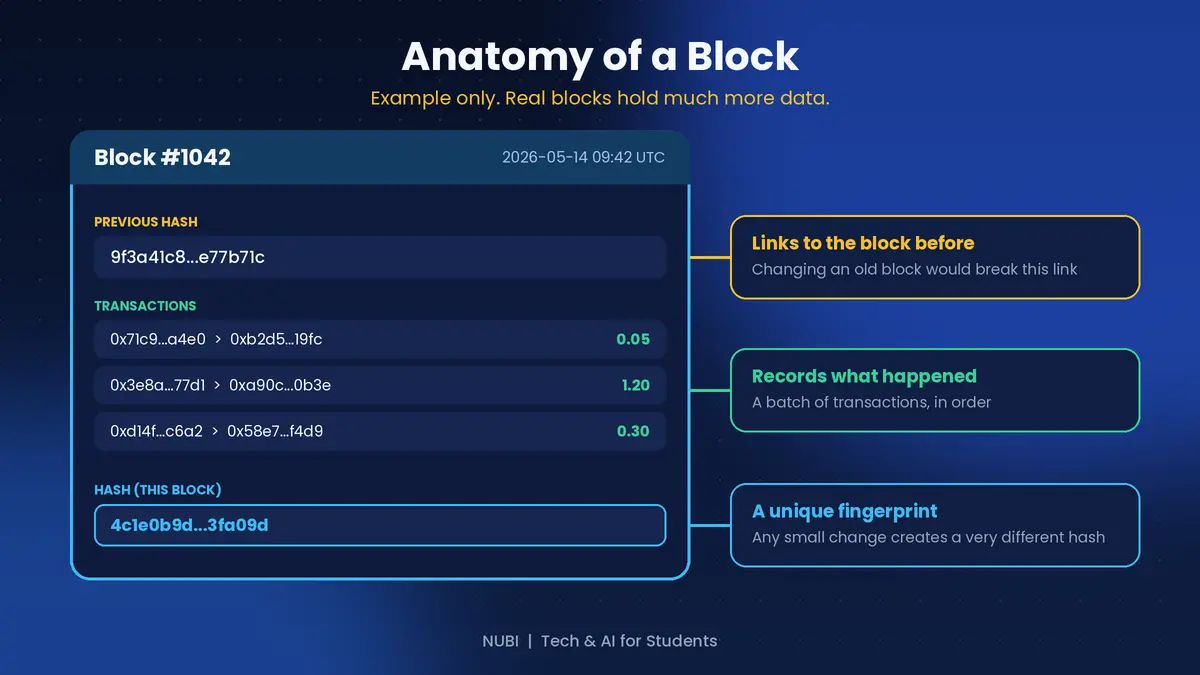
Transactions are grouped into batches called blocks. In a simplified example, a block contains:
A reference to the block before it (the previous hash). This is what links the blocks into a chain.
A batch of transactions, recorded in order, with a timestamp.
Its own hash, a unique digital fingerprint calculated from everything in the block.
A hash is like a fingerprint for data. If even one tiny detail changes, the result is a completely different fingerprint. Real blocks hold much more data, but this is the heart of it.
Why old records are hard to change
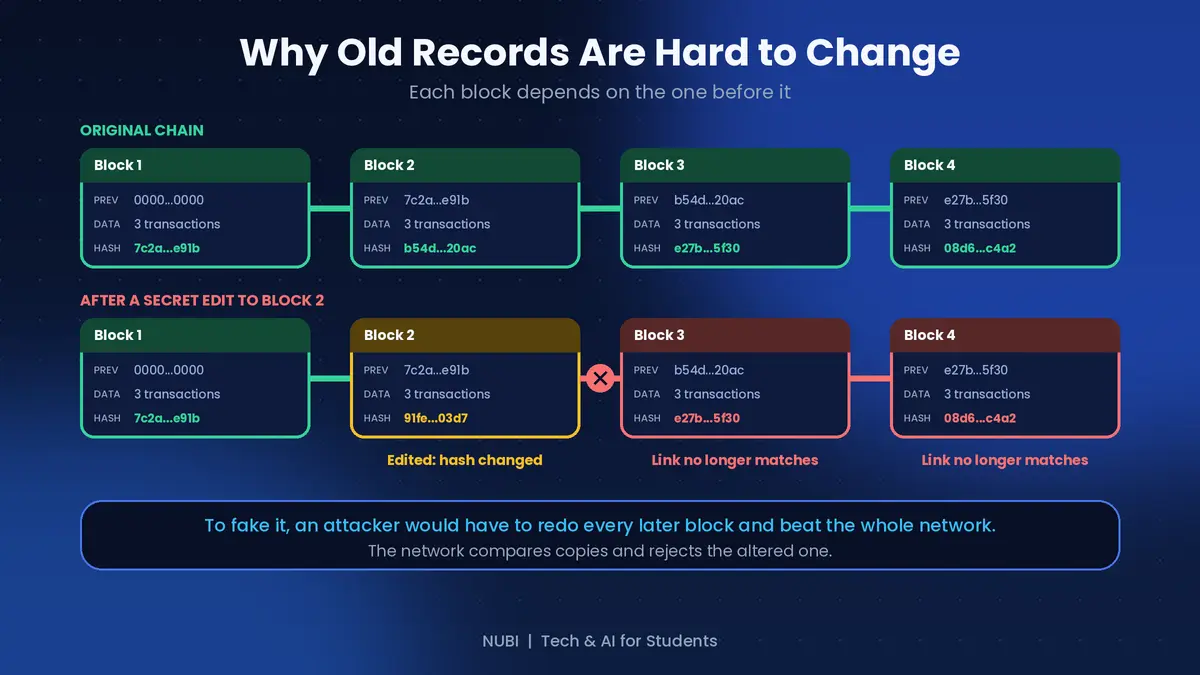
Imagine someone secretly edits an old transaction in Block 2. That changes Block 2's hash. But Block 3 contains Block 2's old hash as its link, so the link no longer matches. Block 4 depends on Block 3, so the problem spreads down the chain.
To make the fake look real, the attacker would have to redo every later block and also beat the rest of the network, which holds the honest copies. The network compares copies and rejects the altered one. This doesn't make records impossible to change in theory, but it makes tampering extremely hard and expensive on large networks, and it's why people say blockchains are "tamper-resistant".
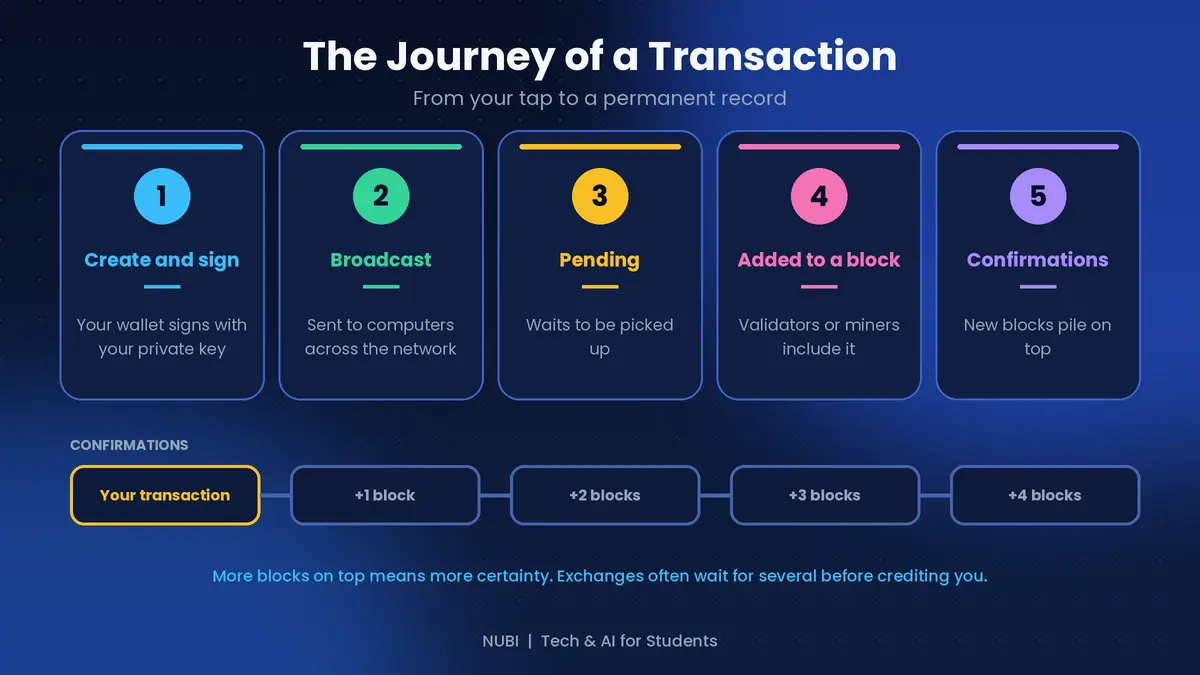
The journey of a transaction
Create and sign. Your wallet signs the transfer with your private key.
Broadcast. It's sent to computers across the network.
Pending. It waits to be picked up.
Added to a block. Validators or miners include it in a new block.
Confirmations. New blocks pile on top of yours. Each one makes it more certain that the transaction is permanent.
That's why exchanges often wait for several confirmations before crediting a deposit.
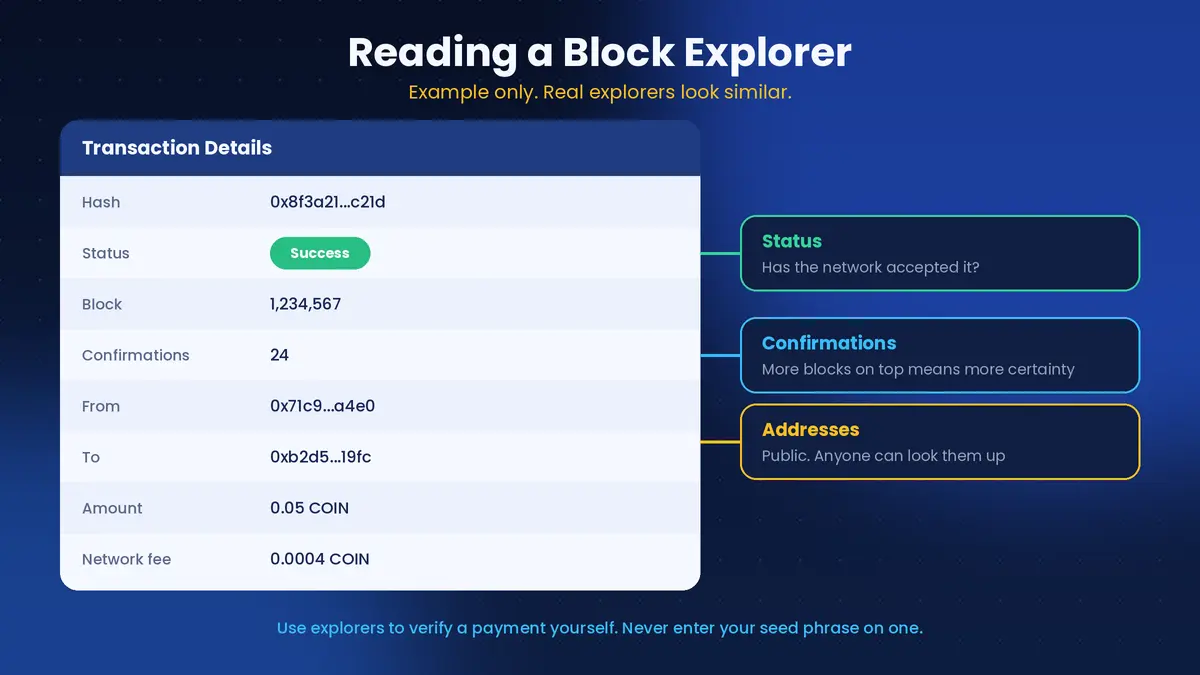
Reading a block explorer
A block explorer is a public website where you can look up transactions and addresses. In the example, you'd check:
Status: has the network accepted the transaction?
Confirmations: more blocks on top means more certainty.
Addresses: these are public, and anyone can look them up.
Explorers are useful for verifying a payment yourself, but never enter your seed phrase on one. Real explorers don't need it.
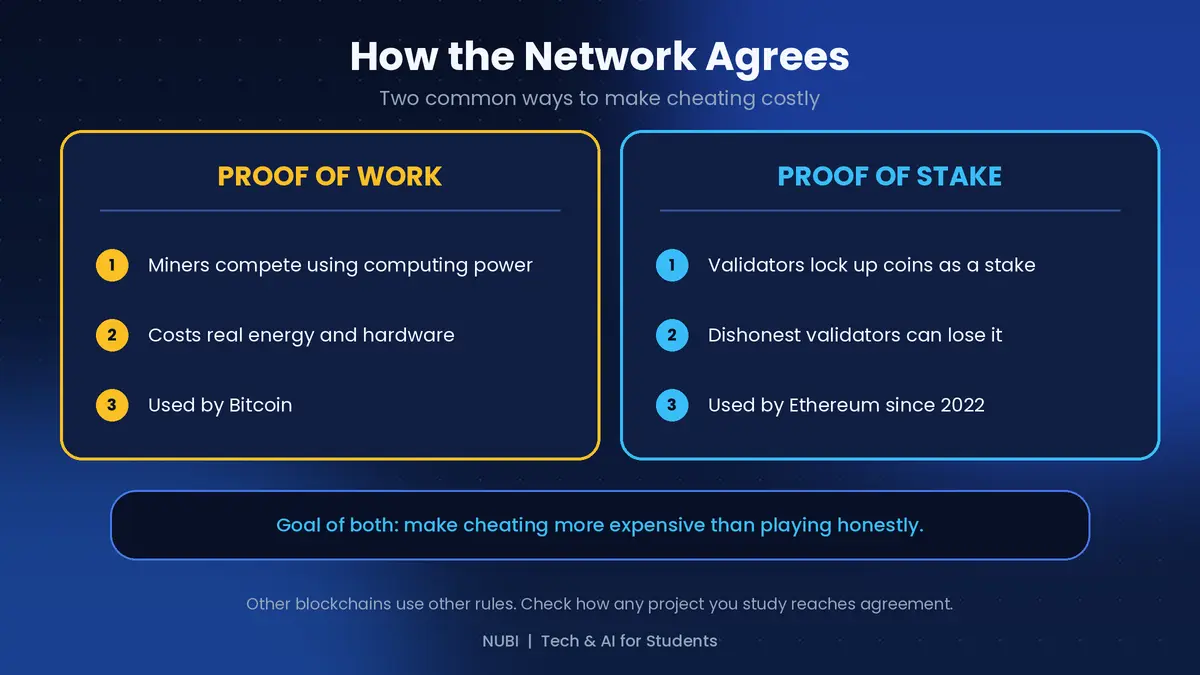
How the network agrees
With no central referee, a network needs rules for deciding which blocks are valid. Two common methods:
Proof of work: miners compete using computing power. It costs real energy and hardware, which makes cheating expensive. Bitcoin uses this.
Proof of stake: validators lock up coins as a stake, and dishonest validators can lose it. Ethereum has used this since 2022.
The goal of both is to make cheating more expensive than playing honestly. Other blockchains use other designs, so check how any project reaches agreement before you rely on it.
What blockchain is not
It's not the same as Bitcoin. Bitcoin is one use of blockchain technology.
It's not automatically safe. The chain can be secure while the people around it, such as exchanges, apps and scammers, are not. Most losses come from human mistakes and fraud, not broken blockchains.
It's not magic. It's a way of keeping a shared record. Whether a project built on it is useful or honest is a separate question.
Quick recap
A blockchain is a ledger shared across many computers
Transactions are grouped into blocks, each linked to the one before
Hashes are fingerprints, and changing an old block breaks the chain
A transaction is signed, broadcast, added to a block and confirmed
Networks agree through rules like proof of work or proof of stake
A secure chain doesn't protect you from scams or mistakes
Final thoughts
You don't need to be a programmer to understand blockchain. The core idea is a record that's shared, linked and very hard to alter. Hold on to that, and the rest of crypto becomes much easier to understand. What part of blockchain would you like explained further? Tell me in the comments and I'll cover it in a future guide.
Support this blog
If this guide helped you, you can tip me. Every bit helps me keep creating free guides for students. Thank you!
Next: what smart contracts are, and why they matter (and carry risk). Follow so you don't miss it.






