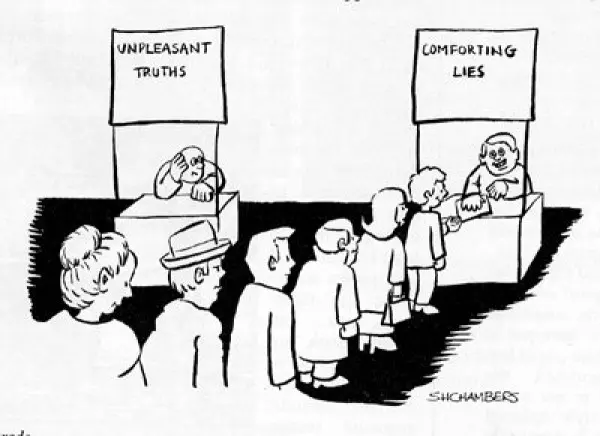
Being surrounded by people can be lonelier than being alone. Walking alone in search of truth can feel more connected than most people ever experience. Most people are terrified of solitude. They fill their lives with noise, people, distraction—anything to avoid being alone. And yet, they end up isolated anyway. Meanwhile, the few who genuinely seek truth are often the least lonely.
The difference isn’t how many people are around you. It’s whether they’re looking for the same thing you are.
The Illusion of Companionship
What does it actually mean to spend your life among people who aren’t seeking truth? Most are comfortable with illusions—convenient stories, unexamined assumptions, accepted narratives. What are you really sharing with them?
An illusion, by definition, isn’t real. So it can’t truly be shared.
The connection becomes performative. You pretend alignment that doesn’t exist. You simplify your thoughts to fit within acceptable boundaries. You nod along to avoid friction. It creates a specific kind of loneliness: being surrounded but unheard. Present, but invisible. You are only accepted as long as you reflect the conformity around you, not as your actual self.
In contrast, one person who is genuinely seeking truth—whether you meet them face to face or encounter them through something they wrote—creates something real. Not because you agree on everything, but because you are engaged in the same act: trying to see what’s actually there, even when it’s uncomfortable.
Truth is all there is. Untruth is just an illusion. So when two people seek truth, they are oriented toward the same thing, even from different angles. That’s a deeper alignment than agreement.
The Havel Paradox: Beware Those Who Have Found It
Václav Havel once said:
“Embrace the company of those that seek the truth and run from those who have found it.”
On the surface, it’s a warning against certainty. History is full of people convinced they had the final answer—ideologues, revolutionaries, rulers. Once someone believes they’ve solved reality, they stop questioning. They stop listening and begin enforcing. That’s when destruction starts.
But Havel’s insight goes deeper than obvious tyrants. It applies to anyone who has stopped asking questions. The moment someone believes they’ve fully arrived at truth, they stop seeking—and when they stop seeking, they stop thinking. They harden.
The danger isn’t the confused person still asking questions. The danger is the certain one.
A truth-seeker stays flexible. They know their understanding is incomplete. They remain open to being wrong. But someone who thinks they’ve “found it” is no longer exploring—they’re defending. They’ve become fixed, protecting conclusions instead of examining them.
And it gets worse. People who have stopped seeking will try to get you to stop too. They offer comfort. They frame questioning as pointless. They present their conclusions as places to rest—somewhere you can finally stop thinking. That’s the real trap.
Real companionship exists between people who continue to ask. True seekers are rare, and valuable to each other precisely because they refuse to settle. In contrast, much of what passes for knowledge—mainstream narratives and institutional certainty—feels lifeless. It presents conclusions as final, as if the questions are already over. No curiosity. No wonder. No search.
For a truth-seeker, that isn’t just unconvincing—it’s boring.
The Warrior’s Path: Seeking Victory, Not Battle
A warrior doesn’t seek battle. A battle happens, but a warrior seeks victory. That’s the aim. That’s what matters, and importantly, the warrior’s commitment doesn’t depend on achieving victory. He may never see it. He might die before it happens. But the pursuit itself provides meaning to the struggle.
Truth-seeking works the same way. You’re not seeking comfort or approval or even certainty; you’re seeking what is real. And that may always remain just beyond your full grasp.
The universe is vast. Our minds are limited. There may be truths we can never fully understand—patterns too complex, too subtle, or too far beyond human perception. We could be asking the wrong questions. We might spend years pursuing something only to realize we were looking in the wrong place.
A Path to Nowhere
If the people around you are on a path that leads nowhere, then you’re going nowhere too. It doesn’t matter how kind they are, or how many of them there are. Niceness isn’t direction. Agreement on something wrong is still wrong.
This is why truth-seekers can seem cold. Not because they lack care, but because care without direction is just shared stagnation. If you truly care about someone, you will not endlessly walk nowhere with them. At some point, the question has to be asked: are we moving toward something real or just staying comfortable?
This isn’t an argument for arrogance or cruelty. It's simply acknowledging that remaining silent while people wander aimlessly isn't an act of kindness; it's complicity in their lostness.
How Do You Know?
There’s an obvious objection: how do you know what’s true? How do you know your path leads anywhere? How is your seeking different from someone else’s certainty?
But that question answers itself. The act of asking “How do I know?” is proof that you’ve rejected blind acceptance. It shows you recognize your own limits. It shows you’re open to being wrong. The person who has stopped seeking doesn’t ask that question; they’ve already decided.
So if you feel that uncertainty—if you’re unsettled by not knowing—that isn’t a weakness. It’s an orientation. You’re facing reality, even if you can’t fully see it yet.
Why the Journey Matters More Than Arrival
If truth might be infinite, and we are finite, then the journey becomes everything, because the destination may never be reached.
Pursuing the truth requires a preference for what is real, even when it's uncomfortable. It involves grappling with tough questions, dismissing convenient explanations, and embracing the unknown rather than holding onto a false sense of security.
The warrior doesn’t need to achieve victory to justify the pursuit. He just needs it to be worth pursuing, and the same applies here. You don’t need to arrive for the journey to matter. The seeking itself: the questions, the openness, and the refusal to settle are where real thought happens. That’s where integrity exists. And that’s where genuine companionship can form.
Conclusion: It Only Looks Like Loneliness
The path of truth isn’t really less crowded. The crowds on other paths are just built on illusion—people walking together in comfortable darkness, mistaking proximity for connection. It may feel solitary, but it’s the only place where real alignment exists, because it’s the only place where people are genuinely seeking the same thing. And if truth is vast, endless, and perhaps beyond full comprehension, then good; that means the journey never runs out.
Seeking truth isn’t about reaching a final destination. It’s about continually orienting yourself toward what is real. That isn’t a burden. It’s the whole point. Don’t fear the path because few appear to walk it. The real loneliness is elsewhere: in the crowds, in the certainty, in rooms where nobody is asking anything anymore.
Truth-seekers may walk alone in body, but in spirit, they are aligned with something far more real than any crowd could offer.






