
Folklore Thursday’s theme this week is on the folklore of bold girls courageous women and powerful goddesses.
Celtic goddesses in folklore are interesting, colorful and magical such as Cerridwen a Welsh enchantress, shape-shifting herbalist and famous witch. She was known as the keeper of The Cauldron of Knowledge and Insight and The White Sow. Welsh magical practitioners considered, Cerridwen as a symbol of wisdom and power. Today she is still revered in the Wicca religion as ‘The Goddess of the Pair.’
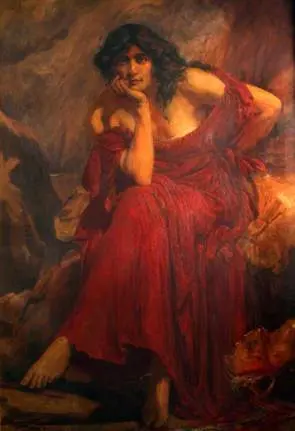
Below Painting of Ceridwen by Christopher Williams (1910)
The 13th century Tale of Taliesin, was named after the 6th century poet who is the focus of the legend. Cerridwen is married to a giant named Tegidfoel.
She births two children, a daughter named Crearwy, which means ” Light.” Cerridwen’s son is named Afagddu which means “Dark.” These Celtic children represent the Gaelic force of Yin and Yang much like the ancient Taoist symbol.
Cerridwen desires the best for her children, especially her son Afagddu who she sees him lacking specific gifts such as being attractive. She doesn’t worry about her daughter as she is equipped with all the desired gifts and skills for life.
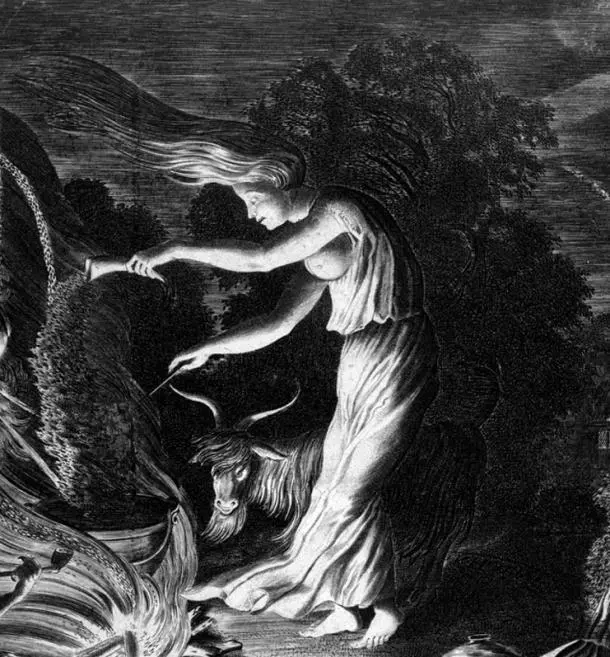
Cerridwen’s cauldron contained a potion that was brewed for a year and a day in order to reach its full potency image at wikimedia.
Cerridwen uses her superior magic to concoct a potion to enhance his powers of intellect, supernatural, fortune telling, botanical knowledge. While Cerridwen collects the herbs and recites her ritual for the potion someone must keep stirring the cauldron and keep it boiling for a year plus one day. A blind man tends to its fire and the cauldron is stirred by an ignorant boy named Gwion Bach who eventually becomes the Future Taliesin.
One day while stirring the pot, three drops splash on his thumb. The splashed potion was scalding hot that Gwion sucks on his thumb to soothe the pain unknowingly tasting the potion. The potion is effective with the first three drops after that it turns into poison.
Gwion suddenly realizes his error of tasting the potion so he flees from the scene trying to escape Cerridwen’s anger. She tracks Gwion across the countryside transforming herself into several different creatures. Gwion has these same morphing powers too. He first transforms into a hare in order to escape the infuriated witch. Cerridwen morphs into a greyhound in order to catch the fast moving hare. Gwion next becomes a fish, the clever witch transforms into an otter to counter his move.
The Gwion morphs into a bird yet Cerridwen turns into a Hawk that flys faster than a small bird. Lastly, Gwion changes into a single corn kernel, only to be eaten by the crafty witch disguised as a hen. However, the tale does not end there. The very fact that the boy had swallowed the potion protected him from being completely destroyed. Once Cerridwen was pregnant she was very insightful and knew the infant would be Gwion once he was born. She plotted to kill him upon his birth. She hadn’t planned for the baby boy to be so handsome that she could not go ahead to kill him.
Cerridwen sewed a bag placing the baby into it and threw it into the ocean. The boy didn’t drown but was rescued near Aberdyfi a Welsh shore. The Prince who rescued him was named Elffin ap Gwyddno; the reborn baby grew to become a man known as the legendary bard Taliesin.
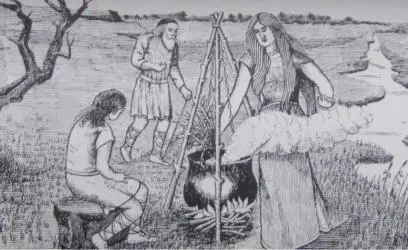
Above Illustration of the skilled witch Cerridwen, the blind man and the boy Gwion stirring the Cauldron (Public Domain.)
Source & Reference:
Gantz, Jeffrey. Early Irish Myths and Sagas (Penguin Classics: London, 1981.






