
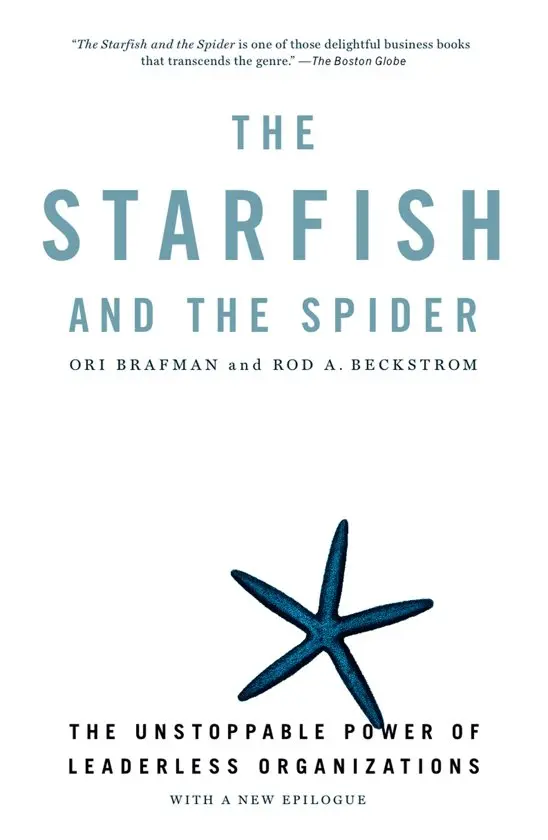
"The Starfish and the Spider: The Unstoppable Power of Leaderless Organizations" is a captivating book that explores the world of decentralized organizations and their unique ability to create an impact. Authors Ori Brafman and Rod Beckstrom use the analogy of a spider and a starfish to describe the two organizational types: a spider represents traditional hierarchical structures, while a starfish represents decentralized, self-organizing groups.
The book offers examples that demonstrate the power of leaderless organizations, such as the success of the Apache tribe in resisting colonization and the rise of peer-to-peer file-sharing networks like Napster. One of the key takeaways is that self-governing structures within a larger entity are resilient, adaptable, and can survive even in the face of external threats, due to their dynamic nature and lack of central structure.
Despite the many benefits of leaderless organizations, they also face challenges. Coordination can be slow, and there’s potential for internal conflict. The authors emphasize that with the right mindset and approach, these challenges can be overcome. Effective structures and strategies enable collaboration, nurturing a deeper understanding of the relationship between the individual and the collective.
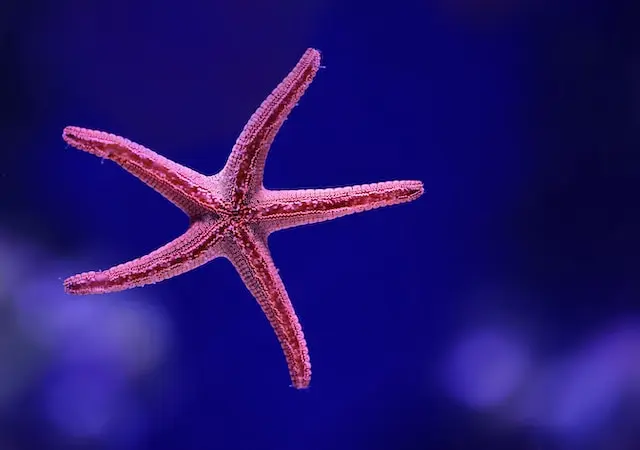
Inspired by the starfish, a fascinating marine animal with unique physiology, leaderless organizations operate as decentralized networks working towards a common goal. The starfish doesn't have a central brain or nervous system but instead has a decentralized network of neurons that enable it to move and respond to its environment. A decentralized structure allows organizations to respond quickly to changes in their environment, innovate rapidly, and make decisions collectively.
In summary, "The Starfish and the Spider" offers numerous insights into the power of decentralized networks and is a valuable read for anyone looking to understand how such networks can bring about significant change in our world today.

Taking inspiration from the book "The Starfish and the Spider," Nexus is currently exploring the concept of a Decentralized Autonomous Organization (DAO). The Nexus operations comprise three branches: Legislative, Executive, and Judicial, with each branch carrying specific responsibilities. Each branch, in turn, has five arms, resembling a starfish, with each arm specializing in its respective area. Nexus aims to have all the essential organs required for its existence in each of the five arms, similar to some species of starfish.
The arms of an actual (biological) starfish constantly communicate to determine the best course of action: eating, fleeing, exploring. Similarly, the five arms of the Executive branch of the Nexus DAO are in constant communication to maximize resources and optimize efficiency. This structure encourages collaboration. However, if one branch feels restricted by the others, it has the option to detach and regrow four new arms to become a complete starfish once again. Likewise, if four arms would like to detach themselves from the fifth, they could do so and later regrow a new one. The "Linckia laevigata" starfish, found in the Indo-Pacific region, functions similarly.
Overall, the Nexus Starfish DAO is created with the dual purpose of fostering the overall growth of the organization while maintaining a truly decentralized structure.
For more information on Nexus please visit https://www.nexus.io





