
Everyone's favorite Internet Transport (HTTP) now has a new standard; HTTP/3. The Internet Engineering Task Force (IETF) ratified HTTP/3 in June of this year. You might have heard of it's pre-release name QUIC or HTTP over QUIC (developed by Google) and is designed to replace HTTP/2.
HTTP background, when the Internet came to be in the early 1990's HTTP was the de facto for the WWW. For those keeping technical score these were RFC 1867, 1945 and thus considered HTTP/1.
Then came along improvements such has HTTP/1.1 (pipelining via RFC 2068 & 2616, 2617 and use of TLS for security)
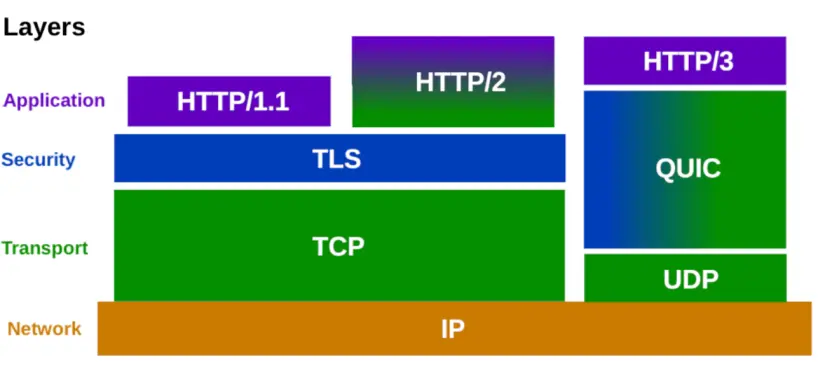
HTTP/2 RFC 2818, 2828, 3986 URL Syntax, 7230-7237 - QUIC - Quick UDP Internet Connections and was introduced by Google in 2014. QUIC had built-in security and it was always on. QUIC is the foundation on which gRPC is built! QUIC multiplexes multiple streams into one connection, so that a connection can serve several HTTP requests simultaneously. HTTP/2 lends itself better toward real-time bidirectional communications like chat apps and games. However, HTTP/2 uses TCP as its transport, so all of its streams can be blocked when a single TCP packet is lost—a problem called head-of-line blocking. Utilized TLS 1.2 for security!
HTTP/3 RFC 9114 uses UDP as its transport and thus addresses multiple issues, first and foremost is head of the line blocking then speed. Both solved with this implementation.
Objectives of HTTP/3? An alternative to TCP for Web traffic, put another way its the transport that makes HTTPS run faster than it does over TCP without the handshake overhead. Perhaps a major shift in Internet traffic from TCP to UDP will take place, only time will tell.
For my visual learners here is a quick slide to help show you the differences in the protocol(s).
Where is HTTP/3 being used?
- Akamai, and other Content Delivery Networks (CDNs),
- Google,
- Expect it to pick up speed (no pun intended) as its impact is understood.
Summary - HTTP/3 is a new version of HTTP that sits on top of QUIC and is being pushed by Content Delivery Networks (CDNs), Google (of course), Cloud based security firms such as CloudFlare. Wonder if Theta or other P2P offerings will adopt HTTP/3 and how quickly?






