Let's discover Ethereum, the first blockchain where decentralized applications and smart contracts can be developed, from wallets to how to buy Ethereum
Ethereum: Introduction to Blockchain by Vitalik Buterin
In addition to carrying out simple cryptocurrency transactions, Ethereum is a blockchain on which decentralized applications can be programmed that automate various types of operations.
These applications are called DApps, short for Decentralized Applications. They are made up of various smart contracts that manage transactions and allow even very complex services to be offered.
Translated into smart contract, the smart contract is an algorithm developed by expert programmers. It contains the instructions to follow to carry out certain operations in a totally automated way. By combining multiple contracts together, decentralized finance protocols but also gaming platforms, metaverses and NFT marketplaces are created.
The added value of Ethereum lies precisely in being the reference blockchain when it comes to smart contracts and applications. The big trends were born on this network, which is still a protagonist despite the many alternatives created over time.
In this article we will understand well what Ethereum is and how it works. We will answer the question “How does the cryptocurrency Ethereum work?”, known as Ether, by exploring its various use cases.
At the end we will be ready to read the many insights into the world of Ethereum that the site has to offer.
Index
- History and characteristics of Ethereum
- What is Ethereum? How does a smart contract work?
- What is the difference between Ethereum and Bitcoin?
- What is the intrinsic value of Ethereum?
- Ethereum 2.0: what has changed?
- Where to buy Ethereum?
- Ethereum wallet: which one to choose?
History and characteristics of Ethereum
The idea of Ethereum was born in 2013, in times when cryptocurrencies were still something for a few IT geeks.
Who is behind Ethereum? It is now a reality with a team of specialists in the field. However, originally, we found only two minds: the Russian-Canadian programmer Vitalik Buterin and Gavin Wood, an English national.
Bitcoin, going so far as to found the Bitcoin Magazine and curating its contents for years.
In thinking about Ethereum, Buterin wanted to go beyond simply "managing a transaction register" (the main task of the Bitcoin protocol). In fact, the objective was to create programmable currency: a unit of value that could be managed automatically by software, maintaining the level of openness and decentralization of Bitcoin. A fascinating but far from simple undertaking.
Years later, we know well how it ended: Ethereum is an immense reality, the only one to deserve a place in the grandstand with Bitcoin.
Simplifying the functioning of Ethereum, we can say that the blockchain also contains actual lines of code, algorithms.
They are packaged within smart contracts (we will learn about them shortly). A multitude of smart contracts that interact with each other form a DApp, already mentioned in the introduction.
The DApp is nothing more than the final interface visible to the user. By interacting, they will be able to send transactions of various types. Some examples of Decentralized Application are Uniswap, Aave and Curve.
Returning to the birth of Ethereum, it is curious why it brings this minus.
As a good nerd, Vitalik is a big fan of science fiction. Browsing Wikipedia, he came across the definition of ether, an element described as "the invisible medium that permeates the universe and allows light to travel". His reaction? After a “how cool!” also came “now I will “steal” the name for my project!”; everything else is history.
Solidity was also born together with Ethereum, a turing-complete programming language designed specifically for writing smart contracts. Today Solidity is the reference language for various protocols, although valid alternatives are spreading.
Initial funding for Ethereum occurred in 2014 by selling the ETH coin in exchange for BTC. The value was a few cents per ETH (yes, I know what you are thinking: a real gem!).
This method allowed 31,500 BTC to be collected, at the time worth around $500 each. It was the first ICO in history, another victory for our good Vitalik.
“Ethereum's goal is to create programmable currency, while maintaining the level of openness and decentralization of Bitcoin.”
What is Ethereum? How does a smart contract work?
We have argued that Ethereum aims to add programmability to Bitcoin's features and use cases. We just have to find out how.
The functional unit that allows value to be managed, in the form of ETH or tokens compatible with its blockchain, is the so-called smart contract.
A smart contract is an algorithm specifically written to perform specific actions, following well-defined rules.
Stocks are nothing more than transactions containing ETH, tokens and data. For example, swapping one coin with another will lead to interaction with several smart contracts, each of which has a very specific task.
Precisely on the topic of the tasks of a contract, it all depends on the relevant source code. In one case it will be able to establish rules and procedures for staking a token; in another you will be able to define the method to provide liquidity to a pool, or exchange one coin for another at a specific price. The applications are almost infinite: it all depends on the platform, the services offered and the work carried out during development.
The outputs are therefore strictly dependent on the type of smart contract.
Let's analyze a concrete case such as the smart contract that changes ETH into USDC on Uniswap. For those who don't know, Uniswap is a decentralized exchange that allows you to execute trades without an intermediary, the exact opposite of a centralized platform like Binance.
Returning to the smart contract, it will receive Ether or USDC as input, it depends on the user.
First of all, the contract will have to know the exchange rate and… guess what? This data will come from another smart contract dedicated to the purpose. At this point, the output will consist of a transaction to the same address as the sender containing an equal value of the other token.
Summarized further: the user initiates the operation; the smart contract inquires about the exchange rate and carries out the necessary checks; the smart contract concludes the work and the user receives what is desired.
By interacting with the contract we have no clue about the complexity of the system that is working for us. What appears to be a simple button really hides a lot of complexity.
If we were to analyze a smart contract, we would "only" see lines and lines of code that are impossible for non-experts to read. After having concluded and tested the contract, it is uploaded to the blockchain, becoming operational and no longer modifiable or stoppable.
By combining various smart contracts communicating with each other, a decentralized finance DApp is formed.
We mentioned Uniswap, that is, the application whose purpose is to allow the exchange of coins and tokens.
To do this, the platform hosts various smart contracts: one for each trading pair, one to manage the price feed, one to control the liquidity within them and many others with technical purposes that are beyond the scope of this article. Just to give a minimal idea of the amount of work to be put in place.
All these smart contracts continuously exchange inputs and outputs, in a flow of information and value.
There are many applications: some are forks (Uniswap boasts numerous copies spread across various networks), while others perform original tasks. On this portal we have a section dedicated to these protocols, divided according to the reference blockchain. All free and constantly updated obviously.
The most important information to keep in mind is that all of this happens in a decentralized manner, which is why Ethereum is often referred to as the World Computer.
"Smart contract: algorithm that carries out a certain task automatically and independently"
What is the difference between Ethereum and Bitcoin?
Whether we are talking about Ethereum or Bitcoin, it is natural to reach the point where the comparison arises. Let's find out what the most significant differences are between the two main blockchains (and related coins) in circulation.
The first big difference is the very nature of currencies: Bitcoin is a store of value and medium of exchange; Ethereum, on the other hand, is the territory of programmability and opens the doors to various applications.
A second difference lies in the consensus algorithm that regulates the operation of the two blockchains.
Bitcoin is a Proof-of-Work reality, based on what is known as mining. Creating a new block takes 10 minutes and the maximum amount of BTC is set at 21 million copies.
Ethereum is a former Proof-of-Work blockchain. In fact, a historic event called Merge occurred in September 2022, responsible for Ethererum's transition to the Proof-of-Stake consensus algorithm. Future updates will bring this network to increasingly better performance.
The maximum quantity of ETH has no limit and this is precisely one of the main criticisms: as there is no ceiling, the currency continually devalues.
However, recently (2021) a major Ethereum fork landed, codenamed London. It involves the removal from circulation of part of the ETH spent on gas fees, which has drastically reduced the emission rate (by around 30% on average).
The Merge led to further declines, which is why we can think that inflation will remain contained in the future; after all, the mechanism is simple: the more the Ethereum network is used, the more gas fees are burned and inflation is minimized.
What is the intrinsic value of Ethereum?
We understood that the purpose and use cases of Ethereum are very different from those of Bitcoin. So, who uses Ethereum? Users are heterogeneous and use the network for various reasons. Smart contracts and DeFi are certainly a driving force, as are NFTs and normal transactions. Let's try to better understand what the intrinsic value of Ethereum and ETH is.
Bitcoin is the ultimate store of value, scarce and safe, while Ethereum is programmable value. But then how do the two coins relate in terms of intrinsic value? What is Ethereum given by? What is Ether used for?
The Ethereum cryptocurrency is used to pay for gas in any transaction performed on the Ethereum blockchain, whether to a wallet or a smart contract.
Therefore, if you want to use the network you need to have ETH. This is the main demand driver. More applications and use cases lead to the growth of the entire ecosystem. This is where the greater demand for ETH comes from and its intrinsic value also increases as a result.
Instead, on the supply side, Ethereum had an issuance rate of 2 ETH for each block. A block was mined approximately every 12 seconds, which put its annual inflation at 4.5%, without a maximum supply.
However, this data is now obsolete.
The Ethereum London hard fork in summer 2021 dealt a first hard blow to inflation. The mechanism is as simple as it is successful: the gas fees spent by those making the transactions are partly burned, i.e. removed from circulation.
Therefore, the greater the use of the network, the higher the gas fees spent and the reduction in inflation increases.
At the time, this factor reduced inflation by about 30%:
Indeed, on some days the use of the network was so intense that it made Ethereum deflationary.
Be careful though because the merge has brought further improvements, not only on the issue of inflation. Let's move on to the next paragraph and discover them in more detail.
“Ethereum has several use cases and, consequently, a very high intrinsic value”
Ethereum 2.0: what has changed?
Ethereum 2.0 (known as this even though the term has fallen into disuse) is the most awaited set of updates ever by investors and users of the network. Not only that: we can consider it an event of historic importance for the entire crypto and blockchain sector.
There are mainly two reasons for this excitement:
the drastic reduction of gas fees, which effectively makes Ethereum more "popular".
the decrease in annual inflation estimated at approximately 70%.
How is all this possible? Let's see it!
The main change in the transition to 2.0 was the farewell to the Proof-of-Work consensus algorithm to the Proof-of-Stake one.
The adoption of PoS first and foremost leads to superior performance. Or rather, it lays the foundations for the integration of more scalable and rapid solutions, eliminating the limits of mining.
In addition, energy and environmental sustainability also benefits. In fact, the computational power required by Ethereum collapses.
But it is inflation that suffers the hardest blow. In fact, the issuance of new Ethereum is significantly reduced, as shown directly by Ethereum.org:
Part of the amount spent on gas fees must always be subtracted from these numbers.
The combination of very low inflation and reduction in supply proportional to the use of the protocol also makes ETH very attractive as a store of value. A novelty for a crypto previously seen only as consumable for carrying out transactions.
Ethereum 2.0 also aims to solve the scalability problem, thanks to the combination of Proof-of-stake and other solutions such as sharding.
This last expedient fragments the blockchain, assigning validators to each fragment. This "piece" will have much less computational load, so transactions will be finalized more quickly and at lower cost.
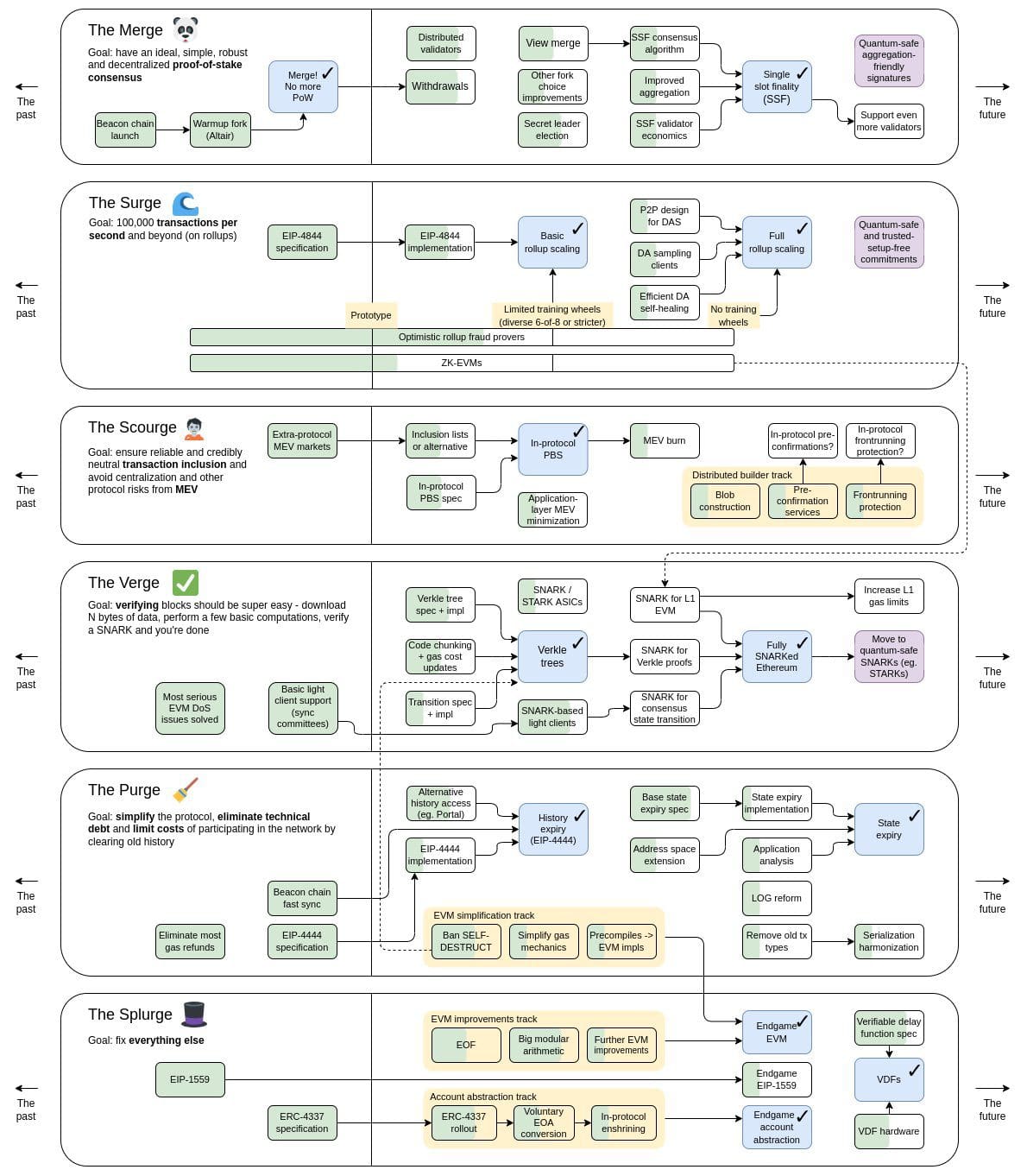
The latest updates to the Ethereum roadmap (illustrated below), also published by Vitalik Buterin, give a lot of weight to rollup solutions, considered technologically better for the network's needs. In any case, the founder continues to demonstrate attention to his creation.
Ethereum 2.0 is divided into several phases that will require years of work. The Merge is just the beginning: we'll see some good things!
"Ethereum 2.0: once again this blockchain stands as a reference model for the entire sector"
Where to buy Ethereum?
If after a careful fundamental analysis you were wondering how to buy Ethereum, here is some advice.
The vast majority of crypto exchanges offer trading for this coin. Among the best around, considering the low commissions:
- Binance
- Bitget
- OKX
How to get an Ethereum? Regardless of the quantity you are interested in buying, CEXs are really easy to use. In just a few steps you are able to deposit traditional or crypto currencies, and then convert them into Ether.
If you then wanted to make an income on Ethereum, Nexo is an excellent CeFi service. The daily audit carried out by Armanino gives users greater peace of mind (never hurts).
If you were wondering “how to buy Ethereum?” outside of centralized exchanges, DeFi also offers many alternatives including Uniswap and SushiSwap.
However, by operating directly on the blockchain, ETH is needed to pay the gas exchange fees. Therefore, if you don't already own Ether, at least the first time you will have to go through a CEX.
Ethereum wallet: which one to choose?
Ethereum offers users a wide choice of crypto wallets with which to operate.
From MetaMask to Trust Wallet, from Exodus to MyEtherWallet, there are so many options.
So, which Ethereum wallet to choose? The truth is that there is no absolute best wallet; each person has specific needs that could be satisfied by a specific wallet.
Indicatively, the names mentioned a few lines above are all valid and safe. You just have to try it and then decide which one you prefer; However, no one is stopping us from having more than one ETH wallet.
How to create Ethereum wallets? It's easier to do than to explain. We have prepared several tutorials on crypto wallets, where we indicate point by point how to proceed. In addition to written articles, you may also find dedicated videos. In short, there is no shortage of supporting material.
Last question about crypto wallets: how to transfer Ethereum? Quick response: all you need is the recipient's address. We talk about it in more detail in the tutorials we talked about above.
"Ethereum offers users a wide choice of crypto wallets with which to operate."






