
How much do you really have to make to beat unemployment and kid credits?
In this video, I run through some of the analysis of that question. Of course, it varies by state. It will also vary on whether or not the feds are kicking additional money on top of the state benefits at any given time.
Bottom line, a lot.
Link to the data source: https://worldpopulationreview.com/state-rankings/unemployment-benefits-by-state
Transcript
How Much Do You Have to Earn to Beat Unemployment?
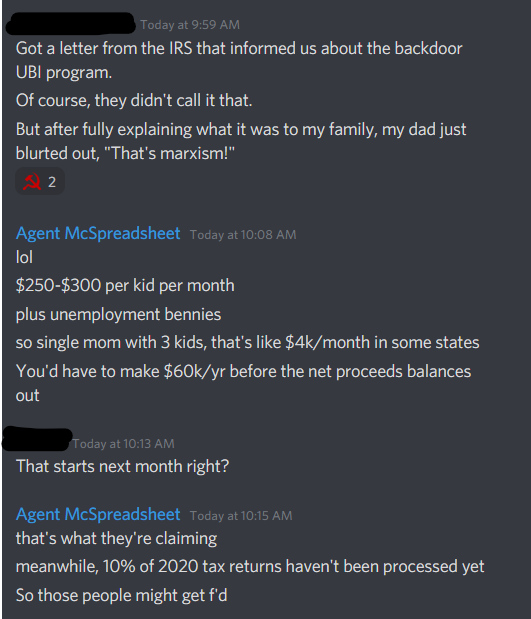
So I had an interesting little conversation with somebody on a discord server earlier today. And apparently, they got a letter from the IRS, informing them about what they're calling, what he's calling backdoor UBI. So UBI is a universal basic income. But what he's talking about is the child tax credit and the way that's changed with the American rescue plan.
If you haven't seen him in my previous material on it the American rescue plan, one of the provisions is that the child tax credit is being changed. One it's going from $2,000 up to $3,000 to it's. If your kid is under six, it's actually going to 3,600, three it's fully refundable instead of partially refundable, meaning that even if you don't owe any taxes whatsoever, you.
Are going to get that full 3000 under the old rules. It was part if you owed tax on the part, even if you didn't but now it's going to be fully refundable. And the fourth thing is that they are going to start sending out checks or direct deposits on a monthly basis. And they're saying, they're going to be starting that in July.
About a month from right now. So yeah, I said and my response was a 250 or $300 per kid per month. Plus unemployment benefits, if you have a single parent with three kids, that could be like $4,000 a month in some states, and that you'd have to make $60,000 a year. Before the net proceeds bounces out.
That got me thinking actually, the unemployment benefits are, you know, very, they vary quite a bit from state to state. I went ahead and I looked up unemployment benefits by state. And I found this site we're on population review.com and they have this handy-dandy table, Virginia, for some reason, their dad is messed up.
I corrected that to what I think it is, which is this number divided by 52, which puts it at about $726 a week. But then I threw that into a spreadsheet. And I said, well, if that's true so people on unemployment, they will, they can get a certain annual benefit. And then they're going to if you don't if they're a single parent or married parents, whatever it is, they're going to get credits for their kids.
And how much what's the welfare cliff on that? Like, how much do you have to make at a job before that starts to balance out what you'd be giving up and not employment benefits. Cause you're gonna get the kid credits either way, but still it's a decent chunk of change.
the way this model is calculated, I took the table that they had even took all the states, took them maximum weekly benefit amount. And you might not get the maximum, but it's playing with numbers as you will maximum weeks. And so you multiply this by this, you get a number and that's the maximum somebody could get on unemployment in a given year.
And the numbers vary widely. So, 20,000 in Washington, all the way down to 6,000 in Arizona. it's a big spread there on top of that people if they have two kids, I, for this model, I just said, one is under six and one is over six. They're going to get $550 a month.
That adds up to $6,600 a year. If we add those two numbers together, the unemployment and the kid credit you're come out with total annual earnings. And this is all tax-free because the unemployment benefits will be below the taxable threshold for a head of household or married filing joint filer.
And the kid credits are credits, they don't get included as part of the taxable income. So yeah, you're looking at tax-free earnings of anywhere from, on the high end 25 to $27,000 on the low end. Florida's the very low end nine, 900 but in 12, 13, $14,000.
So that is what people could potentially be paid for staying home. if they have the two kids, if they've got three kids, it'll be more. If they have one kid will mean less, they have no kids there'll be less. But, two kids is a decent Yeah, approximation. I think so then I was thinking, what, how much would you have to earn at a job in order to make that same amount?
Cause you'd be giving up the unemployment benefits. You'd still get the kid credits. But you'd be paying even if you don't pay any income tax, you'd be paying a social security tax and Medicare tax on your FICO contributions. if you were making 18, nine 44 in unemployment benefits, you'd have to make 20,005 13 after paying social security and Medicare in order to come out to the same after-tax earnings.
But that's not a real number. It's not a real comparison because you're comparing, staying home, doing nothing. To going to work right. Going to work involves a lot of extra expenses. There's transportation back and forth. There's clothing, you have to buy there's childcare there are meals out that you might not otherwise have.
There's a lot of extra costs built into having a job that's not included in just the tax withholdings. And I ballparked that at 10 grand a year. And maybe that number is high. Maybe it's low, whatever it is, but it changes the minimum that you'd have to make to have the same standard of living and had the same take-home pay that you would to the situation where you have unemployment and the kid credits.
And so the numbers go up a lot instead of 20,000, we're talking about 30,000. There's a report that came out. Yesterday. I think it was with the unemployment numbers that there are nine and a half million open job positions. And a lot of those are in the hospitality and foodservice industries.
It's no wonder, right? It's like, well, I'd have to make 30 grand going to work in order to just break. Even with the benefits I have for not doing that. What's the incentive to do that. If you start making 40, 50, $60,000 a year, maybe it's worth it at that point, but for just breaking even, I mean, why bother that's a rational decision to not do that.
People are wringing their hands, you know, as over the state. Oh, the economy it's like, but people are responding to the incentives that they have, and rightfully. So, yeah. I don't expect any of this to change. I don't expect the employment picture to change until these incentives change and obviously, that's a hard political thing to do cause you'll be accused of everything under the sun for cutting off people who really need it.
And maybe they're right. I don't know. Maybe this will be the push that we really need to get automation into these lower-skill positions, I'm reading an article the other day about how McDonald's is trialing AI-assisted drive-throughs where, when you talk into the, to the box at the drive-thru, you're not, you won't be talking to a person who would actually be talking to a voice recognition system.
And there might be something to that because a lot of times they get my order wrong. Maybe that'll end up being a better experience for everybody involved. But yeah, so 30 grand, 20 grand you're breaking even with staying home on unemployment and that's just not worth it.
For anybody who was skeptical or confused by the employment picture, I hope this helps. Now what these people would actually be better off doing is you know, they. They run it, they run down their unemployment benefits get this amount, start a small business on the side, make five, $10,000 in self-employment income.
And then they will get that money. Plus they'll get the earned income credits for the kids. That would actually be the optimal situation where they get the whole, they could stay home. They do whatever they do for self-employment, which a good chunk of that is online and they can do gig work or freelance kind of work.
Or if it's actually going to work and going out outside to do something, whether it's landscaping or delivering food or taking care of people's kids or whatever it is most of those are service businesses. And so they would get the earnings from that.
And then the earned income credit would take care of it, of their self-employment tax. And then we give them another five grand on top of that. That would actually be the best situation that the people in this situation could employ. And then you're only talking about working for a month or two and maybe three, whatever the net earnings work out to be As opposed to working all here for not much better pay.
I hope that helped shed some light on the situation, but I thought it was interesting to actually put some numbers to it.






