
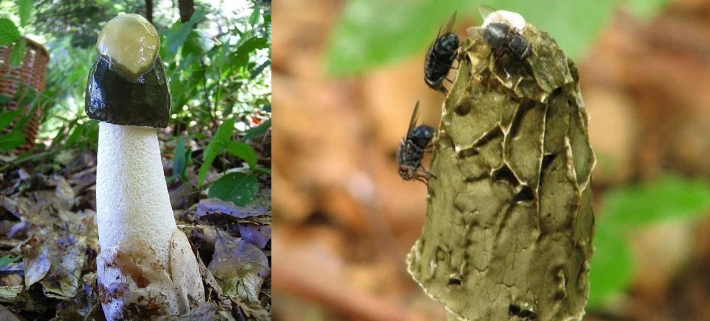
Phallus impudicus - The fungus develops underground and appears on the surface as a white ovoid or spherical piece attached to the ground with strings of white mycelium. During maturation, the egg lengthens to 30 to 50 mm in thickness and 35 to 60 mm in height. Covered with a hard white cover, which becomes creamy, slightly yellowish or pinkish as it matures. Its surface is smooth or weakly knotted, pleated at the base. The shield is three-layered, the outer and inner layers are thin and membranous, the middle is thick, soft and gelatinous, covering the spongy stem with a green mass of spores. During the maturation, the cover irregularly breaks at the top, taking the form of a vagina and in a very short time from 1 1/2 to a few hours emerges an expanding core with a bell-shaped head at the top. The mature fruiting body is composed of a vagina and a long stem with a head. The smell was initially slight, later unpleasant, reminiscent of a strong scent of carrion, attracting flies spreading spores.
Height head 25 to 40 mm and diameter 15 to 30 mm. In the shape of thimble or conical. In the hairy fruiting bodies adhering to the stem, the mature ones stand out. Finished on top with a small whitish shield shielding the hole leading to the inside of the fruiting body. The surface is covered with olive, decaying or green-green mucus composed of a mass of spores, with an unpleasant strong, sweet smell of carrion luring scattering flies and other insects, which soon eat and spread the spores, leaving a ribbed-pleated head, reminiscent of the shape of greaves. The head is then white or cream-colored and produces a sweet, honey scent.
The stem reaches 100 to 250 (300) mm in height and 30 to 50 mm in thickness. White colors, sometimes a little yellowish. Column-shaped narrowing towards the top. It is poorly embedded in the scabbard and is easily torn away. It is porous-sponge-like, inflated, with a wall made of several layers of cells. Inside empty.
White, off-white, creamy flesh sometimes slightly yellowish. Ventricular, fragile, light in the stem. Smell unpleasant carrion until the spore mass disappears, later sweetish, honey. The taste of the fruiting bodies enclosed in the egg resembles the radish flavor.
Occurrence: In deciduous and mixed forests, singly or in groups. From June to November. Quite common.
Value: Sporocarps closed in egg (egg-balls) edible after removal of the cover with a jelly-like layer, when developed - inedible.






