
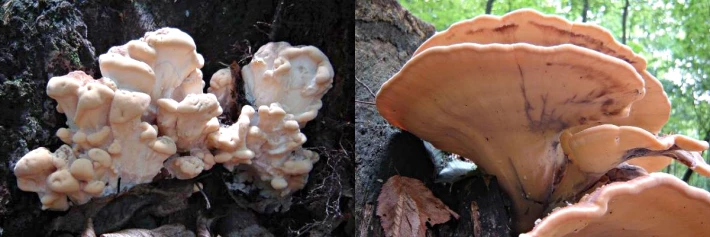
Meripilus giganteus - Annual mushroom, arboreal, irregularly shaped. Composed of fused single, fan-shaped hats in spherical, rosette or tile-like clusters around a common bulbous strong base, sitting on the ground. Very large, with a diameter of 500 to 800 (1000) mm and a weight of up to 8 kg.
A single hat has a semi-circular or lingual shape. 100 to 300 (500) mm in diameter and 10 to 20 mm thick. Colors in young fruiting bodies: fawn, yellow-brown, later soy-brown, chestnut, lighter cream on the edge. Matt, felt-like surface, covered with very delicate, insignificant scales, concentrically striped, wrinkled or striated in the radial direction. The margin is thin, young, rounded, uneven with age, wavy, sinuated.
Off-white tubes, darkening under pressure. 4 to 6 mm long.
Whitish pores, darkened when oppressed. Almost circular, small, 0.3 to 0.5 mm in diameter.
Stem very short, insignificant, lateral, growing out of the common base, or missing.
Off-white pulp with a pinkish tinge, broken and blackening when dry. Leathery, sandy, fibrous consistency, thicker than the tube layer. Smell pleasant mushroom. Slightly sour taste.
Occurrence: most often in parks, along roads, in cemeteries. It produces fruiting bodies from August to October.
Value: Edible mushroom only at a very young stage.






