
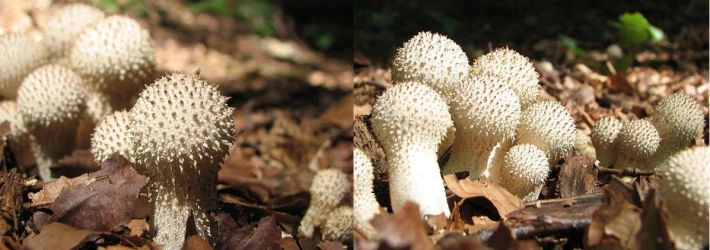
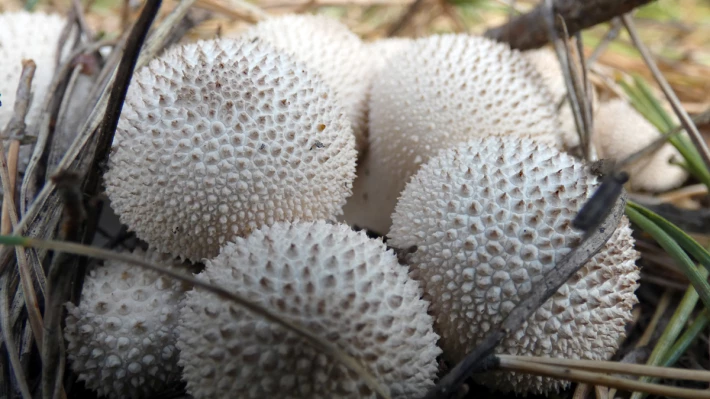
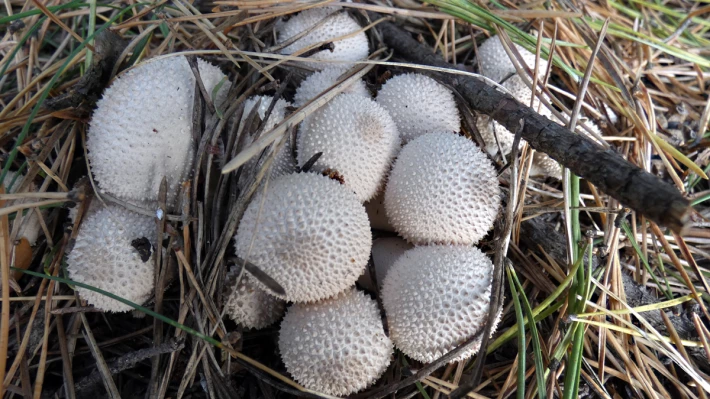
Lycoperdon perlatum - Mushroom quite variable in shape, initially spherical, later pear-shaped, clavateous or capitate, with a narrowed lower part (stipe). Heights from 40 to 80 mm and a width of 20 to 50 mm. The surface of the fruiting body is double-layered. The outer layer initially white, later turns yellow, becomes greyish brown, finally brown. Spikes of the exoperidium from the upper part (head) of the fruiting body, conical, pointed, easily abrasive. Heights of up to 2 mm, surrounded by a series of low blunt warts, may split at the base with a few at age. On the surface of the hearth are lower and replaced by warts. After the spines and nodules fall off, there remains a trace in the form of meshes surrounded by smaller eyes. The inner layer is paper, matte, initially white, later gray-brown. At its top, a relatively large, circular outlet is formed for mature spores with an unevenly jagged edge. The fruiting body is associated with the ground with a distinctive white mycelium cord.
The head is the upper part of the fruiting body, it is fertile (contains spores). In the shape of a spherical, often with a small umbo at the top, with a diameter of 20 to 50 mm.
The stem is an extension of the head, forming the lower part of the fruiting body. Cylindrical, tapering downwards. Thicknesses 12 to 22 mm. Its interior consists of empty chambers that do not contain spores (waste).
The fruiting body of the fruiting body is white when ripe, during puberty it turns yellow, yellow-green, gray-brown. Initially, it is firm and elastic, later soft, watery, finally dry, dusty. The taste of the young fruit-grower is gentle, pleasant and the smell is gentle radiant.
Occurrence: In mixed, coniferous and deciduous forests, thickets, meadows, pastures, singly or in groups. On the ground, sometimes on rotten stumps. From June to November. Frequent.
Value: Edible fungus, when the inside of the fruiting body is white, you can eat it after removing the surface.






