
we will consider three aspects of each phase of the cycle. First,
we will attempt to understand the market through the lens of a simplified model, specifically the psycho[1]logical perspective of two major groups: the smart money players who are assumed to be driving the market, and the general, uninformed public. Second, we will consider the crowd psychology of the public, and the tendency of the individual to be naturally inclined to make mistakes that ultimately work in favor of the smarts money. Lastly, we will begin to see the distinctions and patterns of each portion of the cycle from a price pattern point of view;
The importance of this analysis lies in the motivation that underlies many trading:
patterns and methods announce.
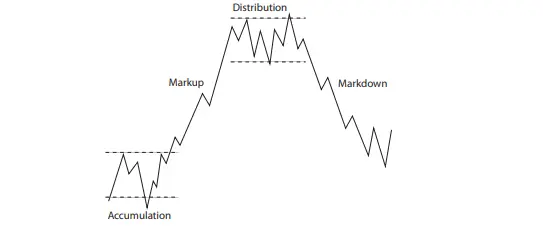
Figure is from the book call pcm_broker wily Finance
1 Accumulation: A sideways range where larger players buy cautiously and skillfully, without moving the price. The public is unaware of what is going on; the market is off the radar and out of the public eye while he was under accumulation.
2 Markup: This is the classical uptrend. At this stage, the public is made aware of the price movement, and their purchases help drive prices upwards. Smart money players who bought in the accumulation phase may sell some of their holdings into the strength of the uptrend, or they may just hold and wait for higher prices
3 Distribution: Finally, the uptrend ends and the market goes to distribution the phase where the smart money players sell the remaining shares to the to the public who are still generally anticipating higher prices. Really smart money players might even sell more than they own and go short in this range.
4 Markdown: This is the downtrend that follows a distribution event. Smart money players who are engaged in a short will buy back some of their shorts into this weakness. Eventually, the public realizes that higher prices are not in their future, so they panic and sell their position Accumulation is the first part of the process; here large operators (funds, banks, institutions, or even individuals) buy without alerting the public to their intentions. This is very difficult to achieve because of the buying pressure that will inevtably accompany the shares. or raise their prices. These players must buy slowly and passively over a long period of time to build their positions. From a technical perspective, the price movement is sidewards in a "trading range" characterized by areas of support and resistance, an intermediate term the moving average is flat, and the price simply chops back and forth on both sides of the moving average. As we have touched on before, this is an equilibrium condition of the markets.
coming uptrend
Distribution The End? Nothing goes on forever. At some point, higher prices will bring increased supply into the market, balance is achieved, and prices will stop rising. From a technical perspective, there are, broadly speaking, two ways this can happen. The manic blow-off end-of-trend pattern just discussed is unusual, but deserves attention because it presents dramatic opportunities and danger
Markdown: The Bear Market
The final stage is markdown, which in many ways is the opposite of the markup. Psychologically, if the market has been in a long distribution phase, the public will most have probably lost part of their fascination. Part of traders will be optimistic and will plan to "get back in” whenever it moves, but the general public follows pretty much the same things the major media do: hot markets that are moving.
The Cycle in Action
The framework laid out here was originally conceived around the equity markets and on ranges from several months to a couple of years. There, it applies particularly well, but also it Has relevance to other markets and shorter time frames. Commodity markets have a tendency to follow a similar pattern or cycle





