
There are predictable, consistent trends within the markets, yet these trends have significance only to the degree that they help you understand the demand and supply pressures behind the changing market structures. The real importance of these trends lies in the fact that they identify specific entry and exit points for you and the techniques to control risks on each trade, yet long-term success can be achieved only if they form part of a more comprehensive approach that incorporates all aspects of market structure and psychology
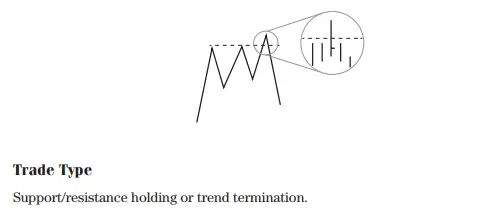
Concept Markets probe for stop orders and activity beyond significant price levels. Many times, there is no real conviction behind these moves, and the moves fail and re[1]verse quickly once the stop orders are triggered. Entering after such a move allows for excellent reward/risk potential with a clearly defined risk point
Entry The market needs to be overbought in some form or another for the market to reverse in our favor. The best setups for this trade take place when the market is in an extended trend, and most likely, will also contain a divergence pattern in momentum. Another common setup is seen in an extended consolidation below resistance. This setup is one that would most likely generate another trend leg beyond that level of resistance because traders are anticipating this move and looking to take part in a breakout.
Trigger When a short position is taken, the market breaks out to trade higher than a well-defined resistance level, only to retrace from there and close beneath the resistance level on either the current bar or the next one. It does not matter how much price action or volume there was during the breakout; what matters is that the breakout lacks conviction above the resistance level
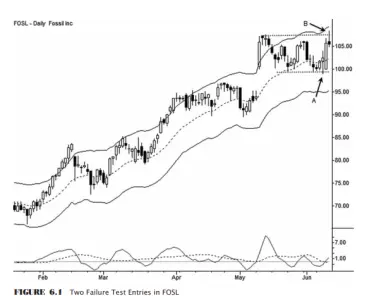
Figure is from the book called pcm_broker
Stop The stop that should be used in this type of trading is very clear-cut: the hard stop has to be placed at a level immediately after the extreme test. For example, if you were trading on the two examples in, the stops would have been placed below the low in A and above the high in B. It is a little trickier with the EURUSD trade since the failure actually happened on the close of the day A, while the day before had reached the highest point of the excursion past the resistance. Nevertheless, in all situations, the stop is placed at a point slightly outside of the extreme test past the support or resistance point.
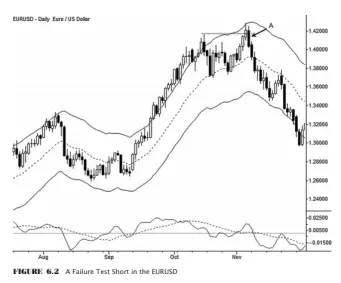
the figure is from the book called pcm_broker
Profit Target The majority of traders get their best results from a strategy where they can capture partial profits along the way whenever possible. As an example, one such strategy might involve capturing profit on the first half once the profit made is equal to the risk taken when the trade began. The profit target on the second half of this trade is discretionary, though the possibility of a lengthy and complicated retracement eventually leading to a continuation of the initial trend must be considered.
Failure Patterns While it is undoubtedly crucial to understand what a pattern would be like when it is successful, from an educational point of view, it may be more logical to direct attention towards what should not occur. By being able to identify these early indicators of failure, it will generally be possible to lower the position size and minimize the overall extent of losses. Additionally, a thorough analysis of these common failure patterns will enable one to develop an insight into how the trade works.
In this case, what we do not want to see after trade entry is simple: the market should not be able to consolidate near the level, nor should it exceed the stop-loss point. Consolidation near the level is more consistent with an impending breakout and continuation of the existing trend. If the failure test trade is successful, price should move sharply a way from the level, and the trade should be immediately profitable (within one to three bars on the trading time frame). This is another expression of the classic price rejection, a further confirmation of the validity of the failure beyond the level
One last point to consider is that some of these trades will hit the stop point and, on the same or the next bar following the stop out bar, will once again fall back inside the level. Though it can be psychologically challenging to reenter immediately after a loss, this second trade, taken on the second failure, is also an excellent entry. This is another reason for trading both entries on smaller risk this second entry sets up often enough (and is virtually obligatory) that the sum of the risk on both trades should not be significantly larger than the maximum risk taken on other types of trades
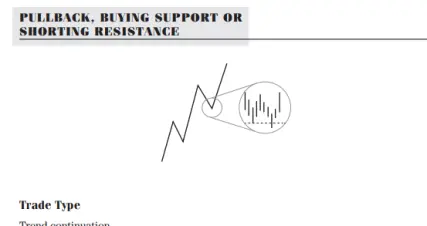
Figure is from the book called Pcm_broker
The concept of pullbacks might be the single most important structural factor that defines trends. For many traders, the idea of pullbacks represents what with-trend trading is all about – using the countertrend pullback as a means of placing your position within the bigger picture of a trend at favorable prices. Under the umbrella of pullbacks lie countless numbers of various patterns such as flags, pennants, wedges, triangles, and many more; however, the pattern itself does not matter because they are continuation patterns of trends after all. There is no need to have separate strategies for each type of pullback
Setup The most important condition for this trade is that the market must be trending.Though it is not always possible to separate trending from non trending environments with precision, many losing trades are the result of attempting pullbacks in non trending environments At the risk of oversimplifying, if the market is in an established trend, the preceding setup leg should be at least as strong as previous trend legs in the same direction. In other words, it should not break the pattern of the trend and should not show momentum divergence. Pullback trades are also possible on trend changes or following breakouts of trading ranges, though this more properly falls under the Anti trade category. In these cases, there will be no established trend, but the setup leg should show a distinct change of character compared to the preceding environment. Whether in an established trend or at the beginning of a new potential trend, the same condition applies: the setup leg should suggest momentum in the market





