
Happy Fungi Friday everyone! I'm back again with more fascinating fungi from western Michigan, USA. Today, I have a diverse collection of mushrooms, some edible, some poisonous, and plenty of others vibrant and ephemeral, posing on the forest floor waiting for their picture to be taken.

My most exciting find of the last few days was, without a doubt, my first encounter with a collection of fresh Coral Tooth Fungus (Hericium coralloides) fruiting from the underside of an otherwise inconspicuous log that lined the woodland trail I was hiking on. This striking white and delicately spined specimen is a close relative of the popular medicinal and edible Lion's Mane (Hericium erinaceus) mushroom as well Bear's Head Tooth (Hericium americanum), another tasty edible toothed fungi. Each of these three species are considered to be choice edible mushrooms whose taste and texture are often compared to that of shellfish or other seafood like fish and squid. Having now had the opportunity to collect and eat each of these three species, I can attest that their flavors are very similar when pan fried with butter and salt. The flesh itself reminds me of shellfish when eating the densely packed spines of Lion's Mane and Bear's Head Tooth, though the experience of eating Coral Tooth Fungus reminded me more or eating squid or octopus. Although the taste was undoubtedly very similar to its sister species, the highly branched, almost tentacle-like growth pattern that Coral Tooth Fungus takes on gave me the mouth feel of eating a very tender piece of squid tentacle, an unexpected but welcome discovery for me. I will certainly be keeping my eye out for more of these in the future.
Apart from the Coral Tooth Fungus, I was able to find a few other edible species, including a small patch of Red Chanterelles (Cantharellus cinnabarinus), small fruitings of both Golden Oyster (Pleurotus citrinopileatus) and Summer Oyster (Pleurotus pulmonarius), as well as a fresh White-pored Chicken of the Woods that was unfortunately wedged beneath the buttressed roots of an old oak tree that make it impossible for me to cut it free from its host. I'll leave this one to sporulate and hopefully spread more chicken of the woods across my local foraging grounds.
A few other notable but inedible finds include my first sightings of the year of Old-Man-of-the-Woods (Strobilomyces strobilaceus), Cornflower Bolete (Gyroporus cyanescens), Shingled Hedgehog (Sarcodon imbricatus), American Yellow Fly Agaric (Amanita muscaria var. guessowii), and a wealth of Yellow-tipped Coral Fungus (Ramaria formosa), among others. As the worst heat of summer has now passed us by, the cool rains bode well for the many other fascinating species yet to show themselves on the forest floor.
I hope that you enjoy these images documenting a small sliver of the beautiful and often overlooked biodiversity of the Kingdom Fungi. As always, feel free to offer your suggestions if you believe that I have misidentified any of the species shown below. Happy Fungi Friday to you all!
Coral Tooth Fungus (Hericium coralloides):


Red Chanterelle (Cantharellus cinnabarinus):


Golden Oyster Mushroom (Pleurotus citrinopileatus):

Summer Oyster Mushroom (Pleurotus pulmonarius):

White-Pored Chicken of the Woods (Laetiporus cincinnatus):

Yellow-tipped Coral Fungus (Ramaria formosa):


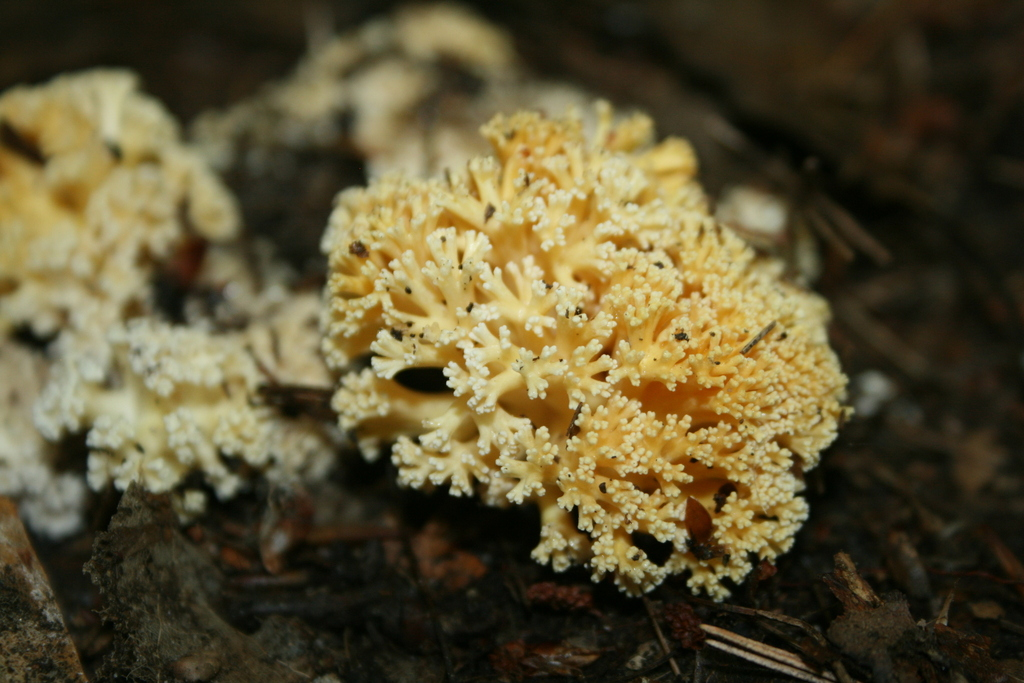

Gyroporus borealis:

White Coral Fungus (Clavulina coralloides):

Dyer's Polypore (Phaeolus schweinitzii):

Red-cracking Bolete (Xerocomellus chrysenteron):


Pinewood Gingertail (Xeromphalina campanella):

Old-Man-of-the-Woods (Strobilomyces strobilaceus):


Beech Rooter (Oudemansiella furfuracea):

Fishy Milkcap (Lactifluus volemus):

American Yellow Fly Agaric (Amanita muscaria var. guessowii):

White Cheese Polypore (Tyromyces chioneus):

Orange Mycena (Mycena leaiana):

Lanmaoa pseudosensibilis:

Red-mouth Bolete (Boletus subvelutipes):

Clitocybula oculus:

Pallid Bolete (Imleria pallida):

Green Cheese Polypore (Niveoporofomes spraguei):

Shingled Hedgehog (Sarcodon imbricatus):


Reddening Lepiota (Leucoagaricus americanus):

Black Knot (Apiosporina morbosa):

Peppery Milkcap (Lactifluus piperatus):

Sharp-scaly Pholiota (Pholiota squarrosoides):

Russell's Bolete (Aureoboletus russellii):

Charcoal Burner (Russula cyanoxantha):

Bitter Bolete (Tylopilus felleus):

Dyer's Polypore (Phaeolus schweinitzii):

Painted Suillus (Suillus spraguei):

Clustered Bonnet (Mycena inclinata):

Blusher (Amanita rubescens):

Small Funnel-Veil Amanita (Amanita multisquamosa):

Frost's Bolete (Exsudoporus frostii):

Cornflower Bolete (Gyroporus cyanescens):


Common Earthball (Scleroderma citrinum):

Bleeding Fairy Helmet (Mycena haematopus):

Dotted-stalked Suillus (Suillus granulatus):

Gloioxanthomyces nitidus:

Mustard Yellow Polypore (Fuscoporia gilva):

Veiled Polypore (Cryptoporus volvatus):

Black Tooth (Phellodon niger):

Northern Cinnabar Polypore (Trametes cinnabarina):

Amanita Sect. Phalloideae:


Field and Button Mushrooms (Genus Agaricus):


Webcaps (Genus Cortinarius):

Genus Coltricia:

Boletes (Family Boletaceae):

My NFT Showroom gallery: https://nftshowroom.com/tych021/gallery
Creary Gallery: https://creary.net/@tych021/projects
Publish0x reflink: https://www.publish0x.com?a=M7e58kDYd2
PeakD reflink: https://peakd.com/register?ref=tych021
NFTShowroom reflink: https://nftshowroom.com/?r=tych021
Twitter: https://twitter.com/tych021
Vimm.tv: https://www.vimm.tv/tych021






