
US President Donald Trump promised to deliver “the most extraordinary first 100 days in American history” at his inauguration ceremony on January 20. So have these promises been fulfilled?
For decades, the 100-day milestone has been seen as a symbolic test for new presidents in the US; this process, which is an evaluation process to assess the progress of the new administration, is nothing new for Trump. After all, Trump is in office for the second time.
So what happened in Trump’s (second) first 100 days? During his election campaign, Trump promised to act quickly on the most important issues. On his first day, he said he would lower prices, end the war in Ukraine and pardon those connected to the 2021 US Capitol attack.
He didn’t achieve all of these, but judging by the number of executive orders made, Trump is the fastest-moving president of modern times. He has issued numerous directives to the federal government that do not require Congressional approval.
These include legally binding executive orders. Trump has issued more executive orders in 100 days than any president in the past century. He has issued more than half of those issued in his entire first term, and nearly 90% of those issued by Joe Biden in his four years.
Some of Trump’s executive orders have had significant consequences, and many have been aimed at undoing Biden’s legacy, which his supporters have applauded. Among the executive orders he issued on his first day in office, Trump announced that the U.S. would once again withdraw from the U.N. Paris agreement on climate change, which he said was a burden on Americans, and declared a national energy emergency to increase U.S. oil production.
Trump has shown little interest in working with Congress on new legislation when it comes to exercising his executive power. According to initial reporting by Punchbowl News, he has signed only five bills into law so far, fewer than all presidents in the past 70 years have signed into law in the same period.
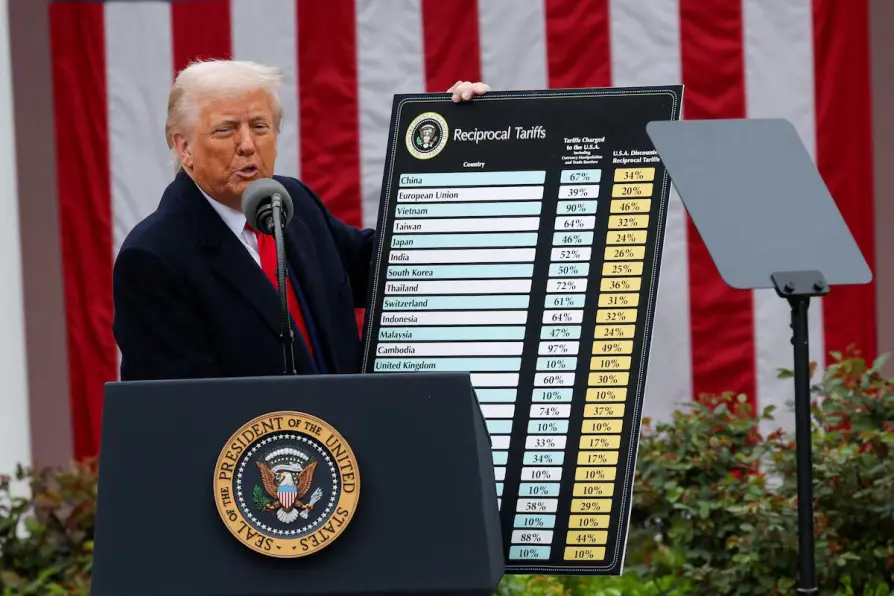
After February and March, when hints of Trump’s trade policies began to trickle in, April was a period no one expected. Trump unveiled his “reciprocal” tariff plan at a White House “Liberation Day” event on April 3, showing a chart showing the steep tariffs imposed on dozens of countries.
Stock futures fell as investors realized that Trump’s tariff plan was not a bargaining chip and that the plan was much more aggressive and unprecedented than expected.
Trump remained unperturbed by the decline:
“The markets are going to explode, stocks are going to explode, the country is going to explode. The rest of the world is trying to see if there’s a way to make a deal. They’ve taken advantage of us for years, we’ve been on the wrong side of the fence for years, and I tell you, I think it’s going to be incredible.”
Wall Street was hit by a sharp selloff as investors tried to make sense of Trump’s escalating trade war.
Despite most countries opening the door to negotiations, China’s countermove has further increased market uncertainty: China has escalated the global trade war by retaliating to Trump’s tariffs, adding to the sell-off in US stocks.
The Dow, Nasdaq and S&P 500 lost more than 5%, while the Nasdaq closed in a bear market, down more than 20% for the first time since 2022.
But this outlook has not convinced Trump to back down on his tough trade policies. “Calm down! Everything will be fine. America will be bigger and better than ever!” Trump said on social media.
Moreover, days after the market turmoil, Trump tweeted, “IT’S TIME TO BUY NOW!!! DJT.” The president was referring to his affiliated company, Trump Media and Technology.
Hours after Trump's post, DJT experienced a strong rally, sparking criticism from the president over his speculative move.
Trump announced that he was suspending most “reciprocal” tariffs, except for China, for 90 days. Investors who had been waiting for any sign that Trump would change his approach to the punitive tariffs finally took action, and stocks soared. It was the biggest single-day gain for the S&P 500 since 2008 and the third-biggest single-day gain in modern history.
Despite the historic rally, the market is still well below where it was before Trump announced the reciprocal tariffs on April 2.
And that boost was short-lived: The stock market fell again when the White House escalated the trade war by announcing plans to impose massive 145% tariffs on China. The Dow fell 1,015 points after rising nearly 3,000 points the day before.
It is increasingly clear that markets will continue to be volatile because of Trump’s tariff policy.
Apple, an icon of American business, is one of the companies most affected by the US-China trade war. Apple is heavily reliant on international supply chains and factories in China, and tariffs could disrupt Apple's business model.
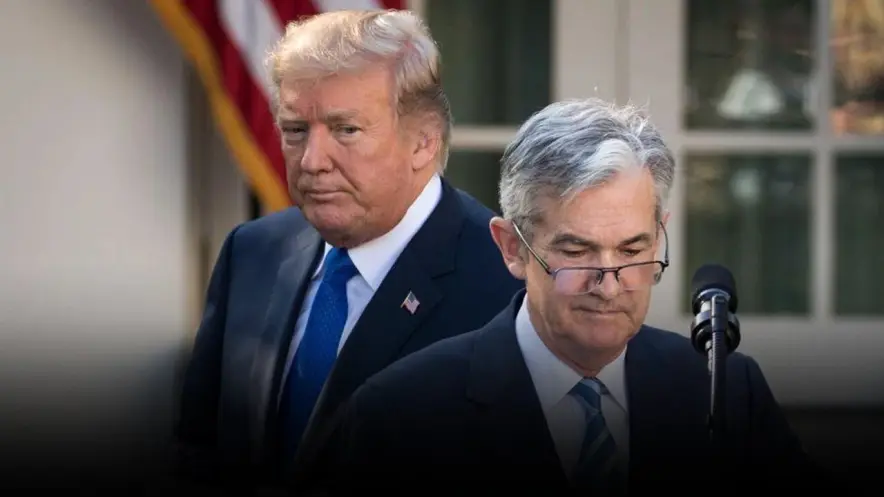
Fed Chairman Jerome Powell has issued a stern warning about the economic impact of Trump’s tariffs, saying they could contribute to inflation and slow economic growth. But the warning has resulted in a move from Trump that will likely ratchet up market tensions.
Trump has been lashing out at Fed Chairman Powell for weeks for not cutting interest rates quickly enough. Trump, who has unsuccessfully lobbied Powell to lower interest rates, has hinted that it could be “only a matter of time” before the Fed chair is eventually fired.
While presidents have often clashed with the Fed, which sets U.S. monetary policy, no U.S. leader has gone so far as to fire a Fed chair, at least since the central bank became functionally independent in 1951.
The Fed operates independently of politics and sets interest rates without political influence. It’s a major departure from the norm for a president to try to control the Fed’s policy, but this isn’t the first time Trump has challenged Powell.
Trump’s first 100 days in office were the worst for the stock market at the start of a four-year term for a president since the 1970s.
The 7.9% decline in the S&P 500 from Trump’s inauguration on Jan. 20 to the close of April 25, according to CFRA Research, was the second-worst 100-day performance since the start of President Richard Nixon’s second term.
Nixon witnessed the S&P 500 fall 9.9% in 1973 after a series of economic measures to combat inflation led to the 1973-1975 recession. Nixon later resigned in 1974 amid the Watergate scandal.
According to CFRA data, in the post-election years from 1944 to 2020, the S&P 500 gained an average of 2.1% in the first 100 days of any president.
The intensity of the stock market decline that followed Trump’s inauguration stands in sharp contrast to the initial euphoria following his November election victory.
At the time, the S&P 500 rose to an all-time high on confidence that the former businessman would deliver on his much-anticipated tax cuts and deregulation. According to CFRA data, the S&P 500 gained 3.7% from Election Day to Inauguration Day.
In addition, with Trump positioning himself as a crypto president with his campaign promises, Bitcoin broke the psychological barrier of $100,000 for the first time in history on December 5. With Trump failing to swiftly deliver on his crypto promises and market uncertainty caused by trade tensions, Bitcoin fell below $80,000 for the first time since November on February 28.
After Trump took office, he implemented other campaign promises that investors did not take seriously, especially his aggressive trade policy that many feared would increase inflation and push the US into a recession, and the rally stopped and then fell sharply.
In April, the S&P 500 lost 10% in just two days and briefly entered a bear market after Trump announced “mutual” tariffs. Trump later walked back some of that statement and gave countries 90 days to renegotiate agreements, which calmed investors’ concerns to some extent. Many are worried that more declines lie ahead.
The biggest blow to stock market tensions has been gold. Spot gold has broken multiple records this year, most recently reaching a record high of $3,500 on April 22.
Gold has gained value this year amid widespread uncertainty about the outlook for the global economy. The yellow metal has historically been seen as a safe haven during times of economic and geopolitical uncertainty.
The countries continue to negotiate with the US regarding bilateral customs duties. While this process contributes to the uncertainty in the stock markets and indicates a cautious outlook, time will tell what other moves Trump will make and which policies he will continue.






