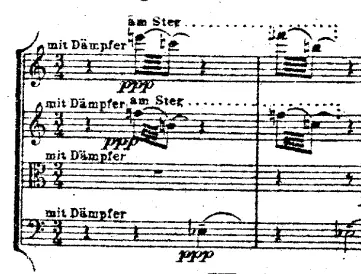
In the first measure of this early Webern masterwork, the first and second violin enter on the second ♩ (quarter-note, or crotchet) beat. Both violinists bow near the bridge of the instrument (what the Germans call am Steg, what the Italians call sul ponticello, Webern opting for the former indication), producing a thin and ethereal tone color emphasizing the upper (hence tonally further and richer) partials of the harmonic (overtone) series. Some might describe the timbre thus produced as "glassy" or "icy," and indeed this implication arises where the player must bow at such a soft, almost inaudible, dynamic as ppp (triple piano or pianississimo). Moreover, the instruction to perform mit Dämpfer (literally "with damper," i.e. with mute, what the Italians term sordina or con sordino), additionally serves to restrain or muffle the tone as well as dynamic range and intensity, contributing to the frosty and delicate timbre and tone color so integral to this work.
Thus -- this directive to play unmeasured 𝅘𝅥𝅱 (64th note, or hemidemisemiquaver / semidemisemiquaver) tremolos, both with damper and near the bridge, at a dynamic level of triple piano, both instruments playing pitches above a4'' (the pitch at which the members of an instrumental ensemble tune their instruments and attain uniformity of tuning), an effect reproduced with no variation except as regards pitch content in the first quarter-note beat of the subsequent measure -- already establishes that this movement in miniature, lasting a mere thirteen measures at a tempo of ♪=58 (Grave, i.e. very slow tempo, equivalent to ♩=29), expresses an unmistakeable restrained intensity at the outset with an absolute economy of means. This affirms the observation of American avant-garde composer and music theory Henry Cowell (1897-1965), in which Cowell stated that Webern's oeuvre constitutes "an almost frightening concentrated interest in the possibility of each individual tone."
Now, of course, one must proceed to the pitch content of these two tremolo pairs in the first two measures of the composition. In the first measure, in the first♩ beat, the first violin alternates for the entirety of that beat between the pitches c6'' and e6'' (two Cs above "middle C" [c4''] and two Es above "middle C"). The first violin begins its unmeasured tremolo on e6'' and ends it on c6'', the "unreciprocated" tie emerging from the c2'' indicating that the violinist must allow a brief free vibration of this pitch at the conclusion of the tremolo. Simultaneously, the second violin alternates between b4'' (B above "middle C") and f5'' (two Fs above "middle C"), starting on f5'', permitting the free vibration of b4'' at the end. Observe that the simultaneous f5'' in the second violin and the e6'' in the first violin occupy the distance of a major seventh (eleven semitones apart) while the simultaneous b4'' in the second violin and c6'' in the first violin occupy the distance of a minor ninth (thirteen semitones apart).
Both intervals supra, the major seventh and minor ninth, the ear necessarily perceives as dissonances quite far apart on the circle of fifths and sounding higher partials in the harmonic (overtone) series when combined. (As noted above, the direction to bow am Steg [con sordino] enhances our perception of these higher, more distant partials). Nonetheless, there is a certain sweetness, an unmoored or floating quality, emerging from this figure. A total suspension of tonal hierarchy and thus gravity/polarity, according to the ethos of "free atonality," permits us, musicians and laymen alike, the privilege of appreciating the sheer beauty of these pitches. Certainly, an implicit hierarchy does emerge in this work; Webern seeks order, he refuses the arbitrary as a matter of principle. Yet, with a boldness guided by the composer's inner ear, tone color and timbre of an almost morbidly sensuous type reveals itself even in a fragmentary moment of this kind.
To return to the intervals of the major seventh and minor ninth, these are very closely related, in fact to the extent of identity. Both the major seventh and minor ninth exist as inversions of the minor second, perhaps with the exception of the tritone (augmented fourth/diminished fifth, more on this anon) constituting the most dissonant interval in our traditional- (or, let us say common-practice-) period conception of intervallic and tonal relations (as discovered [or uncovered] in the centuries-long process of polyphonic-contrapuntal development and the ineluctable pushing-forward of the frontiers of diatonicism into chromaticism and consequent experimentations in tunings and temperaments). Hence, the intervals arising between the two instruments, being essentially identical, embody a principle integral to Webern's compositional process and conception of music as a whole -- that is, his value of organicity.
No matter how varied (even chaotically so!!!) a composition may appear on its surface, Webern's meticulous compositional procedure (deemed a partial explanation for the relative slimness of his oeuvre) embodied notions of rightful order, a reflection as it were of the divine and sublime in the hands of a mere human artisan. Whether we speak of the products of Webern's tonal, freely atonal, or dodecaphonic (twelve-tone) periods, his teacher (and, perhaps, surrogate father) Schoenberg's formulation of developing variation proved decisive. By developing variation, one means that the entire process of unfurling of a musical composition within the parameters of time and space obeys a formal logic overriding any deeply-rooted formulae honored in the classroom. An entire composition, no matter its particular harmonic language and structural idiosyncrasies, let alone its orchestration, attains unity through motivic economy, through the construction of most or all primary and subsidiary material from one or at most a few generative motivic cells. Therefore, the unity and coherence of an entire work, whether a handful of measures in length or encompassing gargantuan symphonic proportions, operates upon the principle of a motive generating all or virtually all other ideas within the composition, the work itself essentially a series of ineluctably unfolding transformations of that motive. Within the warp and woof of a successful work manifesting this formal principle, all elements of the structure invariably relate in the most acute fashion.
Webern saw fit to invoke Goethe's metaphor of the unity of the primeval plant as justification for this principle, stating "the root is in fact no different from the stalk, the stalk no different from the leaf, and the leaf no different from the flower: variations of the same idea." This is the soul of Webern the musical poet, betrayed in all his work, needing in fact no prose justification, let alone one cribbed from another, earlier great personage in his cultural tradition.
We return to the analysis of Webern's "musical text." Besides the inverted-minor-second intervallic distances simultaneously emerging between the first and second violins in the chilly tremolo figure of the first measure, we ought to measure out the intervals between the notes alternated with respect to the two violinists independently, rather than in comparison with one another. Between the c6'' and e6'' of the first violin's tremolo we determine the intervallic space of a major third, while between the b4'' and f5'' of the second violin a tritone arises (here notated as a diminished fifth, enharmonically equivalent to an augmented fourth). Although appearing as a relatively lower partial in the harmonic series, the mere mention of the interval tritone conjures up images of centuries of controversy, this mi contra fa connoting "musical demons" of a sort particularly as Western music reached the apex of modal polyphony. In any event, it is a highly dissonant interval, nearly as dissonant as the minor second discussed supra. By dissonance one means the inherent predilection of an unstable interval, an interval less firmly rooted in the lower partials of the harmonic (overtone) series, to resolve to a more stable interval (what we term a consonance).
The tritone, with its tension all too palpable, indeed yearns for resolution, at least in the strictly tonal context. Possible resolutions include motion inward, toward a major or minor third; or motion outward, toward a minor or major sixth. In essence, such resolutions are identical in pitch content, or at least for the purposes of analyzing pitch content, as the major sixth equals the minor third inverted, while the minor sixth equals the major third inverted. Curiously, the actual resolution of the second violin's tritone/diminished fifth occurs simultaneously in the first violin. That is, the second violin's tritone composed of the pitches b4'' and f5'' naturally resolves inward to c5'' and e5'', which when transposed up an octave in accordance with the principle of octave equivalence yields the pitches c6'' and e6'' that encompass the first violin's tremolo figure.
Perhaps audaciously, in the temporal domain Webern collapses the dissonance and consonance, the tension and its acoustically-determined resolution, into a single breath. One may insist, quite rightly, that this rests upon storied precedent, and such an argument rests on a solid foundation. In music of the common-practice period, rooted in the tonal system of tonics and dominants and the circle-of-fifths, the root of the tonic may sound simultaneously with the pitches of the dominant triad or dominant seventh (or dominant ninth, etc ...) appearing (ordinarily) above it in the pitch space, at some point (if not immediately) resolving to the tonic triad, the root unmoved except possibly in octave equivalence. But this model, an elaboration of the technique of the organ point exploited for maximum cadential effectiveness, demands the integrity of the tonic-affirming authentic cadence. Webern, as much as he envisioned himself a stalwart defender of tradition and a conservative in music, does no such thing, rather "resolving" this dissonance into the silence of the third♩ beat of the measure, or perhaps at most resolving it into the briefly-held laissez vibrer of the c6'' in the first violin and b4'' in the second violin (the intervallic distance of a minor ninth, a strong dissonance only softened by the wider voicing than the interval's prima [minor second] form). Again, we encounter a condensed focus on interval and pitch at once referencing and sliding relationships and practices once deemed carved into stone as immutable musical law. Yet Webern's irresistible musical logic and the sensitivity of his inner ear permit our acknowledgment of the essential rightness of this as procedure and expression alike.
TO BE CONTINUED ...
If you enjoyed this, please consider becoming a patron at https://www.patreon.com/philipdaniel or https://www.subscribestar.com/philip-daniel






