
Art and Microeconomics
“Creating is Necessary” began as an idea. Then it became text, writing on paper, photography, algorithmic interpretation, and digital imagery.
Each transformation left a distinct mark, without replacing the previous one.
A question arises: What is authentic when everything can be copied?
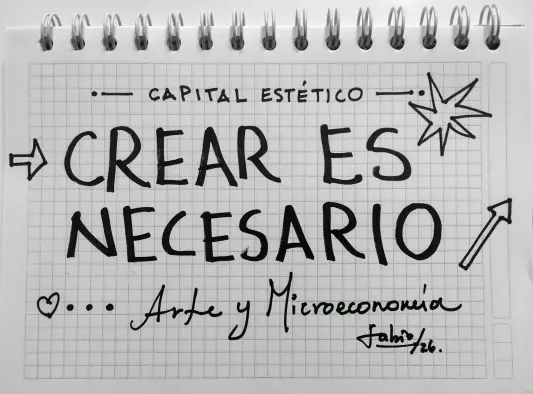
I. PRESENCE
Being aware of the passage of time, feeling the fleeting nature of moments against the vastness of eternity, is part of our essence as human beings.
This Essence "produces" Presence and Transcends through our own memory and the memory of others.
At the same time, everything that can be produced can be refined, and everything that can be copied can be replicated.
Product, Copy, and Exchange form the fertile ground from which our Individuality–Culture symbiosis emerges.
For AI, this fertile ground is humanity itself in its entirety.
II. THE BLOCKCHAIN PROOF
Blockchain does not prevent copying—in fact, nothing does—but it restores uniqueness to the digital object: an immutable record that distinguishes the original from the replica, the author from the imitator, the moment of creation from the moment of forgery. It is an architecture of authenticity for a world in which everything can be duplicated.
The creative process is not primarily technical. It is ritualistic: it has its own rhythms, thresholds, and "charged objects." Emotions do not merely decorate the process; they are part of its structure. The space in which a work comes into being is an extension of the body and life of its creator. This depends upon a singular presence that no system can replicate from the outside.
If the medium is the message—Marshall McLuhan, 1964—then certifying a work on the blockchain is a declaration of existence. The blockchain is the equivalent of a notarial record without the notary: an act of legitimization that transforms artistic labor into aesthetic capital.
III. COMMUNITY
As Chris Anderson described in The Long Tail (2006), in a world where digital distribution carries an almost zero marginal cost, a small and loyal audience can sustain a work more effectively than the model of superficial mass appeal. A small, dense community rather than a large, distracted audience.
The intersection between the ink stain and the blockchain record is a continuous process: the work happens, settles, and is certified. What remains—if the work was honest—is an archive, a token, a trace capable of circulating.
And what is it that cannot clone itself?
Ultimately, we are speaking about the transformation of personal experience into expressions that others may inhabit.
References
Anderson, C. (2006). The Long Tail: Why the Future of Business Is Selling Less of More. Hyperion.
Benjamin, W. (1935/2003). La obra de arte en la época de su reproductibilidad técnica. Itaca.
Benjamin, W. (1935/2008). The Work of Art in the Age of Mechanical Reproduction. Penguin Books.
McLuhan, M. (1964). Understanding Media: The Extensions of Man. McGraw-Hill.
_ by: Fabio. Mu Ink 2026.
Facebook: https://www.facebook.com/muink7
x: https://www.x.com/fabioalarte






