
OlympusDAO's staking rewards make Ohm a handsome investment -- if you understand the risk. A break-even price curve offers a simple way to evaluate how risky a future Ohm price is to your Ohm portfolio's profitability.
I documented preliminary work on a break-even price in a previous Publish0x post. This post updates that work with new rebase rate information, and presents the break-even price as a function of time instead of a single point.
Understanding OlympusDAO's compound interest
OlympusDAO compounds interest on staked Ohms every eight hours. This compounding takes place during a "rebase" where the DAO makes algorithmic tweaks to the compound interest rate, bond offers, and Ohm emissions.
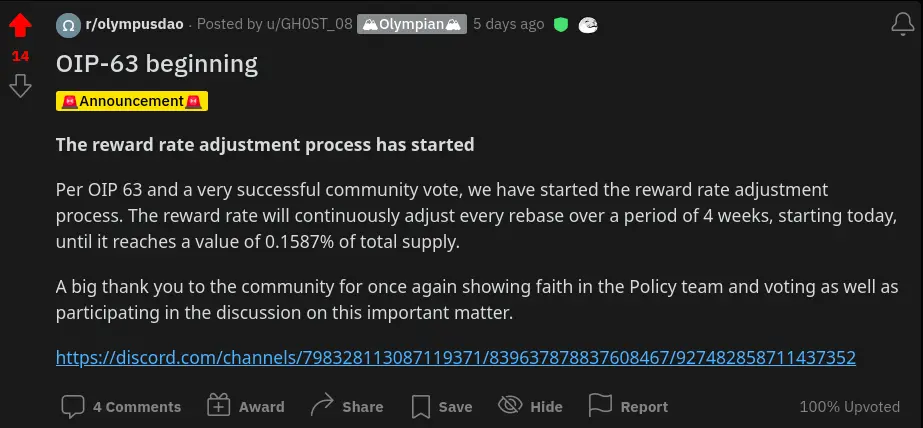
The range of possible rebase reward rates is defined in a DAO proposal called OIP-63. OIP-63 describes a rebase rate range of potential values based on the number of circulating Ohms:
- The rebase rates will converge from their current values to 0.1587 percent over four weeks.
- While the circulating Ohm supply is within 10 million to 100 million, the rebase rates vary to target an equivalent APY between 500 percent and 1000 percent.
The OlympusDAO subreddit contains more information on OIP-63's implementation.
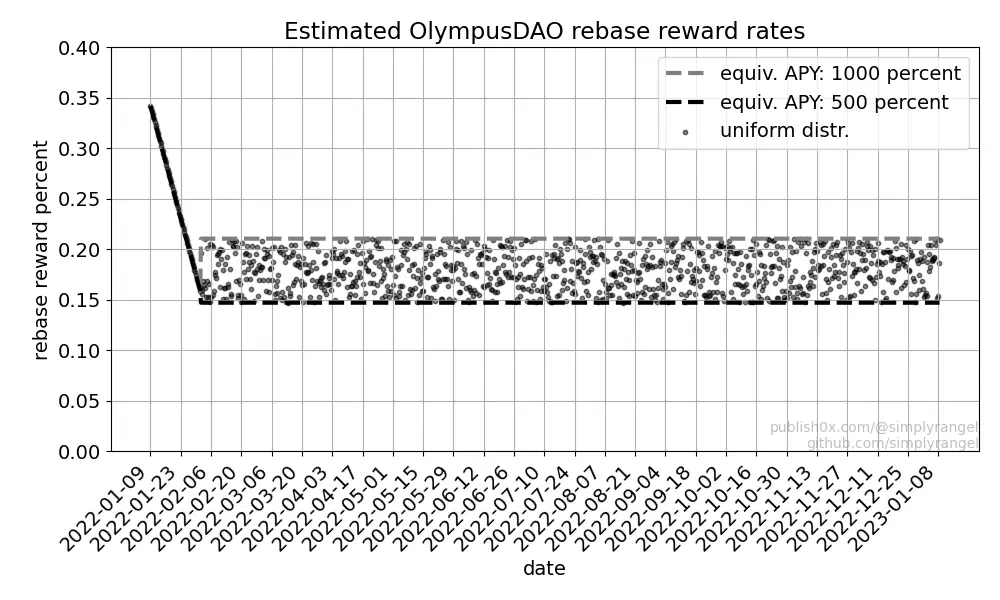
Estimating OlympusDAO's rebase reward rates through 2022
I estimated rebase reward rates for every rebase in 2022 with the following method:
- I assumed OIP-63's rebase reward rate change can be described by a simple linear decline from its current value -- 0.3421 percent when I wrote this post -- to the 0.1587 percent target in four weeks.
- Four weeks from the start of OIP-18's implementation is Jan. 31, 2022. The rebase reward rates after Jan. 31, 2022 are prescribed along a range of values defined by the Ohm supply. I assumed the Ohm supply will exceed 10 million by Jan. 31, 2022. The relevant reward rate range is between 500 percent and 1000 percent equivalent APY.
The rebase reward rates after Jan. 31 can then be estimated using three different distributions:
- The first rate distribution assumes the highest possible rebase rate out of OIP-63's prescribed value range. In other words, every rebase event after Jan. 31 will have an equivalent APY of 1000 percent.
- The second rate distribution assumes there is an equal chance any rebase rate on the prescribed range can occur. In other words, every rebase event carries a random value chosen from a uniform distribution between 500 percent and 1000 percent APY.
- The third rate distribution assumes the lowest possible rebase rate. In other words, every rebase event after Jan. 31 will have an equivalent APY of 500 percent.
Visually, these three rebase interest distributions are shown below. Note the discontinuity for all three distributions occurs on Jan. 31, 2022.
Calculating the break-even curve
The accrued Ohm from a simulated 1-Ohm purchase today using the three different rebase reward distributions is plotted below.
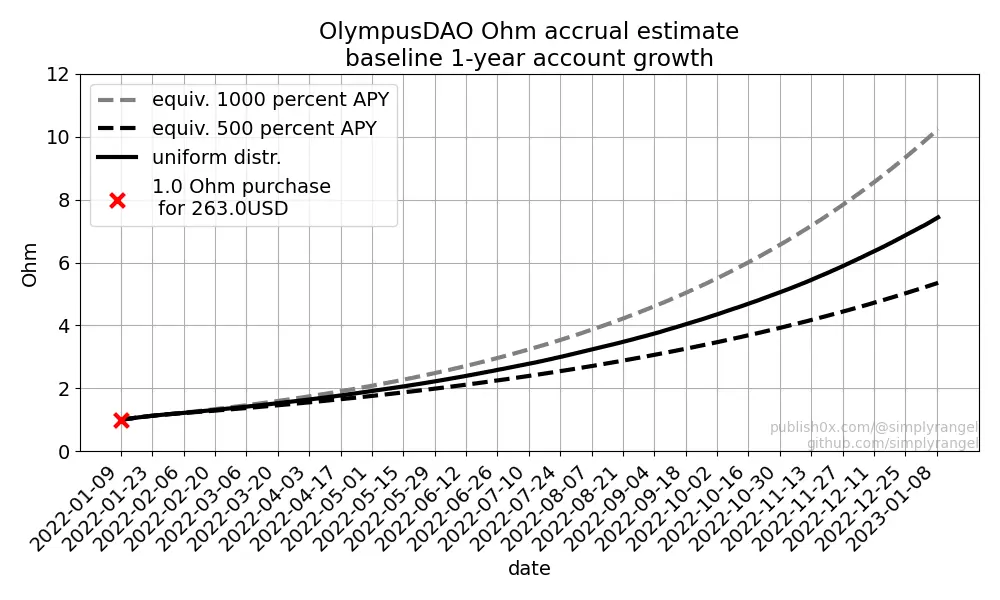
Two high-level observations immediately jump out to me:
- One Ohm purchased today can will likely accrue between 5.5 and 10 Ohm by Jan. 2023
- One Ohm purchased today will double by about May 2022 (about four months)
The break-even price after every rebase produces the curves shown below.
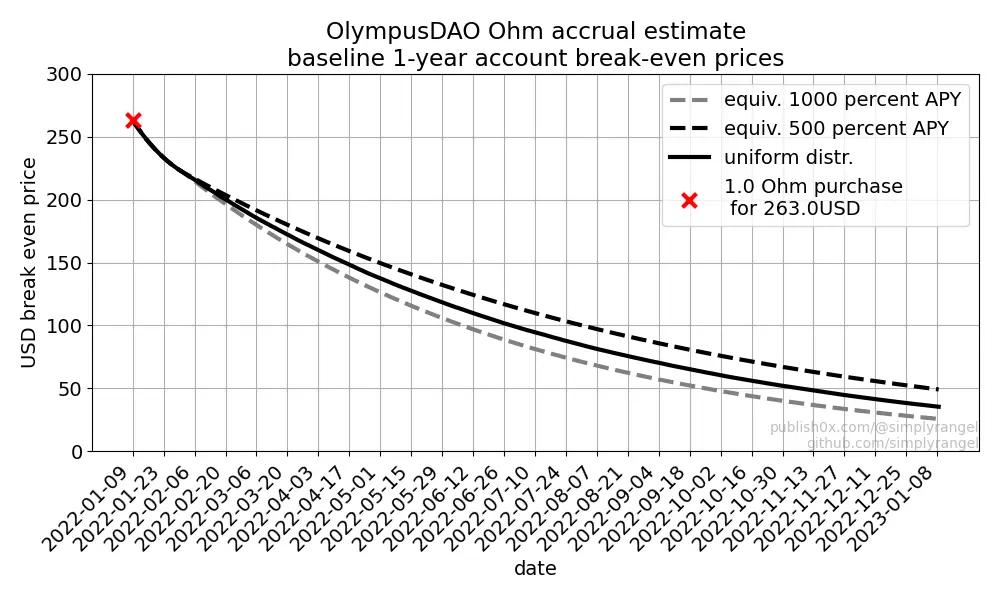
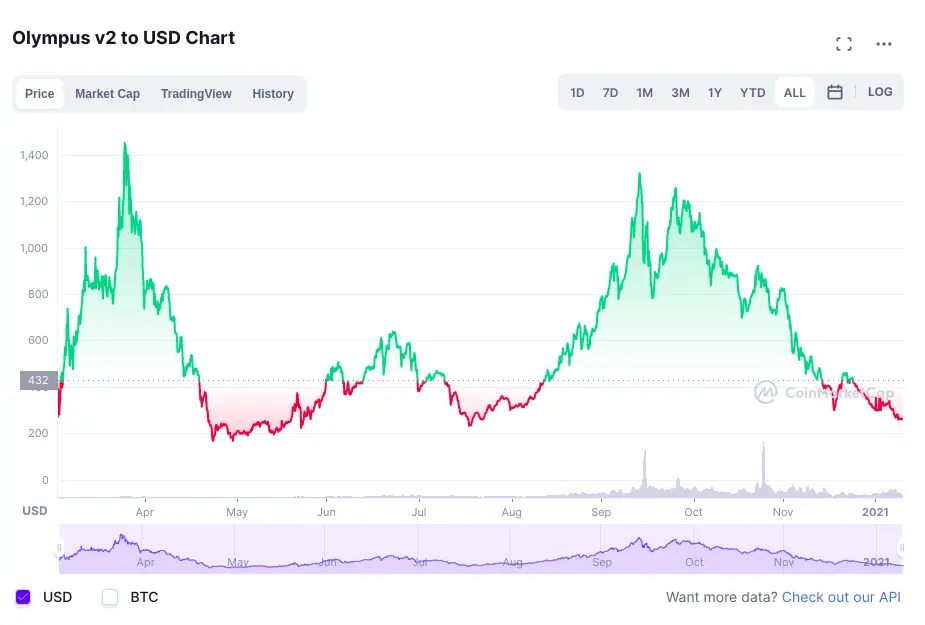
The break-even price experiences a very nice exponential decay from today's $263.0 USD purchase price. By the new year, an Ohm purchase today will likely be profitable as long as the price remains above about $50.0 USD.
This is encouraging to me. Ohm's price action is very volatile, but it appears very capable of reaching prices much, much higher than the break-even price curve. Below is a screenshot of coinmarketcap's Ohm price history.
Please understand that the nature of OlympusDAO means the results here are very speculative. These observations are posted in the spirit of cryptocurrency's open-source community, and in good faith that readers will do their own research to validate, expand, or refute my work.
I hope y'all enjoyed reading. Comments and critiques are always appreciated in the comments.
Thumbnail photo by Clark Van Der Beken on Unsplash.
This analysis was completed in Python. View the source code here: https://github.com/simplyrangel/crypto-publish0x






