
I staked some Ohm on OlympusDAO and estimated a potential break-even price point one year from today -- here's how.
What is OlympusDAO?
OlympusDAO wants to "build a community-owned decentralized financial infrastructure" by creating a reserve currency -- the Ohm -- that is backed by a treasury of cryptocurrencies. OlympusDAO offers very attractive APY's for staking Ohms on its platform.
And by attractive, I mean outright insane.
The APY until recently was 10,000 percent or more. The current APY hovers around a more "modest" 1,000 to 8,000 percent based on my anecdotal observations. OlympusDAO achieves such high APY's by "rebasing" the Ohm once every eight hours. Each rebase corresponds to a small interest percentage that automatically compounds. In other words, staked Ohm compounds three times a day, every day.
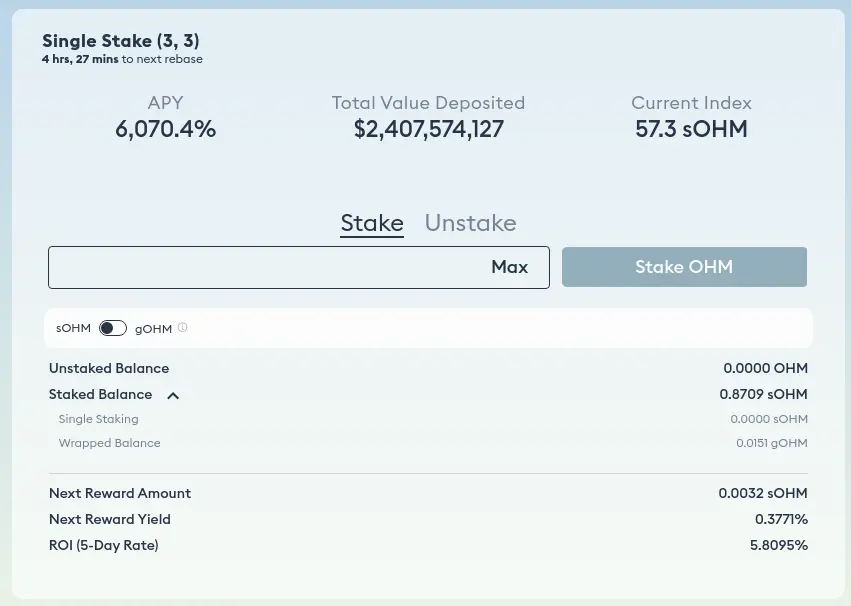
I purchased about 0.75-Ohm a few weeks ago. Below is a snapshot of my dashboard's "staking" page. Notice the 0.3771 percent "next reward yield," aka the current rebase compound interest rate. The rebase compound interest rate and APY change every eight hours according to market conditions.
OlympusDAO's operations are very clever and outside the scope of this post. I'm also still learning, so I don't want to go too in-depth and risk spreading inaccurate information. I highly encourage folks to checkout the OlympusDAO site for more information.
Why is estimating a break-even point difficult?
OlympusDAO is a very speculative play for amateur crypto enthusiasts, and lots of people -- including myself -- have large reservations about investing in it. The Ohm's price, rebase compound interest rate, and APY all experience wild magnitude swings. And because rewards are compounded every eight hours with ever-changing interest rates, calculating reward USD values months from today is not straightforward.
How I estimated a break-even point
The break-even point analysis can be summarized into two broad steps:
- Estimate potential rebase rewards from now until some target date. I chose one year from today -- Jan. 02, 2023 -- as my target date.
- Calculate the compounding interest and accrued Ohms using the estimated rebase rewards.
- Calculate the break-even price. The break-even price on Jan. 02, 2023 is the purchase price divided by the total accrued Ohms. I chose to simulate a 1-Ohm purchase today -- Jan. 02, 2022 -- for this blog post, giving a purchase price of about $350 USD.
- Vary the potential rebase rewards and repeat the steps above to understand the break-even price's sensitivity.
Estimating rebase compound interest rates
OlympusDAO's rebase rates change every eight hours, but the range of possible rates is defined in a DAO proposal called OIP-18. OIP-18 describes a rebase rate range of potential values based on the number of circulating Ohms:
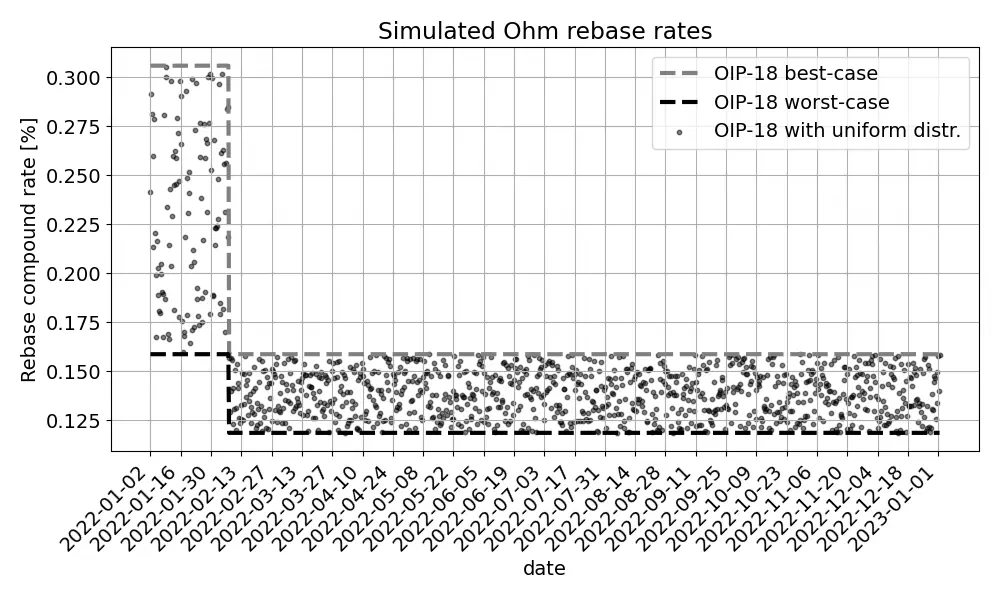
- While the circulating Ohm supply is within one million and 10 million, the rebase rates vary between 0.1587 percent and 0.3058 percent.
- While the circulating Ohm supply is within 10 million to 100 million, the rebase rates vary between 0.1186 percent and 0.1587 percent
A subsequent proposal called OIP-63 adjusts the rebase rate range beneath 10 million Ohms but is not yet implemented, so we'll focus on OIP-18 for now. I extrapolated the daily Ohm supply from the past few months to estimate the date when the circulating supply may exceed 10 million.
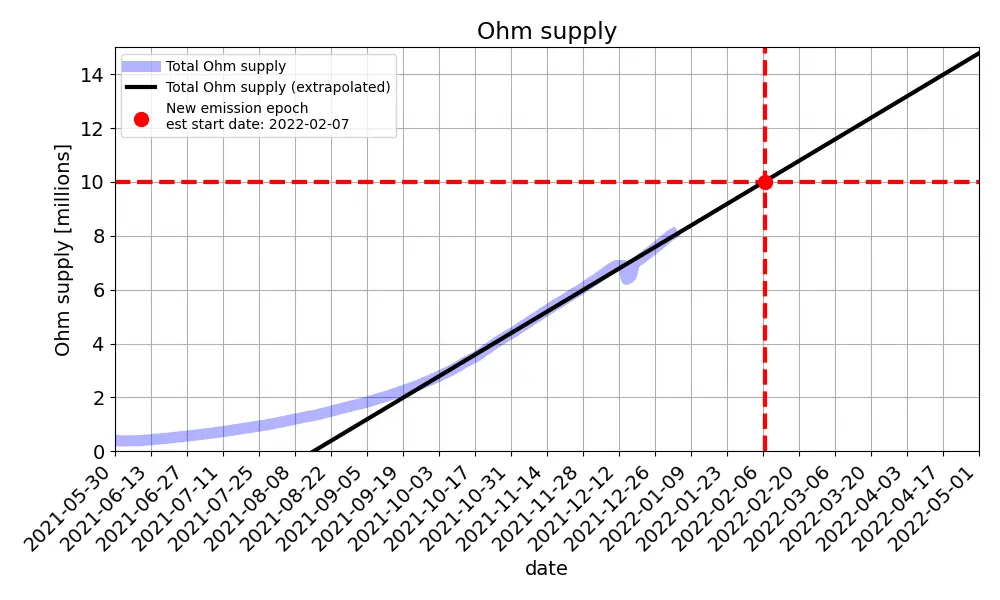
The background, light-blue trace represents the total Ohm supply per day downloaded here. If no dramatic change in Ohm emissions occurs, we can reasonably expect the Ohm circulating supply to exceed 10 million around Feb. 07, 2022.
We can use this estimated date and the information from OIP-18 to create three rebase interest distributions to use:
- The first rate distribution assumes the highest possible rebase rate out of OIP-18's prescribed value range. In other words, every rebase event will carry either 0.3058 percent or 0.1587 percent depending on the simulated Ohm supply.
- The second rate distribution assumes there is an equal chance any rebase rate on the prescribed range can occur. In other words, every rebase event carries a random value chosen from a uniform distribution who's minimum and maximum values are prescribed by OIP-18.
- The third rate distribution assumes the lowest possible rebase rate. In other words, every rebase event will carry either 0.1587 percent or 0.1186 percent depending on the simulated Ohm supply.
Visually, these three rebase interest distributions are shown below. Note the discontinuity for all three distributions occurs on Feb. 07, 2022.
Estimating the break-even points
Now that we have potential rebase rates for the next year, we can calculate the compounding effect each distribution would have on 1-Ohm purchased today.
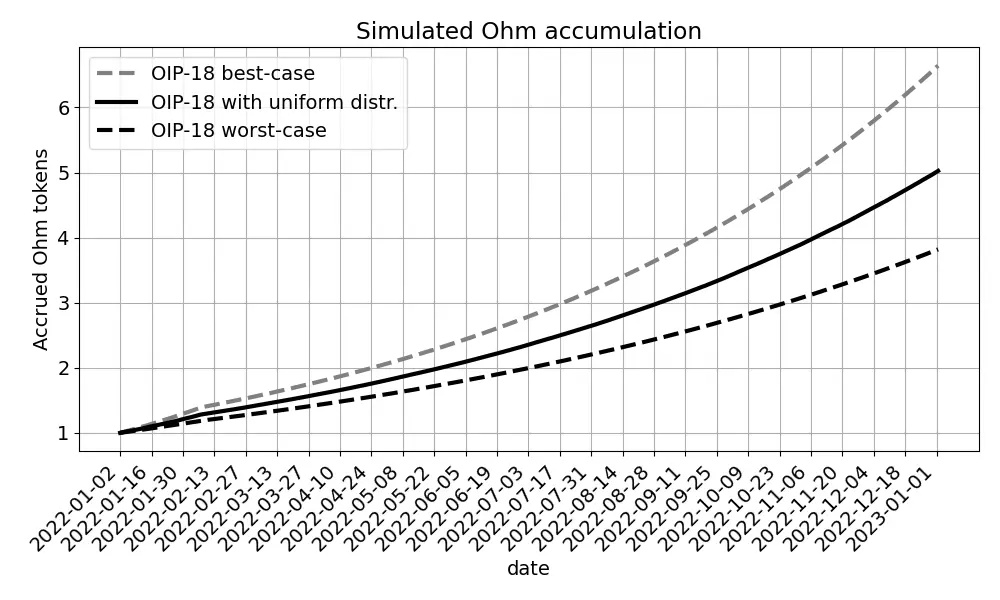
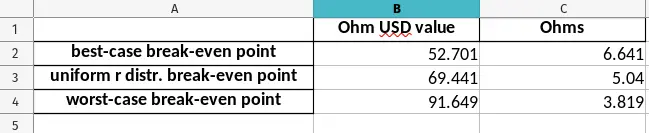
The break-even points for the three rebase distributions, along with the number of Ohms after one year, are shown in the table below.
Discussion
The model above and its results suggest:
- The number of Ohms accrued over one year after a 1-Ohm purchase will likely fall between 3 and 7
- The large range of potential 1-year Ohm returns (3 to 7) reinforces the observation that Ohm staking rewards are very sensitive to rebase compound interest variations
- Investors who purchase 1-Ohm today should consider exit plans if the 1-Ohm price dips into the $100 USD range or below
- Investors should monitor the rebase compound interest rates to ensure they fall within OIP-18's standards. If the rebase rates consistently fall outside of the ranges prescribed by the OIP-18, this analysis will no longer apply.
Anecdotal observation suggests these analysis results are too conservative. Even though OIP-18 was approved, the rebase rates have consistently been higher than the prescribed range for the few weeks since I originally bought Ohm. I'm active on several OlympusDAO web forums, and I hope to clarify if these larger rebase rates are anomalous or if the OIP-18 ranges no longer apply. I'll update this analysis accordingly.
Please understand that the nature of OlympusDAO means the results here are very speculative. These observations are posted in the spirit of cryptocurrency's open-source community, and in good faith that readers will do their own research to validate, expand, or refute my work.
I hope y'all enjoyed reading. Comments and critiques are always appreciated in the comments.
Cheers!
Thumbnail photo by Simone Pellegrini on Unsplash.
This analysis was completed in Python. View the source code here: https://github.com/simplyrangel/crypto-publish0x






