Let me guess how you check a crypto trade. You look at what you paid, look at what you sold for, subtract one from the other and say, "Nice, I made $1,000."
Most people do this, and I think it's the most expensive habit in investing. The number isn't wrong. The exchange isn't lying to you. It just isn't the number that matters. What matters is how much of that profit survives after everything else takes its little piece.
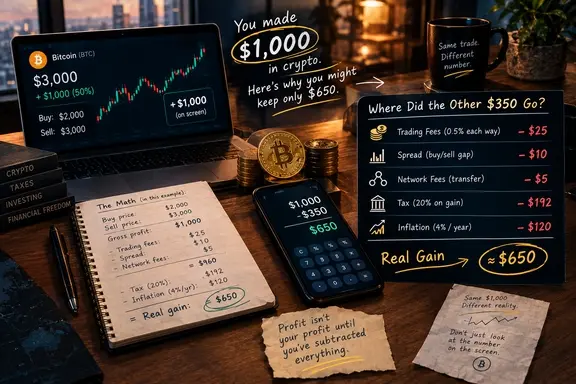
Where Did the Other $350 Go?
Say you put $2,000 into Bitcoin and sell 18 months later for $3,000. The screen says +$1,000. Now let's follow the money.
Trading fees at 0.5% each way come to about $25. The spread, the small gap between the price you buy at and the price you could sell at, costs maybe $10. Moving the coins adds around $5 in network fees. That already puts you at $960.
Then tax. Say your effective rate on the gain is 20%, which takes $192 and leaves you with $768. And then the cost nobody sees on a trading screen: inflation. At 4% a year, your original $2,000 quietly lost about $120 of buying power while you waited.
The real gain is around $650. That's a simplified example, and your numbers will differ. Your tax could be lower or much higher, and inflation doesn't work exactly like a subtraction. But the point survives: $1,000 of profit and $1,000 of real gain aren't the same thing. Your profit isn't your profit until you've subtracted everything standing in the way.
The Tax Bill: Same Trade, Different Country
Taxes are the obvious cost, and what annoys me is how random they feel. The same trade can end in a completely different bill depending on where you live.
In the US, crypto is treated as property. Sell within a year and the gain is taxed like regular income. Hold longer and the rate is usually lower. Germany goes further: hold for more than a year and the gain is tax-free, however big. Sell earlier and you pay income tax, unless your short-term gains for the year stay under €1,000. Cross that line by a single euro and the whole amount becomes taxable. A draft reform would scrap the one-year rule for coins bought from 2027, but it hasn't passed.
The UK takes 18% or 24% depending on your income, after a tiny £3,000 yearly allowance. India is tougher: a flat 30% (about 31% with cess), 1% withheld on transfers, and no way to offset losses. Japan has taxed crypto gains as regular income at up to 55%. Its parliament has approved a framework that moves qualifying gains toward a separate rate of about 20%, with reports pointing to around 2028, but that doesn't mean anyone there is paying a flat 20% today.
That's the distinction I care about. I've seen people online treat a proposed tax change as if it's already law, and that's dangerous. Whenever someone says "crypto is tax-free in this country," I want to know: when, for whom, and under what conditions? Singapore has no general capital gains tax, Switzerland doesn't tax private investors' gains (it has a wealth tax instead), and the UAE has no personal income tax. But trade like it's a full-time job, and those exemptions can disappear.
Some countries also tax the act of trading itself. The UK charges 0.5% stamp duty on many share purchases, and France charges 0.4% on shares of big companies. Tiny, until you trade a lot.
The Costs I Barely Notice
A $5 fee doesn't feel like much. Neither does a $10 spread. But they all come out of the same place: your money.
The spread is easy to overlook. You buy at one price, and if you sold right back, you wouldn't get the same price. In a liquid market it's small. With a smaller coin or a volatile week, it can sting, and if you trade often you pay it again and again.
Network fees get sneaky when you move small amounts. Paying $1 to move $10,000 is nothing. Paying $1 to move $20 is a different story. Same dollar, very different percentage.
Add exchange fees, withdrawal fees, currency conversion when money crosses a border, and VAT, which hides inside nearly everything you buy, including the things you spend your cashed-out profit on. None of it destroys a portfolio alone. That's exactly why it's easy to ignore. Think of a slow leak: you don't notice one drop, but you notice the empty bucket.
Then there are beginner mistakes: wrong-address transfers, the wrong network, lost records, panic selling. They can cost more than any government, and unlike a fee, some can't be reversed.

Inflation Doesn't Send a Bill
This is my favorite hidden cost, because nobody actually charges it. There's no notification saying you lost purchasing power today. The same money just buys less.
That's why I don't like looking only at nominal returns anymore. A portfolio can go up in dollars while your real purchasing power improves much less, or not at all. Inflation isn't literally a tax, but from an investor's side, it feels like another force quietly working against you.
Energy: The Cost Behind Every Other Cost
Energy prices never show up on your trading screen, but they reach your money anyway.
Electricity and fuel are baked into the price of almost everything, from transport to groceries, so when energy gets expensive, everything follows, and the inflation problem above gets worse. Your power bill also carries taxes, since VAT and other levies are often built into electricity and gas prices. And higher energy costs squeeze company profits, which can push share prices down.
If you mine crypto, it's more direct. Electricity is usually the biggest expense, and it comes straight out of your profit. Mining income is also commonly taxed as income instead of capital gains, and whether you can deduct power costs depends on the country. If you only buy and hold, your home electricity won't change your crypto tax. But it shapes the economy around your investment, and that chain is bigger than the trading screen makes it look.
The World Is Getting Better at Tracking Crypto
For years there was this idea that crypto lived outside the normal financial system. I don't think that's a useful assumption anymore, and a handful of big economies are the reason.
The US sets the tone. Fed decisions move markets worldwide, and American brokers have had to report crypto sales to the IRS on Form 1099-DA since 2025. From 2026 they also report what you paid, though only for coins you bought this year and kept on the same platform. The IRS also expects you to track your cost basis wallet by wallet.
The EU built one rulebook for crypto companies (MiCA) and added a tax reporting directive called DAC8. Platforms have been collecting user and transaction data since January 2026, and the first reports go to tax offices in 2027. Behind it sits the OECD's CARF, a framework that lets governments share crypto account data automatically, the way they already do for bank accounts. According to the OECD, 77 jurisdictions have now committed to it, with 46 planning to start exchanging data in 2027 and the rest following in 2028 and 2029.
China went the opposite way. Trading and mining are banned on the mainland, and the ban now covers stablecoins too, while Hong Kong runs its own licensed system.
I'm not saying every crypto transaction is automatically taxable. It isn't. I'm saying I wouldn't build a strategy on the assumption that nobody will ever see my transactions. That era is getting harder to rely on.

The Crypto-to-Crypto Trap
Sometimes you don't even need to cash out into dollars for a tax problem to appear. In many countries, swapping one coin for another counts as a sale. BTC to ETH may be a taxable event even though you never touched real money.
Now imagine doing that 50 times. BTC to ETH, ETH to SOL, SOL to USDT, USDT back to BTC. It sounds harmless when you click the button, and much less harmless at tax time.
Moving your own coins from an exchange to your own wallet is different. That usually isn't a sale. It's just you moving your own stuff. But keep the record anyway, because months or years later you may need to prove where those coins came from and what you paid.
The Most Boring Habit That Pays Off
If I could give one piece of practical advice, it would be incredibly boring: keep records from day one. Date, amount, price, fees, which exchange, where you sent it, when you sold, what you received. A spreadsheet is enough for a small portfolio, and tax software makes sense if you trade constantly. Trying to rebuild two years of trades from screenshots and old emails is a nightmare.
So, Did You Really Make $1,000?
Yes, in nominal terms. That gain is real. But after fees, taxes and lost purchasing power, the result can look very different. In my simplified example it was about $650. Someone else could end up with $800, or $500. There's no magic number, and that's the whole point.
I'm not a tax advisor, and no single article can tell you what you owe. But this is how I'd look at it. Don't celebrate the number on the screen too quickly. Only trust what's left after the costs that apply to you. Trade less if you don't have a good reason to trade. Learn the tax rules before you sell, not after. And be careful with anyone selling you a "tax-free" shortcut, because the cheapest thing on paper often carries the biggest risk somewhere else.
Now when I see a big green number, I ask a different question: how much of this do I actually get to keep? I think that's the number that matters.
General info only, not financial or tax advice. Rules change often, so check the current law where you live.