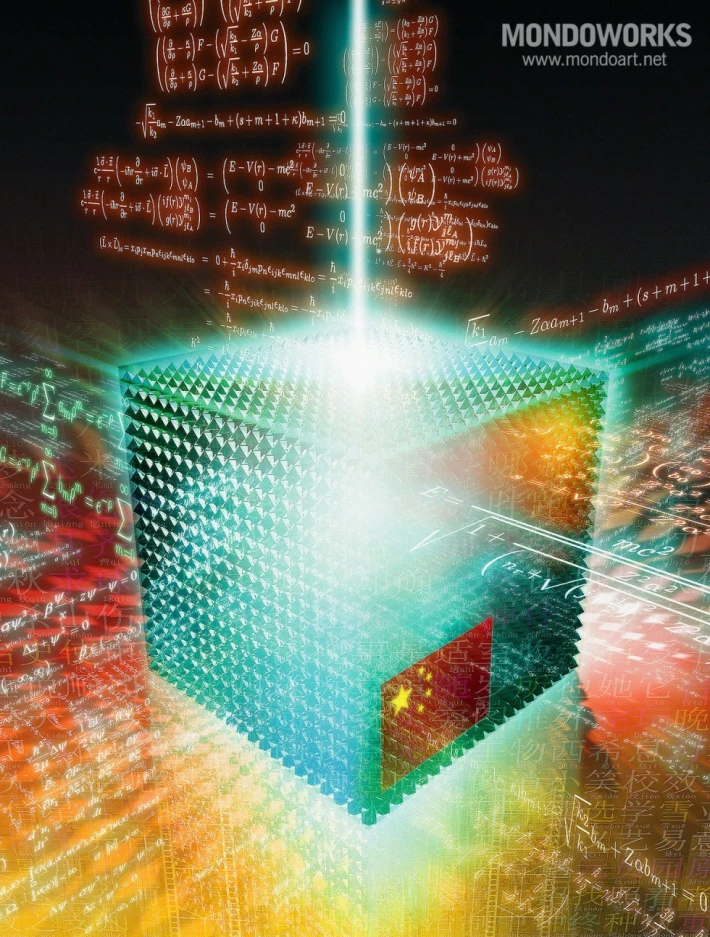
The National Laboratory for Quantum Information Sciences, slated to open in 2020, has two major research goals: quantum metrology and building a quantum computer. Both efforts would support military and national defense efforts, as well civilian innovators.
But let's back up. What is quantum metrology, anyway? Basically it measures minute changes in gravity and other physical effects, which can be used to build highly accurate, self-contained navigation systems. This has a key application for autonomous vehicles and submarines, which wouldn't have to rely on GPS or other external navigation signals that could be jammed or used to detect their location.
And then there are quantum computers. Pan Jianwei, a leading Chinese quantum scientist, says that the first general-purpose Chinese quantum computer could have a million times the computing power of all other computers presently in the world. In the computers we use today, information is encoded in a series of bits set as either 1 or 0. In a quantum computer, bits would theoretically be able to hold one, both, or some combination of these states. They could be used to speedily crack encrypted messages or solve complicated research problems involving anything from weather modeling to fusion research and biomedicine, because quantum bits allow certain calculations that happen one by one on a standard computer to occur simultaneously.
Quantum computing studies theoretical computation systems that make direct use of quantum-mechanical phenomena, such as superposition and entanglement, to perform operations on data. In classical computer, we transforms any data to zeros and ones, so called bits. Actually to high voltage and low voltage for processing, then pass them through a series of gates called logic gates which can manipulate the data to figure out result. Logic gates like AND, OR, NOT, XOR, etc. can be arranged in different ways to process the bits and produce the output. It can do simple operation like addition to complex encryption. Logical gates are physically realised by using transistors, which now days depends on the properties of silicon semi-conductors to perform operation instead of using mechanical switches. Sure classical computers are fast and efficient but they are not good at problems which involve exponential complexity like the Integer factorization. Especially the prime factorization when integers are further restricted to prime numbers (Semiprime). Basically, it is easy to find product of two large prime numbers but it take enormous amount of computation with classical computers to find the numbers that produced it given the product. In fact this complexity is the basis of many cryptosystems including RSA. *hackernoon






