
Are you haunted by the thought of buying cryptocurrency? Is FOMO getting the best of you? Are you spoiled by choice with all the cryptocurrencies out there? Are you even thinking about selling everything you own and going all in on crypto in the hope that at least some of them will 'go to the moon'?

In this blog, I will try to give you some insights in terms of crypto investments based on my own experience with crypto and I hope it would be useful to you in some way or the other, if it doesn't help you to choose a coin to invest.
Hold on for a sec - what is a Cryptocurrency?
Charlie Munger says that one should never invest in something that they don't understand. So taking that advice, I am going to start with the 'whats' and 'why' of cryptocurrencies. In simple words, a cryptocurrency is the currency of a blockchain. That's basically it. A cryptocurrency for a particular blockchain is what is used by that blockchain network to 'self sustain' itself to run it's various operations like payment to the miners/validators, who keeps the blockchain stable & free from hacks, and to ensure transactions between the users of that blockchain network. There are two types of cryptocurrencies - stable coins and non stable coins. Stable coins are pegged to either an algorithm like Ampleforth or to a physical asset like a fiat currency or to bitcoin. Tether, for example, is pegged to the US dollar and the team behind tether claims that they have sufficient reserves to peg each Tether to an actual dollar. Non stable coins are coins which are not pegged to anything but to the underlying value of it's blockchain. Bitcoin or Ethereum is a good example for this. They are refereed to as 'non stable' because their value fluctuates based on the market demand like stocks.
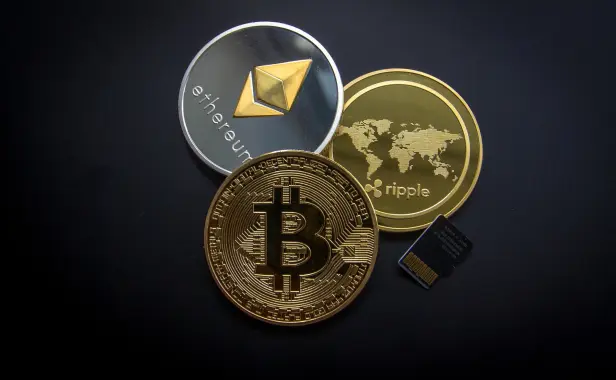
Now why wouldn't the network simply use a fiat currency like the dollar for this purpose? Well, for starters fiat is a physical currency. And it is owned by a government like the US dollar is issued and distributed by the United States of America based on the gold reserves they have in their central bank. So if a network wants to use US dollar or a representation of US dollar as their currency, then they'll need to have a lot of US dollars to back it up. We're not talking about a million dollars or two; a blockchain network needs billions of coins to operate. All things considered, creating a new coin to be used by the network sounds more economical. As cryptocurrencies exist on computer networks, these new coins can be used in special computer programs called smart contracts which can be used to make various digital products on the blockchain like housing contracts, lottery, voting system, etc. Why would anyone do that? This is better than it's conventional counterpart operations because a blockchain guaranties a hack-proof network, based on a blockchain's underlying cryptography principles upon which it is built on, such that nothing in the network can corrupt it (given the underlying smart contract is a genuine one). Another interesting thing about cryptocurrency is that most of them are not owned by an individual or a corporation; it is community owned entities driven by the blockchain network itself. So if tomorrow a country bans a network, it cannot go down as it runs on a global network on supporting community members.
Okay so this looks promising. Why should I buy a coin now? I mean I am not using the network
Valid point. At the moment, cryptocurrencies are traded at exchanges, both centralized like Binance and decentralized like Pancake Swap. I am not going into details about how these exchanges work which should be a post on it's own, but we'll save that for later. Anyways, getting traded on exchanges means these coins can be treated as stocks. A coin of a network represents a piece of the blockchains worth itself. Some are highly valued like Bitcoin & Ethereum and a majority of them are not like Doge coin, Shiba inu coin or any such meme coins.

At the moment, the main reason why most of the general public is buying various crypto is FOMO, people buy coins by valuing the underlying blockchain network. The more people use a network, the more valuable it is. An exception to this statement, though some may argue it is not, is Bitcoin. Bitcoin, being the first generation of cryptocurrency, cannot be used to create smart contracts; it is slower than other alt coins or alternative coins in terms of transaction speed. There are better alt coins with better network and other associated facilities. But still, Bitcoin is valuable because it is literally the first cryptocurrency which is ever created and it is not owned by anyone. In short, it has got a 'first mover' advantage. Ethereum is the first blockchain to introduce the concept of smart contracts. Given it's vast reach among it's community, it is valued higher than other similar but better blockchains like Solana, Cardano or Polkadot. Okay but why should I buy a coin now? Imagine buying bitcoin for a dollar 10 years ago. That one dollar investment now could have made one a billionaire! Basically, that's the reason people are buying - getting in on these crypto as early as possible such that when they blow up in value, they can reap the benefits. Every single person who buys any coin is basically hoping that it would become a multi-bagger sooner or later giving 10x or 50x or even 100x returns just like buying shares from the share market.
Alright, alright. I will buy a coin. Which one should I buy?
Here's a golden rule - DO NOT BUY A COIN BECAUSE A RANDOM PERSON ON THE INTERNET SAYS SO!

This is true for even this post. Just because I suggests it, doesn't mean it's a dogma. I could be totally wrong and your investment in crypto could become zero in any instant. You should only invest in crypto with money you can afford to lose, atleast until you know what you are doing. Never go 'all in' on any crypto; that story never had a happy ending. Do not get carried away (I am guilty of making this mistake time and again; I can only warn others from my mistakes) and do proper research before buying because your profits and losses are yours, not mine. There is no 'next bitcoin' that will guarantee you multi fold returns. That coin doesn't exists and even if it does, there is no way a random person on the internet can simply tell you about it out of 'good will'. More often than not, such coins fade into oblivion after a short pump-and-dump cycle. Open Medium or YouTube even, search for cryptocurrency to invest in 2021 and it will throw a bunch of videos of various randoms claiming X coin is the future or Y coin is 'going to the moon' or Z coin will fetch you '200x results'. Do not pay attention to such content; simply ignore them. If you really want to learn, then start learning about the Blockchain technology. Take bite sized information every day and compound your knowledge gain into this field. Some exchanges like Binance offers free education about blockchain technology for example. There are a lot of YouTube channels which educate people about it like 99Bitcoins, Finematics, Whiteboard Cypto, Coin Buero etc to name a few. It's a good place to start. I am not associated with any of these channels; I simply find their content informative. Be your own judge. Once you get a good understanding of the underlying blockchain technology, soon enough say about a month or two, you'll be able to decide which one to buy or invest in and which one to not. If you are interested, then here are some free courses which I got by a simple google search (again I am not affiliated with any of these) - Harvard Blockchain course, Blockchain course on Udemy, a free course from 101Blockchain, etc. Do your own search and you will find even more.
Got it. I'll do my own research. But do you have any recommendations?
I do but I stress on this point again - do not buy these coins because I said so; I could be wrong and your investments could become zero in the next minute.

That being said, these are the coins I personally put my money on. And when I say money, I don't mean to say millions; I am talking about spare change which I could afford to lose -
- Solana : Solana is growing to be one of the fastest growing blockchain network with a capability of over 50,000 TPS (Transactions Per Second - the higher the TPS, the faster the network when a lot of people are using the network ); for comparison, Ethereum has got ~15 TPS at the moment. Cardano has got about ~120 and Dot has got about ~166. Though Ethereum is rumored to solve this TPS issue with the latest breaking changing in ETH2.0, it is not implemented yet. A couple of projects are already migrated to Solana from Ethereum due to this TPS issue. The only issue is no one knows for sure how much secure the 'Proof of History' algorithm is compared to 'Proof of Stake' algorithm of Cardano or Polkadot. Nevertheless, I like this blockchain.
- Algorand : Algorand is another blockchain technology that I like. It is headed by a top MIT professor - Silvio Micali. I like it when top academicians get it into the blockchain space to solve existing problems or make things faster. It uses an improved staking algorithm called "Pure Proof of Stake (PPoS)" which is claiming to have solved the blockchain trilemma of Scalability, Decentralization, and Security (i.e. you have to sacrifice one of these three to get the other two). Just to be clear - Solana also claims to have solved this using their algorithm. However they have got some projects onboard to get started. I believe Algorand has got good long term potential.
- Cardano : Though it has got zero projects onboard (not kidding), I do have some hope somewhere for Cardano because of it's community. Cardano too believes in it's community and there is a lot of information out there which claims Cardano could be the future of blockchains. I have got mixed feelings about it's founding father Charles Hoskinson but somehow Cardano convinced me of it's potential for which I got myself some of it for better or worse.
- Polkadot : What I don't like about Polkadot is the fact that the currency is inflationary, i.e., it's value depreciates over time just like fiat currency. I got myself a couple of dots just to stay in the conversation. Polkadot is apparently doing better than Cardano in terms of projects and where there is prosperity there is hope. It's value can become zero but at least for now, it is not depreciating that much. In order to make money from Polkadot, you will have to stake it but the exchange from which I bought it doesn't offer staking but it does offer lending at a marginal interest rate. And I am okay with that. If Dot is not your cup of tea, then give Kusama, a canary network for Polka Dot, a try.
- Shiba Inu : I know I know, we are talking about serious alt coins and how did Shiba Inu came here. Well, I got a tonne of Shiba Inu coins for literally a few bucks. I consider it as a lottery. If it gets hit out of the park, well that's awesome. If it doesn't, well not bad. I won't lose that much. They have recently launched their own exchange called Shiba Swap so it looks like they are here to stay. I am not going to buy anymore of this coins just because it is not that awesome. It is a meme coin at the end of the day but in some way better than Doge coin

I will share a neat trick which I uses to separate potentially good coins from the meme coins - if the total market cap of a coin has over 5 commas, it's probably a meme coin and do not invest in them. This is just what I use - feel free to use this tip.
That's all folks. That's all I have to talk about cryptocurrencies. Treat it like a fortune cookie wisdom. And remember - choose wisely before you buy any and only invest what you can lose. Stay safe from all the 'pump-and-dump' squad - who buys meme coins when they are super cheap, creates an artificial hype pumping it's value way up and then once it reaches it's peak value, they just dump all of it making a hefty profit but the people who bought it unknowingly will lose all their money. Only invest in coins you see potential. I hope this article helps.
Couple of other articles which you might be interested in:
- 3 Hot Cryptocurrencies to watch out for
- Is Solana (SOL) the real 'Ethereum Killer'?
- All you need to know about Security Token Offering (STO)
- All you need to know about Liquidity Pools
- All you need to know about Hyperledger
- All you need to know about Aave
- All you need to know about Hardware Wallets
- All you need to know about NFTs
- All you need to know about Algorand
- All you need to know about blockchain speed






