
"Imagine, if you will, there's a magical island that exists in the ocean. And it's a perfect island. It's an island where everything goes right. It's an island where the things that you build, it works right the first time. It's just beautiful. And it's a happy place."
This, my friends, is Cardano.
At least, according to its founder Charles Hoskinson.
I've been loosely following this next-gen blockchain project for a few years now. It quickly made an impression on me as unusually ambitious, thorough and innovative – even in this land of rampant creative destruction we call "crypto".
A few days ago I watched a 28min Youtube live-stream Hoskinson did that hugely re-emphasized what I'd suspected a few years ago: These guys think BIG. While most of the technical jargon he used in this recent spontaneous mind-map presentation is way over my head, let me try to break it down as best I can.
If you first want a high-level introduction to the Cardano project, check out e.g. raxpi22's The Hitchhiker’s Guide to Cardano ADA.
In the video titled "The Island, The Ocean and the Pond (Soon)" Hoskinson outlines three distinct domains that together encompass the global community of software developers: The Ethereum developer community (The Pond), the Cardano developer community (The Island), as well as the total aggregate mass of software developers around the world (The Ocean).
The main point of the video is to give an overview of Cardano's strategy to get as many developers as possible to start building on their blockchain network over the next months and years.
To start off, Hoskinson emphasizes that while the Ethereum ecosystem is "where the cryptocurrency space currently exists", it really only makes up a minute segment of the worldwide community of application developers.
So where IS everybody else? Well then, time to hoist our sails and hit the open waters.
An Ocean of software developers
According to a recent statista.com article there are a good 25 million (and counting) software developers around the world today. Judging by some metrics provided by ConsensSys it's safe to say the amount of active Ethereum developers is probably somewhere between the 20'000 - 100'000 mark. Impressive as it is, this number only comes in at 1 in 200 compared to the worldwide software developer pool. (notice the little purple circlet on the top right representing the Ethereum ecosystem)
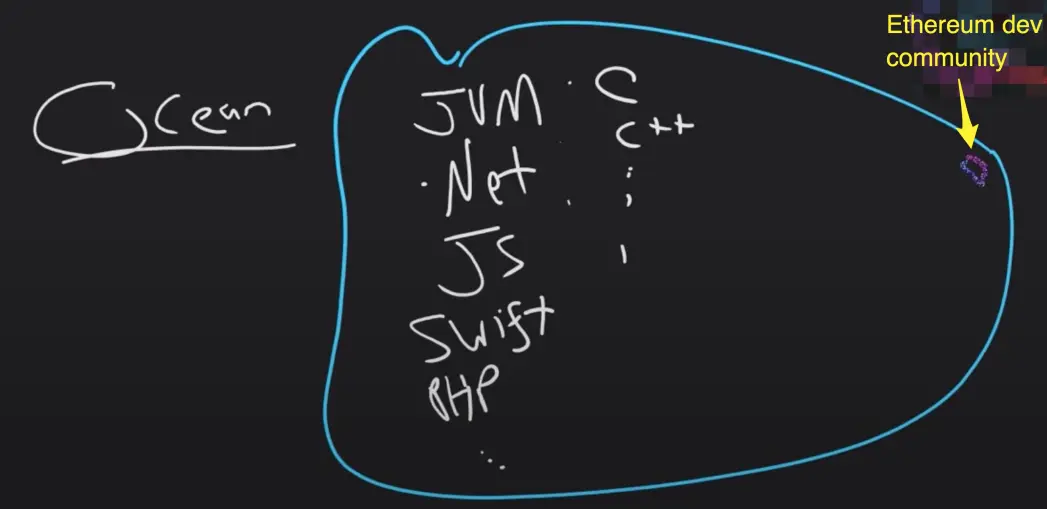
So what Cardano is aiming for, according to Hoskinson, is to bring the entire worldwide software development community on-board with the Cardano blockchain.
Getting a little grandios there Charles?
Well, maybe. And maybe not.
Enter "Runtime Verification", or RV, a software development company led by Grigore Roșu, professor of Computer Sciences at the University of Illinois.
To get a first impression of these cats, I suggest having a real close look at the portraits of the RV team: https://runtimeverification.com/team/
Have you ever seen a team as nerdy-looking as this?
Thought so.
(I can assure you, this really is not financial advice!)
RV is best known in the blockchain space for their Ethereum smart contract verification services. They were the first company to put together an ERC-20 verification toolset capable of proving that specific lines of code will bring about exactly the intended ERC-20 token charateristics and behavior and nothing else.
Their references include e.g. MakerDAO (DAI stableoin), Uniswap, Gnosis, Ethereum 2.0 Staking. They seem to know their shit.
Also, Roșu used to work at NASA. You know. Rocket science.
In 2017 Cardano (or Hoskinson's own company IOHK) started collaborating with these chaps with two goals in mind:
- 1. Build a bridge between Cardano and any programming language out there.
- 2. Integrate formal verification into the software development process, allowing for greatly enhanced security in smart contract code.
RV brings two fancy toolsets in particular to the table:
- IELE, a magical virtual machine based on an old well-researched Apple project called LLVM and extended upon by RV's comprehensive experience sniffing out weaknesses in the architecture of the Ethereum Virtual Machine (EVM)
- k, a meta programming language framework that can be taught to understand any programming language semantic out there and then bridge that programming language code to the IELE VM via "semantics based compilation" (SBC).
Got it? Me neither. But here's a cutting-edge visualization of what I imagine it to mean using the Java programming language as an example:
Java code => "k" SBC => compilation into IELE VM => runs on Cardano.
(PLEASE let me know in the comments if this is all but a pile of horse shit!)
As you may have guessed, Solidity is the primary target here: Some time soon, in early 2021, Solidity developers will be able to use the tools they're accustomed to and compile their Solidity code right into the Cardano VM on the IELE Devnet, which should be live in the matter of days or weeks.
Hoskinson:
"What we wanted RV to focus on was the ocean. Basically say: ok, build us a path so that one day, in a 3-5 year time horizon, we can write the semantics of all of these different languages and platforms and [...] eventually it just works."
So it's going to take some time to integrate all the major programming languages out there into this framework, but it sounds like the foundation has been put in place to allow Cardano to support all developers worldwide that are working on a blockchain use case. Pretty LIT, right?
But it doesn't end here. By plugging these programming languages into the IELE VM they are also automatically verified to do what they're supposed to. i.e. IELE makes things like the 2016 DAO hack and the 2017 Parity Multisig hack and many more small and large catastrophes on Ethereum vanish like magic.
Keyphrase: "it just works"
Hoskinson: "What's really cool about RV is they're also experts in formal verification. [...] we're going to also design a light-weight formal verification and specification language so you can then be specifying your smart contracts and verifying that your contracts are correctly implemented."
Roșu: "There is nothing to prove about the correctness of the IELE VM, with respect to its formal specification, because it is correct by construction." "IELE offers improved security guarantees over and above what EVM provides making it easier to write contracts."
That's as much as I have time to go into here (see what I did there? ;) but if you want to dig deeper, here are a few links to get you started:
more on IELE: https://www.youtube.com/watch?v=_gxUg0CjITA
more on "k": https://www.youtube.com/watch?v=z4mIo38x1u8
RV Website: https://runtimeverification.com/
"k" framework Website: https://kframework.org/
A IELE Devnet is coming online either in a few days or in January 2021 initially allowing developers to write smart contracts in IELE assembly code only. But by Q2 2021 we should see a "k" module for Solidity being added, giving Solidity developers a completely new toolset to formally verify their code themselves before deploying it to the chain.
All in all it sounds to me like RV is a highly valuable partner to have on-board and from what I can tell, the RV team seems to really hit it off with the Cardano crew. They seem to speak the same language and work well together.
But Hoskinson points out that beyond all of this there's one more big advantage to this partnership for Cardano: RV has lots of high-profile customers making it very easy for Cardano "to have the Fortune 500 conversation".
🤑🤑🤑
So there we have it: Cardano has set sail and is venturing out into the open sea to discover all the world has to offer.
The Ethereum Pond
But what about Ethereum?
A fruitful, creative, fast-moving, innocent-looking but slightly perilous ecosystem full of rainbow-colored unicorns, diamonds, orange-colored golden fluffy canines and the odd nerdy joke.
I've often heard Hoskinson talk about Ethereum in his interviews and youtube videos and contrasting his brain-child to the Ethereum project, its vision and technical capabilities. The reason is obvious: Ethereum is the undisputed king of innovation in the blockchain space today, especially in decentralized finance and the upcoming NFT (non-fungible token) craze. Any blockchain project trying to bring the blockchain space into a future of widespread adoption needs to either catch up with Ethereum's infrastructure as well as developer and user communities or needs to do a lot better to start cutting into Ethereum's market share. Add to that Hoskinson was part of Ethereum's founding team back in 2013/2014 – before parting ways due to differing views on the project financing and governance – and it's no mystery why he talks about it so much. (Do I sense some unresolved resentments there, Charles??? 😉)
In the video, we see Hoskinson choosing the color blue to draw the pond representing the Ethereum ecosystem, but he catches himself just in time:

"Actually, when we're talking about the Ethereum pond we should use rainbow!"
There you go: Ethereum, the rainbow-colored pond made of the promordial soup of highly energized molecules, randomly mutating and interacting at break-neck speeds to produce early life forms.
Not the worst analogy in my book. :)
Recognising Ethereum's pole position in the blockchain space today, and recognizing the importance of the innovation, experience, and learnings that have to take place in "the pond", Cardano seems hell-bent on incentivizing Ethereum developers to venture out into the greater Cardano universe asap.
"What if you're an Ethereum developer and you really want to use all your Ethereum tools 'cause you just love Truffle, you just love Solidity, you're a masochist and you love pain. Hellrazer's your favorite movie.
We've got you covered."
So here's the really big news imho: Cardano is launching an Ethereum Devnet that is running the EVM, the Ethereum Virtual Machine, as a permanent sidechain to Cardano. This is happening now! I.e. as of mid-December, Ethereum developers will be able to use all their favourite and established development tools and seamlessly deploy their apps into the Cardano network, essentially without changing a thing. Just take their code repository and commit to a different implementation of Ethereum, in this case a Cardano side-chain. Done. This applies both to smart contracts written in Solidity as well as Ethereum Bytecode.
"You can begin running Ethereum code on Cardano and it's just going to run better, faster and cheaper."
Importantly, Hoskinson promises the Cardano team will keep supporting the EVM side-chain into the future, even as Cardano and Ethereum continue to evolve.
"We're going to build a Devnet to cover the pond and stick with the pond. We're going to maintain that infrastructure with Cardano. The maintainers of Cardano are going to work on it."
I'm not sure how important this news really is for the short-term momentum in the Cardano ecosystem. But as a hobby developer myself, I imagine this is pretty big. What really matters to most developers (especially the Ethereum move-fast-and-break-things crowd) is to be able to install, write, deploy, test and get a hands-on feel for things. This, as I understand it, can now be done on Cardano, offering a huge community of Ethereum developers an attractive point of first contact.
The Island of Cardano
So we've crossed the ocean and we've fished the pond which brings us finally to the magical island of plenty quoted at the top of this article. A land where computer science, psychology and philosophy scholars mingle with Italian renaissance mathematicians and Greek Gods under luscious coconut and mango trees to ponder the circle of life and all the big questions of the universe.
This, of course, is the native Cardano developer ecosystem.
"It's about time to have a proper smart contract language. With resource determinism, easy to shard and a better way of approaching things."
He goes on to talk about "extended UTXOs", "native multi-assets", the "Plutus developer environment" and a few other things.
Key take-aways for me: Cardano wants to build the first programming language and developer environment perfectly geared towards smart contract development on a 3rd gen blockchain. To create the Gold Standard so to speak. As Hoskinson puts it:
"It's like Swift with iOS: You can write an Apple application for the iPhone with many different programming languages, but the best experience you're going to get is the one that Apple provided through Swift.
Well, equivalently, the best experience for writing Cardano applications is going to come from Plutus."
Clearly this is the pet project of the Cardano dev team. It's all still a few hard forks away but it'll be interesting to see what smart contract developers say about it when it all goes live.
There's one more thing I need to mention here, that Hoskinson didn't mention in this video: The Cardano development team has already built a simple token swapping mechanism between Ethereum ERC-20 tokens and Cardano's "native multi-assets". This will allow Dapp projects to move their code to Cardano and also move existing ERC-20 tokens over to Cardano as well. The promise of native multi-assets is to have ERC-20 tokens behave similarly to how ETH behaves on Ethereum: Like an asset native to the ecosystem instead of a generic smart-contract based construct. This means, among other things: greatly enhanced security and much lower fees.
You can see a short demo of the token-swap feature in this video.
To me it is quite noteworthy that despite all the peer-reviewed scientific research and careful engineering behind the Cardano project they are not getting lost in their own vision of a perfectionist island that is fully under their control, but rather want to invite everyone to join the party by offering anybody who's interested multiple ways to connect, participate and — once they've had a taste of the sweet island life — perhaps even set up shop in the land of Cardano.
As a further incentive for developers to give the island life a try, the Cardano Catalyst framework is offering $500'000 worth of grant money to anyone who wants to build Cardano Dapps on the upcoming Cardano Devnet. This upcoming 3rd funding round "is going to be all about Dapps, all about DeFi, all about Goguen, all about developers." As I understand it there will be regular funding rounds with ever-increasing amounts of grant money going forward. And all the code resulting from this development activity will be open-source.
Additionally, Cardano is working on professional introductory e-courses for the various Cardano technologies, and better documentation and a developer forum are soon to follow.
In summary, a whole lot is happening over at Cardano, and as Hoskinson says: "It's going to be a very exciting next 90 days"
Some finishing thoughts
I'm not aware of any other blockchain project with such an all-encompassing approach to attracting the software development ecosystem as a whole to their network. (do you?)
I think Cardano might be getting close to the point Ethereum was at when I first learned about Ethereum in late 2016, downloaded the Mist wallet, deployed my own custom tokens and played around with first blockchain games. Only now we have 5+ years of explosive innovation and tons of painful but important experiences to build upon. All of this – as I understand it – can now be ported to Cardano in a blink of an eye.
Boom. 🤯
Whether Cardano will become THE UNIVERSE OF BLOCKCHAIN, as a youtube commenter put it during this livestream – a world-wide open blockchain infrastructure that connects them all: I don't know. But Cardano clearly is a force to be reckoned with for years to come.
The team behind the project, the technological foundation, the free and transparent flow of information to the public, its founder's overall vision and the roadmap put into place in order to turn this vision into reality: It all puts this project in its own category as far as I'm concerned.
It blows my mind how seldom Cardano comes up in the greater crypto media sphere. Am I missing something? (let me know in the comments!)
In a world of hype, scams, ponzis, copycats, attention-seeking, rent-seeking, boom-and-busts, reddit-drama and Twitter tirades, it really is refreshing to see people work together with excitement and determination like this. It's one of the important reasons why I immediately felt attracted to the Ethereum project back in 2016. The Cardano community has quite a different feel and their focus is put on slightly different things. But what they're working on is pretty damn impressive and exciting, if you ask me.
If you want to keep closely up to date with the project and even get a chance to ask Charles Hoskinson some questions, he does regular live AMA (ask me anything) sessions on his personal youtube channel.
If you prefer skipping right to some of the the highlights of these AMAs over the past years, have a look at the youtube channel Crypto ADApter instead. There's some pretty funny stuff on there and leaves me with an impression of the Hoskinson guy as being generally pretty honest and straight-forward.
Towards the end of this video, Hoskinson utters a conspicuously Steve Jobsian "I cannot wait to see what you guys build".
I must say. I concur.
Gotta love this space.






