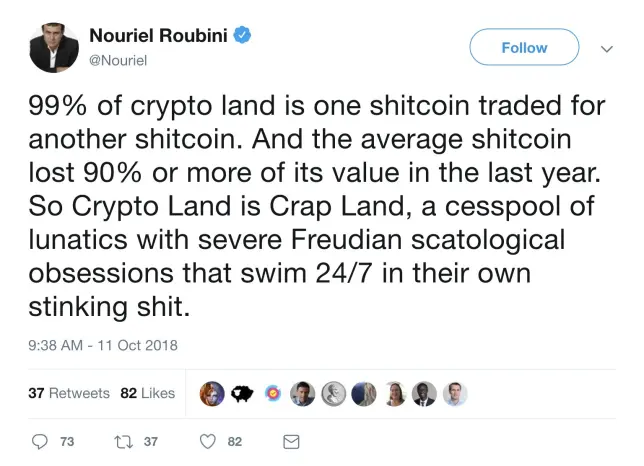
Nouriel Roubini, Biology 1o1, a nauseating photo from the National Cancer Institute, and a superficial analysis of a deep topic. That’s the way things are. Behind the mud and under the stones there is value. It takes effort to discover it

Why do cryptocurrencies exist?
The first and main reason is because a way to exchange value online without the need for third parties was technically and technologically achieved (see bitcoin white-paper). One of the natural motivations of human beings, and the main driving force behind inventions, is to solve problems. Cryptocurrencies are a further resolution (or micro stage of macro evolution) to the original issue of what value is.
Second, because the idealistic pseudonym Satoshi Nakamoto behind blockchain (paradoxically hyper-capitalist-communist) and bitcoin got fed up with the behavior of the traditional, centralized and corrupt financial system, especially during and after the 2008/2009 crisis.
Third, because the ‘double spending’ was solved through a community game (the irrepressible impulse to challenge and challenge each other) without owners or properties. The result became one of the most revolutionary events of the 21st century: the creation of internet cash.
Fourth, because Satoshi invented a peer-to-peer electronic cash system.
What are cryptocurrencies for?
To disrupt (crack) the system, to solve problems that are inscribed in human nature (as it is also to create them), and change the status quo. Hand in hand with this desire comes the need for financial disobedience and rebellion against the bullying of the powerful. It also exists to simplify the cumbersome traditional financial system, and in turn to make finance truly universal. Cryptos also came as a response to the desire for adrenaline, risk and the gamble of earning quick money anonymously.
Too sexy a combo for thrill-seekers, rebels, anti-establishment, non-conformists, troublemakers, and (FOMO-fearing) novelty-followers.
Living together (symbiosis)
One of the negative consequences of this innovation is the appearance of parasites that live off the profit of others without effort. There is no mutualism but selfishness. The cost benefit obtained by each of the participants is abysmally unequal: what the trout wins or benefits, the honest loses or harms.
Of the almost 20,000 cryptocurrencies that exist, there are 10,067 listed on CoinMarketCap (a guaranteed seal), 80% are useless at all.[1]
Pareto, always Pareto. The 80% who live off the 20%.
[1] 8,500 have a market capitalization below $1 million. 8,881 are worth less than $1. 9,163 have 24hr volume of less than $1 million. 791 have a circulating supply between 100 million and 1 billion. Some 7,450 complete the combo of market capitalization and volume less than $1 million and price less than $1.
*