
Hello friends!
Today we're going to talk about another big pillar of the METAHASH ecosystem.
A big, almost empty universe to be written in this wonderful ecosystem.
Hope you like it
Enjoy ...
metahash.org
#MetaApps
Decentralized cloud for real-time applications
High speed, decentralization and the ability to handle large loads shape the new decentralized Internet
With #MetaHash, any program written in any programming language on any operating system can become a decentralized application and work with data from the Internet and data from any blockchain system.
#MetaApps run in real time like regular websites and services, but they are decentralized and not even their creator can change their behavior unless their users or owners of their digital assets (tokens) vote.
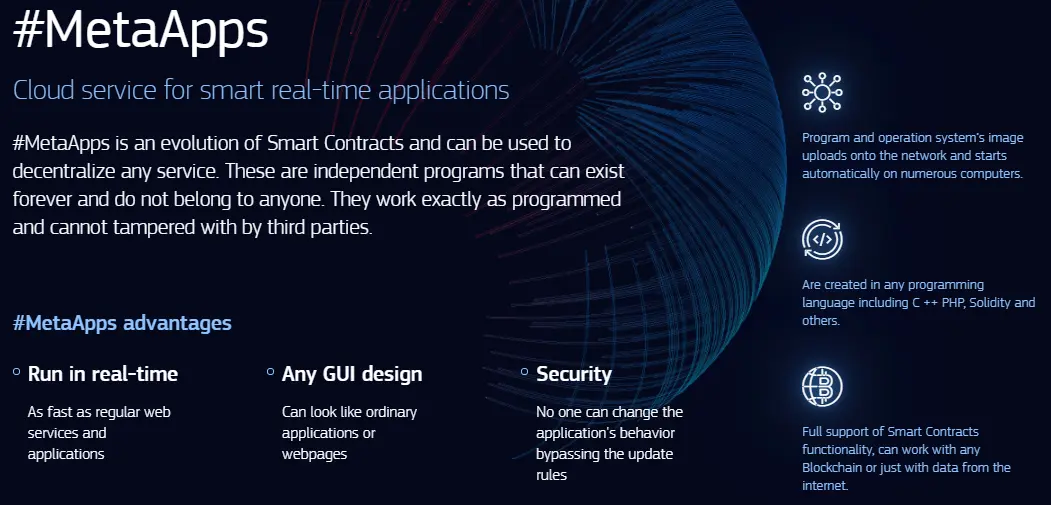
#MetaApps is an evolution of smart contracts and can be used to decentralize any service. They are independent programs that can exist forever and don't belong to anyone. They work exactly as programmed and cannot be changed by third parties.
Any developer can create a #MetaApp from code in any language
-
Uploads of programs and operating system images to the network
and starts automatically on multiple computers.
-
They are created in any programming language including C++, PHP, Solidity and others. Compatible with any operating system.
-
Full support of smart contract functionality. #MetaApps can work
with any blockchain or just with internet data.
Application-ready modules
The #MetaHash network will include a series of decentralized modules to accelerate the development of new projects.
For example, the creators of each project will be able to use the existing #MetaChains service instead of creating their own Bitcoin or Ethereum analysis scripts. Projects that require a decentralized database can use #MetaDataBase. The protocol's basic functions support the creation of #MetaTokens and data networks protected by the basic consensus of the #MetaHash network.
#MetaApps As fast as regular web apps and services. They may look like ordinary apps or web pages Nobody can change app behavior by ignoring update rules Run in realtime GUI mode Work exactly as scheduled
Self-Funding Applications
The number of computers running a copy of a #MetaApp depends on the amount of #MetaHashCoins generated per day, as well as its resource consumption. Anyone can top up the account from which #MHC will be debited. Alternatively, a certain percentage of an app's revenue can be transferred to your account.
Any app developer can program an app to use a certain portion of its revenue to support its work on the network and keep the rest of the revenue to fund app development. In this model, the team that develops an application can be selected by project users by general vote. Marketing issues and the need for other services can also be addressed collectively.
Following the logic described above, we can create a social network that:
-
It is controlled by general vote of the #MHC and project holders
active users;
-
Encrypts user data and messages so that no one has access to them;
-
It's self-financed.
Here is an example of a decentralized self-funded social network based on the #MetaHash platform:
-
The project team launches ICO Round A to finance project development;
-
The completed code from the various nodes of the project is uploaded to the #MetaHash network and the wallets from those nodes are funded. Node code is automatically implemented in #MetaHash;
-
User posts are encrypted and stored on the #MetaHash data network. They can only be decrypted by users who are "added as friends" and are therefore allowed to see updates. Thus, only those who are on the user's list will be able to get the key to decrypt and read the current and previous updates published by this user. Private messages are encrypted with end-to-end encryption and are only available to their recipients despite the fact that they are publicly stored;
-
After the ICO, the project is financed through ad sales made in #MetaHashCoins or through the user function "Disable Ads". Both the project support team and the project Marketing team are remunerated in #MHC while a certain amount of #MHC is exchanged through the automatic decentralized exchange service and credited to the portfolios of the project nodes.
Note that the example described is just a concept.
The implication of such a project would require detailed planning, which cannot be done within the scope of this White Paper
Applications developed by the #MetaHash team
#MetaChains
Decentralized analyzers of all popular blockchain platforms.
In order for #MetaApps to immediately respond to events on any blockchain system, we will be launching decentralized analyzers, allowing the use of API to obtain balance and transaction history information from portfolios across multiple blockchain platforms.
This will allow applications to respond to different blockchain events and verify data accuracy by sending queries to network nodes.
#MetaToken
-
App features include:
-
Automatic tokenization of #MHC on ERC20 and digital assets
others;
-
Conversion of any digital assets to #MHC;
Transfer of digital assets between #MetaHash, blockchain and Ethereum wallets
Tokenization of digital assets:
Using the data provided by the #MetaChains app and taking advantage of the secure and automated decentralized data storage service, the user can convert any blockchain network token into #MHC and use it on the #MetaHash network. If necessary, the asset can be automatically converted back and transferred to its original blockchain network. In this way, any digital asset (token) can be transformed into a #MetaToken and used in the #MetaHash network.
The secure and automated decentralized data storage service will be created under the supervision of #MetaHash Company, but financed by data storage fees. They will not belong to the #MetaHash Company.
#MetaStorage
The decentralized data storage service allows you to work with public encrypted data stored on the #MetaHash network, as well as with individual data nodes that are funded by an application that uses that data.
#MetaICO
The app allows launching #MetaHashCoins through the #MetaToken interface without knowledge of any programming language, using a combination of settings.
In addition to simplifying the #MHC creation process, it is very important to support the protocol and create a comprehensive protection environment against hackers by checking code across multiple applications.
Currently, all ICOs are maintained using smart contracts. Creating, executing and understanding your results would require extensive programming knowledge. #MetaICO offers a new ICO template. Absolutely anyone will have the opportunity to perform an ICO using tools similar to smart contracts. The tools offered by #MetaICO will be simple enough to be used by people who don't have significant programming skills.
#MetaICO will accept any cryptocurrency using the data received from the #MetaChains app and convert the #MetaHashCoins into Ethereum tokens and other ERC20 tokens from other networks.
The #MetaICO app will allow any ICO participant to use their digital assets (tokens) on any network, not just the #MetaHash network, facilitating the storage of digital assets from multiple projects (tokens) and providing connection for multiple token exchanges
Censorship in #MetaApps
While the idea of apps that cannot be blocked or deleted sounds wonderful, let's not forget that some people would like to use the system to harm others.
We believe that we should apply censorship, but it is not up to each one to decide how it will manifest itself, but to the entire #MetaHash community. This will be done through open voting.
When defining content placement rules, the #MetaHash community will always take all applicable laws into account.
lock an app
- The open voting procedure is started if 10,000,000 voting coins are accumulated in favor of blocking an application. Voting takes a month.
- If an app receives 100 million voting coins, the voting period is reduced to one week.
- If an app receives 500 million voting coins, the voting period is reduced to 24 hours.
As a protection measure against various malicious apps, a deposit sufficient for three months of app hosting (not less than
10,000 #MHC) will be required to upload an app. This number can be changed by a general vote. If an application is blocked, the remaining deposit will be frozen.
If 67% of the votes in favor of blocking the app are gathered at the end of the voting period, it will be blocked.
The app owner can file an appeal, unlock the app and return the deposit. The feature follows the same rules as blocking and is approved if there is 67% of the votes in favor of unblocking the application by the end of the voting period. A second appeal can be filed one month after the first. The appellant can offer a modified version of the application, eliminating the reasons that led community members to decide against it.
Source - Metahash.org
In our next article, we'll talk about another big pillar of the #Metahash ecosystem.
#Metagate
You can review articles already published on #Metahash below:
https://www.publish0x.com/metahash/metahash-xnqmljx
https://www.publish0x.com/metahash/metahash-meet-tracechain-xkyooko
https://www.publish0x.com/metahash/metahash-meet-tracechain-2-xdnoqgo





