
Ask a Telegram group which trading bot is best and there’s a good chance you’ll get five referral links before you get a straight answer.
That was more or less my experience. So I spent a few days trying Dawn, Trojan, Bloom, Maestro and Banana Gun, paying attention to the things that actually annoyed me: too many menus, moving funds between wallets, and settings that got in the way of a straightforward trade.
Dawn was the easiest for me to use. Trojan had plenty of depth, while Banana Gun felt more suited to someone who wants to fine-tune everything. Bloom and Maestro didn’t fit the way I wanted to trade quite as well.
Those are personal impressions. A smooth interface doesn’t tell you whether a wallet is secure, and a handful of fast trades doesn’t establish which bot is always fastest.
The quick comparison
These are my usability scores from the sessions described in this review, rather than independent measurements of product quality.
Dawn — 9.5/10: The simplest experience for my workflow.
Trojan — 8/10: Useful depth, with more menus.
Bloom — 7/10: More features than I needed.
Banana Gun — 5/10: Plenty to configure; less comfortable for casual use.
Maestro — 4/10: Navigation felt dated and took me longer.
What each bot felt like to use
Dawn
Dawn made the best first impression. I could find what I needed without spending much time digging through settings.
The balance setup was the main attraction. In the version I used, the appeal was being able to fund a USDC balance and trade across supported networks without constantly juggling separate balances. If you’ve ever had money on one chain and needed gas on another, you’ll understand why that stood out.
That convenience mattered more to me than having another page of advanced controls. I’d still check the current supported networks, funding routes and withdrawal conditions before depositing, especially if you’re moving between chains regularly.
My usability score: 9.5/10.
Trojan
Trojan felt like a trading terminal squeezed into a Telegram conversation. There’s a lot there, which is useful once you know where everything lives.
My frustration was the navigation. I kept working through submenus to get the setup I wanted. For someone who spends a lot of time trading on Solana, that depth may be worth learning. For a quick trade from a phone, it made the experience feel busier than I wanted.
I wouldn’t call the extra controls useless. They just weren’t what I was looking for in this comparison.
My usability score: 8/10.
Bloom
Bloom gave me a similar feeling: plenty of tools, but more going on than I needed.
The wider ecosystem may appeal if you want to build a more automated workflow. My priority was much simpler: paste an address, check the trade and get on with it. Moving between the bot and its other tools felt like extra work for that purpose.
That’s why it sits below Trojan for me. Someone who actually uses those additional features could reasonably put it higher.
My usability score: 7/10.
Maestro
Maestro’s interface felt the most dated of the five. Switching between menus and managing the different parts of the workflow took more effort than I wanted.
That doesn’t mean an experienced Maestro user will have the same problem. Familiarity counts for a lot. Coming to it alongside the other bots, though, I found it harder to settle into.
Its security history also deserves a separate look, but I wouldn’t mix that into a score for how easy the buttons are to use.
My usability score: 4/10.
Banana Gun
Banana Gun felt built for someone who likes having control over the details. Its official documentation covers spot trading, sniping, limit orders and copy trading across its tools. (Banana Gun documentation)
I found the number of settings a bit much for ordinary manual trading. If you spend time configuring entries and execution, you may see that as a strength. I mostly wanted fewer decisions between opening the bot and placing a trade.
There were moments when navigation felt slow to me, but I can’t pin that on the bot’s internal design. Connection quality and Telegram responsiveness can affect how an interface feels too.
My usability score: 5/10.
Fees: look at what the trade actually costs
A headline fee only tells you part of the story. The bot fee, network costs, priority fees and the price you actually receive all matter.
For example, Trojan’s FAQ currently lists a 1% fee per successful trade, with cashback linked to rank. That’s more useful than assuming everyone pays a flat discounted rate through a referral link. (Trojan FAQ)
I’d check the current fee screen in whichever bot you choose. Offers change, and a gas subsidy may come with limits or conditions. A feature that sounds generous in a comparison article might not apply to your next trade.
The same goes for rewards. Cashback on your own fees, commission from referrals and rewards for holding a token are different things. Banana Gun’s documentation, for example, describes a 40% share of revenue after referrals for eligible token holders. That isn’t the same as a flat 40% referral commission. (Banana Gun rewards)
I wouldn’t choose a bot mainly for its referral programme. I’d want to know what I paid on a completed buy and sell, and whether the tool was comfortable enough to keep using.
Security needs more than a score out of ten

Convenience and wallet security are separate questions. Illustration generated with AI.
This is where I’m less comfortable handing out neat rankings. A few days of using a bot can tell you plenty about its menus. It can’t tell you whether its infrastructure will withstand an attack.
Maestro’s October 2023 incident is a useful example. CertiK’s analysis describes a router vulnerability that allowed an attacker to take tokens users had approved the router to spend. The issue wasn’t simply whether somebody’s private key was stored safely. Contract permissions mattered too. (CertiK incident analysis)
Banana Gun also has a reported exploit in its history. The Defiant reported a roughly $3 million incident and the team’s pledge to reimburse victims. A repayment pledge should not be confused with proof that every repayment was completed, or that the same service is now risk-free. (The Defiant report)
Dawn’s claimed use of Privy is worth checking, but a wallet provider’s name alone doesn’t establish who can authorise transactions, how recovery works or what happens if the trading app is compromised. The exact setup matters.
For the same reason, I wouldn’t call Trojan or Bloom safe simply because I hadn’t come across a major incident. The absence of a headline is a weak security test.
My approach would be to keep the trading balance limited, understand the withdrawal process and check what permissions the service needs. No interface makes a risky token safe to buy.
What about execution speed?
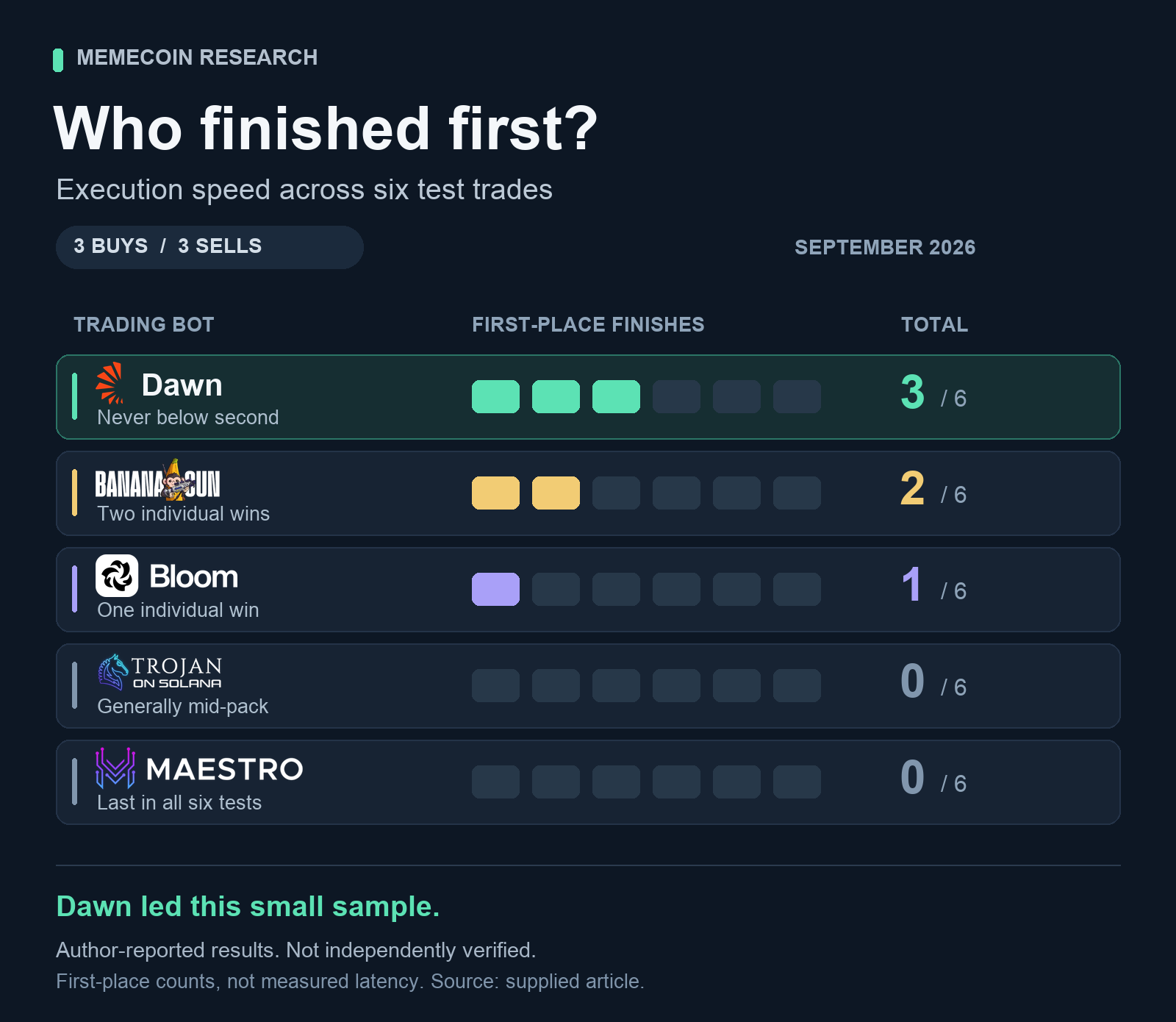
The short test described in my original notes favoured Dawn for consistency, while Banana Gun also had strong individual results. Trojan generally sat in the middle, with Bloom and Maestro lower overall.
I’d treat that as an observation from those sessions, rather than a definitive speed ranking. Six trades are a small sample. Network conditions, routing, transaction settings and submission timing can all influence the result.
There’s also a difference between a bot responding quickly in Telegram and a transaction landing on-chain. Even the landing block alone doesn’t explain every difference in execution.
Without publishing the transaction links, exact settings and timing records alongside the results, I don’t think numerical speed scores add much. The practical question is whether the bot reliably executes the trades you intend at a cost you understand.
Which one would I choose?
For the way I wanted to trade, Dawn was my favourite to use. Less time managing balances and navigating menus made a noticeable difference.
Trojan would be the next one I’d look at for a more involved Solana workflow. Banana Gun deserves a look if detailed execution settings are a priority. Bloom’s broader toolset may suit someone who wants more automation, while an existing Maestro user may prefer a familiar setup to starting again elsewhere.
I’d keep the conclusion that narrow. My favourite interface isn’t automatically the safest bot, and it isn’t a promise of better trading results.
A good bot can make placing a trade easier. It can’t fix a bad entry, thin liquidity or a token nobody wants to buy when you’re ready to sell.
A few common questions
Which bot is safest?
I can’t establish that from this comparison. Check the wallet architecture, permissions, recovery options and current security documentation before trusting any service with funds.
Are these bots free?
Free access doesn’t mean free trades. Check the current bot fees and network costs, including what applies when you sell.
Can I trade across different chains?
That depends on the product and version you use. Confirm the networks and token routes in the current interface instead of relying on an old comparison table.
Do rewards make a big difference?
They can reduce some costs, but read the conditions. A percentage of fees is not a percentage of your trading balance, and cashback doesn’t offset a losing trade by itself.
Cover and wallet illustrations generated with AI. This article describes personal usability impressions and is not a security audit or a recommendation to buy any token.






